
SpaceX’s latest quarterly financials sparked a fresh debate on All-In Podcast, where the hosts singled out Starlink as the business with the biggest upside. Their argument was that, as Starship and the next-generation V3 satellites begin expanding network capacity, Starlink’s addressable market no longer stops at remote-area connectivity and starts to look more like global telecom and internet infrastructure.
Elon Musk later responded directly, saying the market is still severely undervaluing Starlink. His reasoning centered on future bandwidth demand: as AI and robotics spread, the amount of data they need to move will exceed human usage by orders of magnitude.
Musk said that even if the global communications market only doubles in size, Starlink could still capture at least 25% of the market outside China, which would translate to more than $500 billion in annual revenue. He also said he would not rule out the possibility of entering China one day. In a more aggressive long-term case, Musk said it is not impossible for Starlink to carry more than 50% of global internet traffic, pushing annual revenue above $1 trillion. “I currently see no obvious impediments to that outcome,” he said.
All-In’s case for a $1 trillion Starlink valuation
On the podcast, host David Friedberg offered a similarly bullish view. He said Starlink’s connectivity business generated about $4.3 billion in quarterly revenue and roughly $2.6 billion in adjusted EBITDA.
Starlink’s subscriber base has reached 12 million, double from the same period a year earlier. Average revenue per user was about $66 per month, and subscribers still grew about 20% during the quarter.
Based on those figures, Friedberg said that if current growth continues and enterprise demand expands through customers such as airlines, Starlink by itself could advance toward $40 billion in annual revenue and generate around $30 billion in free cash flow. Applying a roughly 30x multiple for a subscription business with high retention and low acquisition costs, he said Starlink alone could support a valuation of about $1 trillion within the next 18 months to two years.
That estimate, he added, does not include any contribution from SpaceX’s launch business, AI Compute, or Grok.
Why Starship sits at the center of the expansion thesis
The podcast argued that Starship is the key to getting Starlink from 12 million users today to the scale Musk has described in public. At present, Starlink mainly relies on Falcon 9 to launch V2 satellites. Each mission can deploy about 27 satellites and add roughly 2.6 Tbps of network capacity.
By comparison, SpaceX’s V3 satellites are expected to deliver about 10 times the bandwidth of V2 on a per-satellite basis. Starship, in turn, is expected to deploy about 60 V3 satellites in a single launch, adding around 60 Tbps of capacity at once.
That means one Starship launch could increase Starlink network capacity by more than 20 times what the current Falcon 9 launch model adds. If Starship reaches a high-frequency launch cadence, total Starlink bandwidth could rise by another 10x or even 100x.
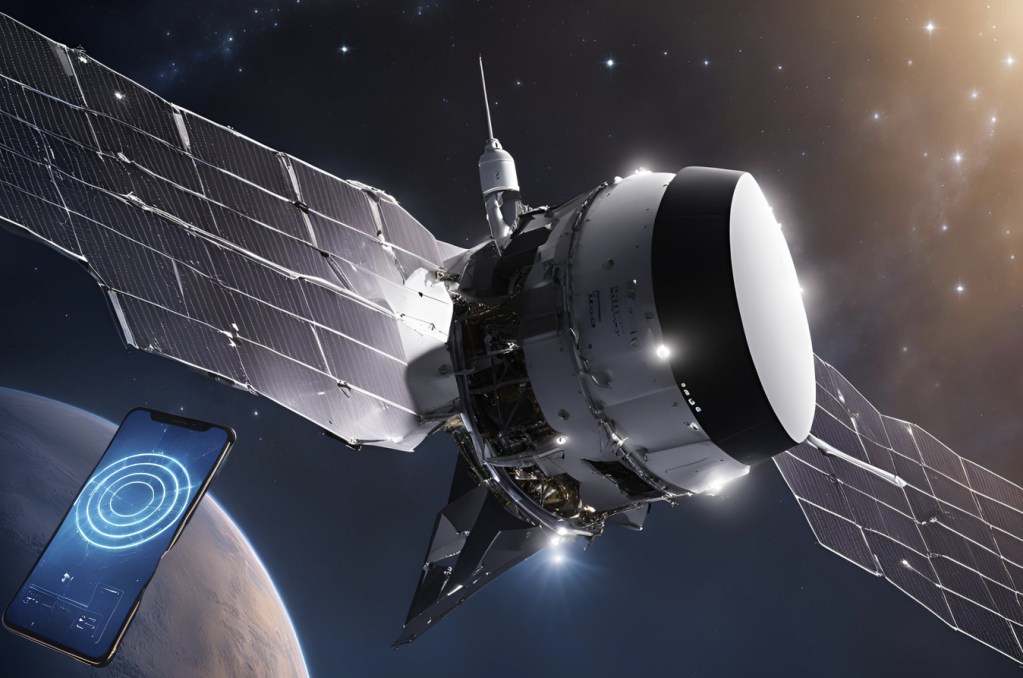
The show said that scale is what would give Direct-to-Cell — ordinary mobile phones connecting directly to Starlink satellites — real room to expand commercially. It also noted that Musk had previously discussed on an earnings call the possibility that Starlink could one day carry about half of global internet traffic.
Musk shifts the demand story from humans to AI and robots
The article said investors have often framed Starlink’s potential market in terms of how many people around the world need internet access, which is why the company is often compared with telecom operators such as Verizon and AT&T.
Musk’s latest comments point to a different assumption. In his view, the largest future users of the network may not be humans. AI agents, robotaxis, humanoid robots, and other autonomous devices will all need to exchange large volumes of data across endpoints, data centers, and the cloud on a continuous basis.
That is why Musk said AI and robotics data transfer demand will exceed human demand by orders of magnitude. Under that framework, even if Starlink’s market share stayed unchanged, the communications market itself could expand sharply because of AI and robotics.
- 25% of the global communications market outside China: more than $500 billion in annual revenue
- More than 50% of global internet traffic: annual revenue could exceed $1 trillion
The gap between the two views is notable. All-In argued that Starlink could become a trillion-dollar business by valuation. Musk’s response was more aggressive: he was talking not about a $1 trillion market cap, but about the possibility that Starlink’s annual revenue alone could top $1 trillion.