
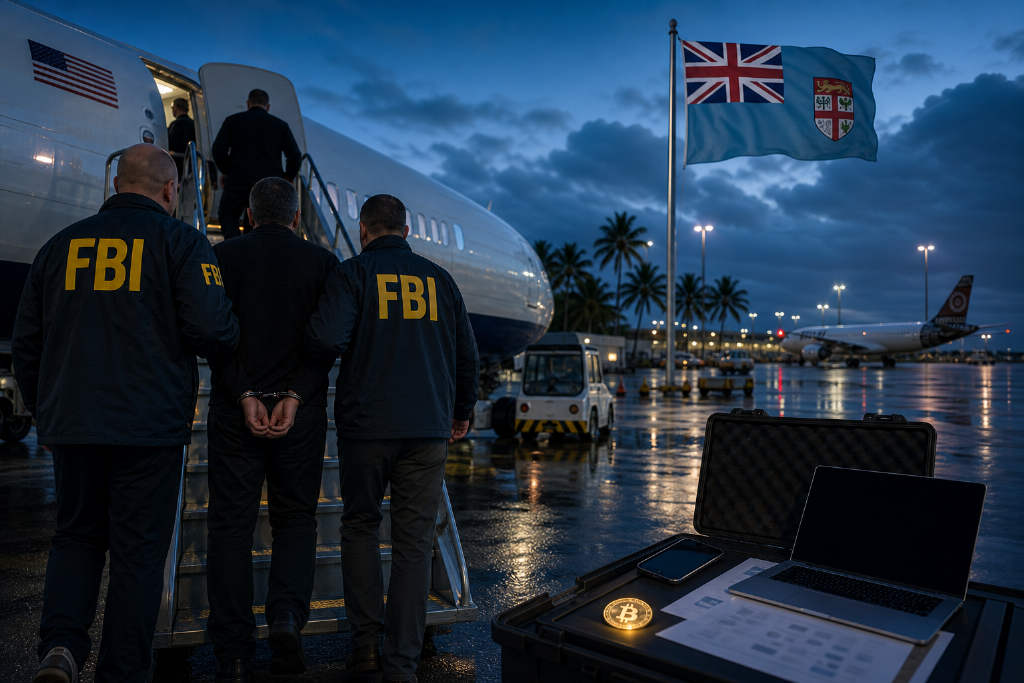
A man accused of masterminding a $165 million cryptocurrency Ponzi scheme is back in the United States after more than a year outside the country, the U.S. Department of Justice said Monday.

Edward Zimbardi, 59, of Flowery Branch, Georgia, appeared in federal court after Fijian authorities deported him to the U.S. on Aug. 14. The Justice Department said the transfer was carried out with support from the FBI and the State Department.
Indictment includes 25 counts
Zimbardi was charged in a July indictment with 12 counts of wire fraud, 12 counts of money laundering, and one count of conspiracy to commit money laundering.
Prosecutors say investors were promised 25% monthly returns
According to prosecutors, Zimbardi built and promoted an operation known as The Crypto Program from June 2022 through August 2023. Videos and websites tied to the operation pitched advertising packages that supposedly carried a guaranteed 25% monthly return.
Participants were told to buy those packages by sending cryptocurrency to wallets that Zimbardi secretly controlled, prosecutors said. The government says thousands of people ultimately sent more than $165 million to those wallets.
Government says funds were diverted to trading and personal spending
Rather than using the money to buy advertising, Zimbardi allegedly used more than $34 million on risky foreign-currency trades. Prosecutors also say he paid earlier investors with money from newer ones, a core feature of a Ponzi scheme.
They further allege that he spent at least $10 million on himself, including a house for his son, luxury vehicles, and alimony payments.
DOJ says he left after the scheme collapsed
The Justice Department said Zimbardi traveled abroad after the operation collapsed in August 2023. After learning of an FBI investigation in July 2025, he then settled in Fiji, according to prosecutors.
Prosecutors also said he did not attend his son’s wedding in Virginia in May 2026 because he suspected agents would be there waiting to arrest him, and that suspicion was correct.
FBI asks investors to come forward
The FBI is asking people who invested in the operation to come forward.