

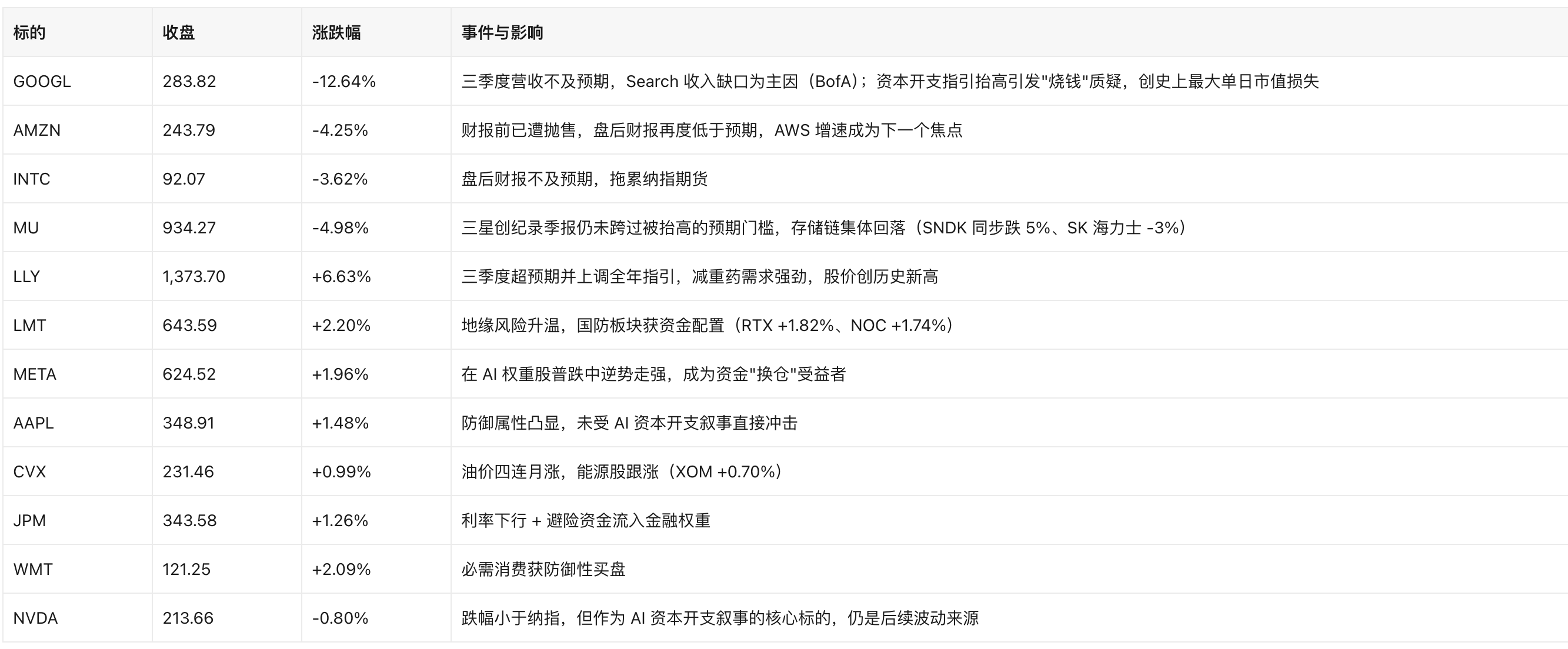
Pressure in U.S. markets remained centered on large-cap technology after the Oct. 29 close. Alphabet posted its biggest one-day decline on record after third-quarter revenue missed expectations, with a gap in Search revenue dragging on the overall result. The stock fell 12.64% to $283.82, erasing $482 billion in market value based on Wall Street Journal and Yahoo Finance figures. CNBC described the loss as nearly $500 billion.

The market narrative also shifted. The question had been whether AI spending could be monetized. It is now increasingly about whether AI capital expenditure has gone too far, and that change has become a core theme in the latest pullback across major tech names.
After-hours earnings added to the pressure. Amazon and Intel both reported results that fell short of expectations. As of 04:31 UTC on Oct. 30, Nasdaq futures were down 1.88% and S&P 500 futures had slipped 0.89%, a sign that selling pressure continued beyond the regular session and that risk appetite was still contracting.
Crypto markets were under strain as well. Binance said it had suffered the largest crypto asset attack in its history, with $6.3 billion in assets affected. More than $2.5 billion had been frozen across multiple platforms, and withdrawals were temporarily suspended. Bitcoin dropped below $77,000 and later traded at $78,329.
Among crypto-linked U.S. equities, Strategy reported $20.9 billion in operating profit for the third quarter, but the entire profit came from fair-value changes in Bitcoin. Revenue was $125.4 million, down 3% year over year. BTC Yield was -3.7% year to date, and CFO Andrew Kang departed.
Indexes, rates and the macro setup
At the index level, the move looked moderate on the surface at the Oct. 29 U.S. close. Underneath, the split was sharp. Alphabet accounted for much of the Nasdaq’s weakness, while the Dow was supported by financials, healthcare and energy.
This was not a broad-based clearing event across risk assets. It looked more like a concentrated break in AI-heavyweights, paired with a rotation into defensive sectors and real assets.

Cross-asset moves pointed to a market still arguing with itself. Stocks fell, Treasury yields moved lower and the dollar weakened, which fits a risk-off bid for bonds and a downgrade in growth expectations rather than a straightforward inflation trade. At the same time, oil moved above $103, adding fuel to inflation concerns. Those two forces pull in opposite directions, and the lack of a single dominant narrative helps explain the rise in volatility.
Gold slipped 0.68% after trading above $4,000. In the report’s reading, that looked more like profit-taking at elevated levels than a disappearance of safe-haven demand.
Central banks and the next data window
The European Central Bank kept rates unchanged at 2.5% on Oct. 29, while signaling that a December hike remained possible. Christine Lagarde also announced an early departure the same day.
In the U.S., the Federal Reserve has entered its blackout period ahead of the Nov. 3-4 policy meeting, leaving the market without fresh guidance from officials on the path ahead.
U.S. September PCE and the advance estimate of third-quarter GDP are due at 08:30 ET on Oct. 30. That is the final major macro data window of the week.
Sector rotation: away from AI capex, toward defense and energy
The report argues that this adjustment is not a broad technology sell-off. The damage to the narrative is concentrated in hyperscalers. Capital has been moving out of the companies most exposed to AI capital expenditure, whether as beneficiaries or as spenders, and into defense, energy, pharmaceuticals and consumer staples.

If the GDP and PCE data due later on Oct. 30 do not come in weak, that rotation from high-multiple growth into lower-valuation defensives could continue. If the data undershoot materially, the move could broaden into a wider de-risking episode.
Strategy: record profit, thinner cushion
Strategy (MSTR) closed at $141.62 on Oct. 29, down 2.44%. According to Benzinga and Crypto Briefing, the stock fell another 2.5% after hours.
In its Form 8-K filed with the U.S. Securities and Exchange Commission on Oct. 29, the company reported the following for the third quarter:
- Operating profit of $20.9 billion, entirely driven by Bitcoin fair-value gains;
- Revenue of $125.4 million, down 3% from a year earlier;
- Bitcoin holdings of 848,517 BTC as of Oct. 25, 2026;
- Original cost basis of $64.02 billion, or $75,446 per BTC;
- A holding value of $68.90 billion using a Bitcoin price of $81,200 on Oct. 23.
The report also included arithmetic checks showing that 848,517 multiplied by $75,446 equals $64.02 billion, and 848,517 multiplied by $81,200 equals $68.90 billion.
On financing, Strategy has raised $21.23 billion year to date, making it the fourth-largest equity issuer in the U.S. this year. It raised a net $5.41 billion through its at-the-market program in the third quarter, then another $58.7 million from Oct. 1 to Oct. 23. Short-term investments stood at $3.40 billion as of Sept. 30.
The more difficult part of the picture is dilution. BTC Yield was -3.7% year to date, BTC Gain was -24,947 BTC, and BTC $ Gain was -$2.03 billion. In practical terms, the amount of Bitcoin represented by each share has been falling, and equity issuance has not outpaced dilution.
Using the report’s calculations, Strategy’s market capitalization was $54.41 billion at the Oct. 29 close, based on 384.23 million shares multiplied by $141.62. Using a spot Bitcoin price of $78,329, the value of its holdings was $66.46 billion. That puts mNAV at 0.82x, or an 18% discount to the value of the Bitcoin position.
The report’s key conclusion is that once mNAV falls below 1, at-the-market issuance shifts from accretive to dilutive. That weakens the mechanism Strategy had relied on to increase Bitcoin per share, and it helps explain why a record $20.9 billion accounting profit did not support the stock.
The margin above cost is also narrow. Strategy’s average acquisition price is $75,446, only 3.8% below the current Bitcoin price of $78,329. Bitcoin’s 24-hour low of $76,500 came close to that line. If the price falls through it, unrealized gains would turn into unrealized losses, which could hit both sentiment and financing capacity more directly.
Other developments cited in the report include the departure of CFO Andrew Kang, shareholder approval for daily dividend arrangements on four preferred share classes, and the launch by 21Shares of a Strategy Bitcoin ETP in Europe.
Crypto-linked equities and ETF flow data
The report said it was unable to obtain a reliable latest single-day ETF flow figure. Farside’s interface returned a 403 error, and secondary trackers showed material discrepancies, so the data was not used.
The most recent public reporting available around Oct. 29 pointed only to a directional description that U.S. spot Bitcoin ETFs had seen net outflows. Because the dollar amount could not be cross-verified, the report did not treat it as a firm conclusion.

New entrants, a cautionary case and accounting rules
No new U.S.-listed entrant or newly transformed digital asset treasury, or DAT, company was identified through confirmed corporate disclosures on the day, and the report avoided speculation about additions to any watchlist.
One negative case did stand out. Datavault AI acknowledged that its Bitcoin holdings were stored on a small exchange and could not be withdrawn. Its stock fell nearly 50% in a single day. The report treats that as a reminder that custody counterparty risk is starting to be priced into companies that announce Bitcoin purchases.
Accounting rules remain a major engine behind the DAT trade. Fair-value accounting allowed Strategy to recognize $20.9 billion in gains in one quarter, directly amplifying the income statement when Bitcoin rises. The same mechanism would produce large paper losses if the price falls.
Regulation, legislation and the election calendar
The CLARITY Act, a U.S. market structure bill, failed to advance in the Senate, and Democrats proposed an alternative. The report noted that prediction markets had marked down the probability of passage this year, citing a CoinMarketCap relay, but also said that claim was unverified.
Bloomberg Law separately reported that crypto tax lobbying was still expanding even after the market structure bill stalled.
On a strategic Bitcoin reserve, Senator Hagerty said that once the CLARITY Act passes, the reserve could be expanded “very quickly,” according to TheStreet. The report explicitly described that as a statement of position rather than established policy.

The U.S. midterm election is four days away on Nov. 3. In the report’s framing, the direction of crypto regulation is directly tied to Senate control, making the election the biggest policy variable of the week.
Geopolitics and the oil move
Geopolitical risk continued to feed into energy prices. Reuters reported on Oct. 30 that an oil tanker was attacked in the Strait of Hormuz, helping push oil to a fourth straight monthly gain. Reuters also reported on Oct. 28 that Houthi forces attacked Saudi energy facilities, with repeated headlines around refinery disruptions affecting supply expectations.
WTI settled at $103.13, up 1.11%. Defense stocks moved higher as well, and uncertainty around inflation and the rate path increased.
CNBC reported that the U.S. had asked Gulf states to prepare for possible action against Iran after the midterm election. The report labeled that as a media account without official confirmation.
The World Bank warned that conflict in the Middle East could trigger a shock in commodity prices, though the report did not adopt any specific price-rise forecasts mentioned elsewhere.
Across markets, two trades are running at once. One is classic safety: buying bonds, gold and defensive sectors. The other is reflation: buying oil and defense. The report argues that the two cannot coexist indefinitely, and that the Nov. 3 midterm election and the Fed’s Nov. 4 decision will determine which theme takes the lead.

What the market is watching over the next 24 hours
At 08:30 ET on Oct. 30, equivalent to 20:30 Beijing time, the market will get:
- Advance U.S. third-quarter GDP, expected at +3.2% versus a prior reading of +2.2%;
- September PCE, expected at +0.5% month on month and +3.6% year on year;
- Core PCE, expected at +0.3% month on month and +3.1% year on year;
- Initial jobless claims, expected at 198,000 versus a prior 195,000.
The report says a meaningful deviation in those figures would directly shape the balance between the safety trade and the reflation trade.
Before the open on Oct. 30, earnings are due from XOM, CVX, ABBV, REGN, AZN, GD, CL, CCJ, EXC, D and KVUE.
On policy and politics, the Nov. 3 midterm election is approaching, with the fate of the CLARITY Act tied to the result. The Federal Reserve’s Nov. 3-4 meeting is also close, and officials are already in blackout.
For crypto and crypto-linked equities, the next focus points are the aftermath of the Binance incident, including whether frozen funds can be recovered, whether withdrawals fully resume and whether regulators step in; whether Bitcoin breaks below Strategy’s average cost of $75,446; and whether the 0.82x mNAV discount disrupts the DAT cycle of issuing stock, buying Bitcoin and lifting the share price.
On ETF flows, the report said the data still needs to be checked against Farside or issuer websites in the next trading session.


