

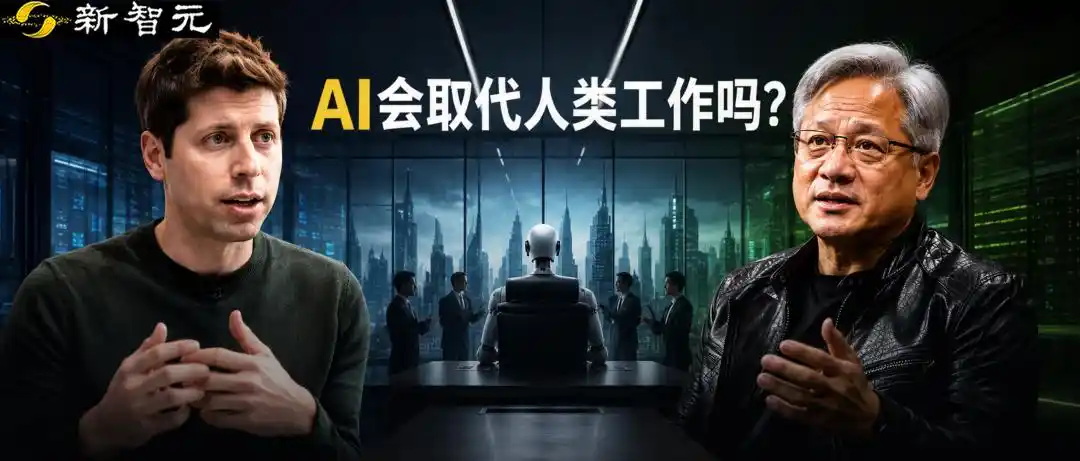
OpenAI CEO Sam Altman has softened his stance on two of the most discussed AI fears: companies run by machines and large-scale job destruction.
On the July 28 episode of Invest Like the Best, episode 484, Altman said people “don’t actually want an AI CEO” because they want to know who is making decisions inside a company and who should be held responsible when something goes wrong.
That marks a clear change from his position in October 2025, when he said he would be ashamed if OpenAI was not the first large company managed by an AI CEO. Nine months later, he publicly revised that view.
Altman also said in May this year that he had overestimated the speed at which AI would eliminate entry-level white-collar jobs, adding that the feared “jobs apocalypse” probably would not arrive.
At nearly the same time, Nvidia CEO Jensen Huang made a similar move from a different direction. In remarks at YC Startup School 2026, Huang said the narrative that AI destroys jobs is “exactly backward.”
One executive runs a company at the front edge of large-model development. The other controls the computing infrastructure behind the boom. Both are now putting distance between themselves and the most extreme version of the AI unemployment story.
Why Altman changed his view on an AI CEO
Altman’s explanation was direct. People want to know who is responsible for a company’s decisions and who can be pursued when those decisions lead to problems.
By that logic, even if AI is capable of making decisions, that does not mean people are willing to hand over a company to it. Altman added that most people still trust humans more and still prefer dealing with humans.
His point was not that AI lacks intelligence. The issue is accountability. AI may be able to compute an optimal answer in seconds, but it cannot stand in court, answer to a board, or face the public and bear the consequences of a decision.
He offered a small personal example. Altman said he had tried using AI to reply to his Slack messages and emails, signing those messages as “this is Sam’s AI,” but later switched back to responding himself. The reason, he said, was simple: people care that they are dealing with a real person.
Even in his earlier 2025 discussion about an AI CEO, Altman had drawn a division of labor in which humans handled external matters while AI handled decision-making. His more recent framing draws a sharper line: AI may help make decisions, but it cannot be held liable for them.

Huang says people are confusing tasks with jobs
Huang’s argument starts with a distinction. He said many people have treated “tasks” and “jobs” as if they were the same thing, and that is where the analysis breaks down.
In his description, a job has a purpose, and many tasks must be completed to achieve that purpose. AI can take over some of those tasks. That still does not mean the whole job disappears.
Jobs also contain communication, judgment, coordination, review, and responsibility for outcomes. Those parts do not vanish just because AI has absorbed part of the workflow.
He used radiologists and software engineers as examples. AI is taking on more image reading and more coding, yet employment in both roles has increased. Huang’s figures were roughly 10% year-over-year growth for software engineering jobs and about 20% growth in radiology roles over the past few years.
His explanation was that demand backlogs remain large. Hospitals already have patients waiting. Companies already have software to build and product requests piling up. If tasks are completed faster, hospitals and businesses can take on more work and expand, which then creates demand for more people to handle the parts AI still cannot do.

Altman pointed to a related example. A year ago, he said, many people were saying software engineers were finished. That did not happen. What changed was the content of the job itself. People may no longer write code line by line in the same way, but the work is still recognizably software engineering.
In other words, tasks may be replaced while the job remains.
Huang did not claim every occupation is safe. He also said all jobs will change and that some professions will disappear altogether.
The article adds an important condition to his logic: companies have to use the efficiency gains from AI to pursue more business and hire more people. If demand does not grow, or if employers simply convert those gains into layoffs and lower costs, headcount can still shrink.
Hiring data shows no broad collapse in demand
The piece cites a project by the University of Maryland and LinkUp that examined 155 million U.S. job postings since 2018.
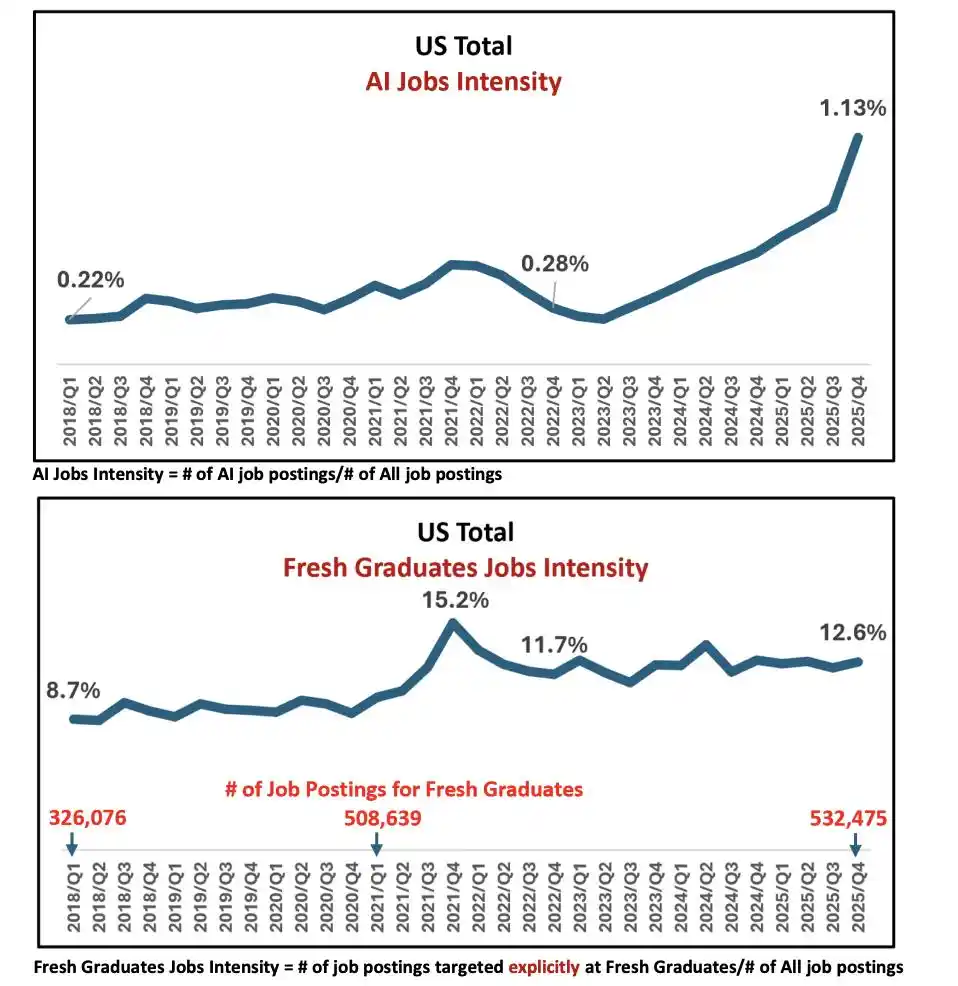
Its conclusion: as of the fourth quarter of 2025, there was no evidence that AI had crushed hiring demand across the economy as a whole.
- U.S. “AI job intensity,” defined as AI jobs as a share of all jobs, rose from 0.22% in Q1 2018 to 1.13% in Q4 2025.
- “Graduate job intensity” rose from 11.7% in Q4 2022 to 12.6% in Q4 2025.
- There were 532,000 job postings aimed at graduates in Q4 2025.
The article says the most counterintuitive data point concerns graduates and entry-level hiring. The claim that AI would first wipe out junior jobs has been repeated for the past two years, yet in this dataset the share of postings explicitly targeting graduates increased rather than declined.
That share climbed from 11.7% in the fourth quarter of 2022 to 12.6% in the fourth quarter of 2025. In Q4 2025 alone, those postings totaled 532,000, up 63% from Q1 2018.
Even in mathematics and computer-related occupations, which are often treated as especially exposed to AI, graduate-level openings were 55% higher than in Q1 2018.
On that basis, the claim that entry-level jobs are disappearing does not hold up in terms of total volume.
The report also made another observation that runs against common assumptions: younger and less experienced workers may be more likely to benefit from AI tools, because AI is especially good at surfacing large stores of experience for them instantly. That can make them attractive to employers as low-cost and effective early adopters.
Total jobs may be intact, but the entry path is narrowing
The article does not stop at the topline numbers. It argues that stable totals do not mean the transition is painless.
Traditionally, young workers built experience through standardized beginner tasks: data entry, junior coding, basic analysis, and information organization. Those tasks were repetitive, but they were also where people accumulated judgment and practical skill over time.
Those are exactly the kinds of tasks AI tends to absorb first.
As a result, the path into junior positions is getting narrower. For recent graduates and people just entering the workforce, the article says that is the more immediate pressure point.
Where human value sits in AI-era work
Placed side by side, the Altman and Huang comments point to the same shift. As AI becomes more capable, the value of human work moves upward, away from simply completing tasks and toward taking responsibility, building trust, and setting goals.
Machines may replace one task after another. The gap around final authority and signed accountability remains open.
The article’s practical question is not whether AI will take a job in the abstract, but how much of that job requires a person to sign off on outcomes and appear in situations where others need a human counterpart to trust.
By that reading, the parts AI still cannot replace are the closest thing workers have to a defensible moat.