
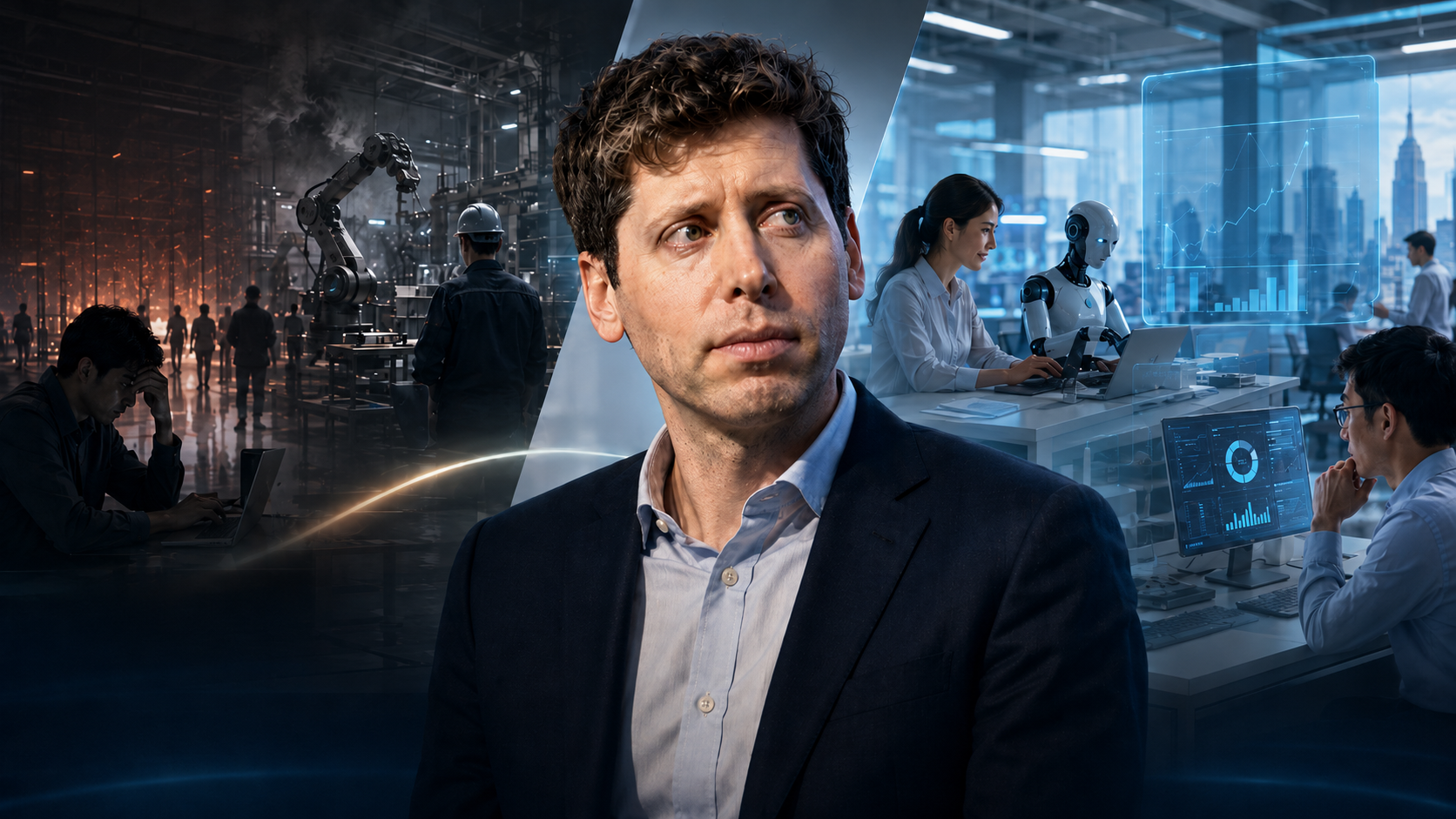
OpenAI CEO Sam Altman has said he was “pretty wrong” about how quickly AI would wipe out white-collar jobs. A year ago, he warned that entry-level office roles faced serious risk and suggested the damage would already be visible by now. His current view is softer: the impact has been much smaller than he expected.
Altman made the comments in a conversation with Commonwealth Bank of Australia CEO Matt Comyn. He said he thought the effect on entry-level white-collar work would be much larger by this point, but that has not happened. At the same time, he did not fully abandon the earlier warning. He added that the risk could still materialize, leaving his original thesis only partly withdrawn.
Altman points to human interaction as a limit for AI substitution
He also described a personal experiment. Altman said he once let AI handle Slack messages and email replies, then switched back to doing them himself. The reason, in his telling, was simple: people care deeply about human interaction, and he cannot imagine that part being outsourced to AI any time soon. That experience led him to rethink what the employment picture may actually look like, and he said it could end up being very different from what he had expected.
Around the same period, Anthropic CEO Dario Amodei also shifted his framing. He had previously said AI could eliminate 50% of white-collar jobs. Earlier this month, he recast the issue through the lens of Jevons paradox, moving the discussion away from direct replacement and toward expanding productivity and demand.
Anthropic leans on Jevons paradox to argue efficiency can grow work
Jevons paradox comes from economist William Stanley Jevons, who observed that better coal-use efficiency in the steam era did not reduce coal consumption. Lower costs increased demand, and total use went up instead of down. Amodei applied the same logic to labor: if 90% of a job is automated, people will focus on the remaining 10%, and that fraction can expand until it fills a full workload again, with productivity rising by a factor of ten.
Apollo economist Torsten Slok has offered a similar reading. He pointed to occupations such as customer service and radiology, jobs often seen as vulnerable to automation, and argued that headcount in those areas has at times held steady or even increased as AI tools spread. In that framing, lower cost per interaction does not mean fewer interactions. It can mean more customers served and more channels opened.
Layoff data and academic research are pointing in different directions
The debate remains unsettled because the evidence does not line up neatly. According to layoffs.fyi, tech layoffs in 2026 through May had already exceeded 115,000, close to the 124,000 recorded for all of 2025. Meta, Amazon and Snap have all explicitly cited AI as one reason behind job cuts. Those figures suggest AI is already shaping workforce decisions inside parts of the tech sector.
Academic work has painted a different picture. Research from the Yale Budget Lab found that since ChatGPT launched in late 2022, occupations with high AI exposure have shown no significant change in occupational structure or unemployment duration. Research by Nobel Prize-winning economist Daron Acemoglu also supports the view that AI substitution effects are often offset by labor demand created through productivity gains.
These data sets do not necessarily cancel each other out. Tech is a concentrated early adopter, and staffing changes there may arrive faster than in the broader labor market, where adjustment takes longer. One point is clearer than the broader conclusion: with both companies pushing toward IPO preparations and valuations nearing $1 trillion, Altman and Amodei are now choosing to emphasize the “no significant change” side of the story rather than the side showing large-scale layoffs.
Altman said he is glad he was wrong. For now, the real scale of AI’s effect on white-collar employment remains an open argument, not a settled outcome.