


Amazon is in talks to acquire AI startup Decart at a valuation of around $7 billion, The Wall Street Journal reported on Oct. 11, citing people familiar with the matter.

The discussions surfaced after another large AI company had already looked at the same target. Bloomberg reported in September that Anthropic had discussed a deal for Decart at about $6 billion, then decided not to proceed after completing due diligence. Decart’s valuation has climbed quickly this year: when Nvidia invested in the company in May, its valuation was still close to $4 billion.
Why Decart has drawn interest
Decart’s business is centered on software that helps AI models run on different chip platforms and get more work out of the hardware they use. Nvidia offers GPUs, Google has TPUs, and Amazon has Trainium. Because those chips are built on different architectures, models usually need adaptation and optimization before they can run efficiently on each one.
A program that performs well on Nvidia hardware often needs code changes and tuning before it can take full advantage of Amazon’s chips. For developers and enterprise customers, the chip decision is not only about purchase cost. It also comes down to migration work, time spent on adaptation, and whether the move improves speed and lowers operating cost.

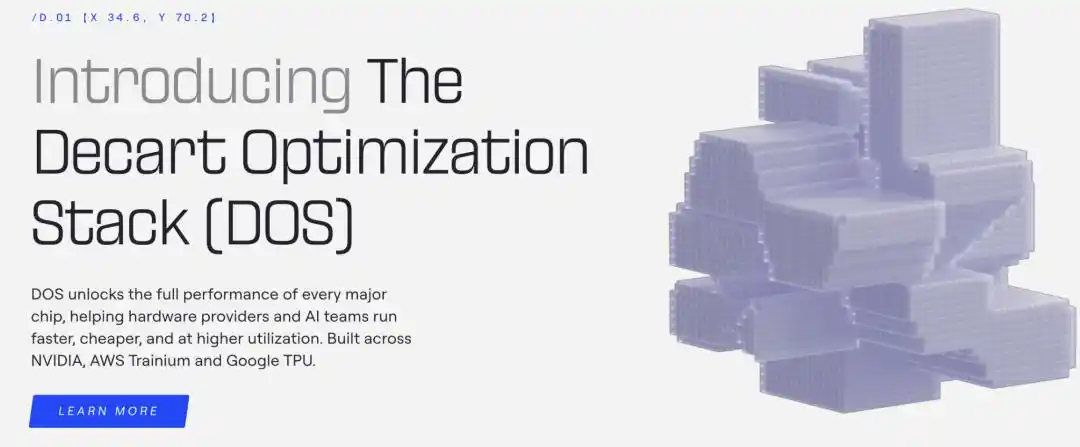
That is where Decart’s DOS, short for Decart Optimization Stack, fits in. According to the company, DOS supports Nvidia GPUs, Google TPUs and Amazon Trainium, and it is used for both model training and inference. The software adjusts how models run on each chip type and optimizes lower-level computation so the hardware spends less time waiting and more time doing useful work.
That capability matters to chip vendors as well. Amazon already has its own Trainium line, and software that reduces adaptation work while improving performance could make Trainium more attractive to developers.
Amazon and Decart are already working together
The two companies already have a commercial relationship. In a company announcement released in May, Decart listed Amazon as a strategic customer and said its video model Lucy2 was running on Trainium3. Nvidia also joined that same financing round as a new investor in Decart.
Seen from that angle, Decart is not just selling a general optimization layer. It is addressing a practical question in the chip market: why should a customer switch from one chip platform to another? A company that can make migration easier and improve speed and cost on the new hardware has a stronger case to win workloads.
Lucy2.5 targets real-time video generation and editing
Decart also builds its own AI models. Lucy focuses on real-time video editing, while Oasis generates virtual environments that change in response to user actions.
According to the company, Lucy2.5 can alter video while it is playing. Users can swap people, change clothing, adjust backgrounds, add effects and remove objects through text prompts or reference images. Decart says the model supports real-time generation at 1080p and 30 frames per second. The use cases it points to include live background replacement, virtual try-on and adding effects during filming rather than after the fact.
Real-time video is highly sensitive to latency. The system has to ingest video, modify the frames and display the result fast enough that the delay is not obvious. If any part of that chain slows down, users notice it immediately.

An AWS customer page published an early set of test results from Decart. According to Decart co-founder and CEO Dean Leitersdorf, the company’s real-time video model on Trainium reached up to 4x the frame throughput of a comparison GPU, achieved 2x cost efficiency and reduced latency from 40 milliseconds to 10 milliseconds.
Oasis3 is aimed first at autonomous driving simulation
Oasis serves a different workload. Decart’s Oasis3 is initially focused on autonomous driving, where the system generates a virtual environment that changes as the vehicle turns, accelerates or brakes. The company says the setup can also present road conditions through multiple synchronized camera views so driving systems can be trained and tested inside the simulation.
That kind of environment also depends on sustained compute output. The longer the training session runs, the more frames must be generated and the more computation must be completed. If the software schedules those tasks more efficiently, the same budget can cover more scenarios and more rounds of testing.

Chip competition is moving beyond hardware specs
From live video editing to autonomous driving simulation, Decart’s products point to the same issue: how to extract more usable performance from existing chips. For AI companies, buying hardware is only one part of the cost equation. Training and inference efficiency, and the amount of work completed per dollar, matter just as much.
If the same chips can handle more tasks, the cost of each generation job may fall, giving providers more room on pricing and usage limits. That does not mean end users automatically pay less, because product pricing and monthly quotas still sit with the service provider. Smooth output and stable quality also depend on the model itself, along with network and device performance.
Even so, the interest from Anthropic, Amazon and Nvidia shows why Decart has become a strategic asset. In AI infrastructure, the contest is no longer only about raw hardware performance. It is also about how much of that performance software can actually unlock.