
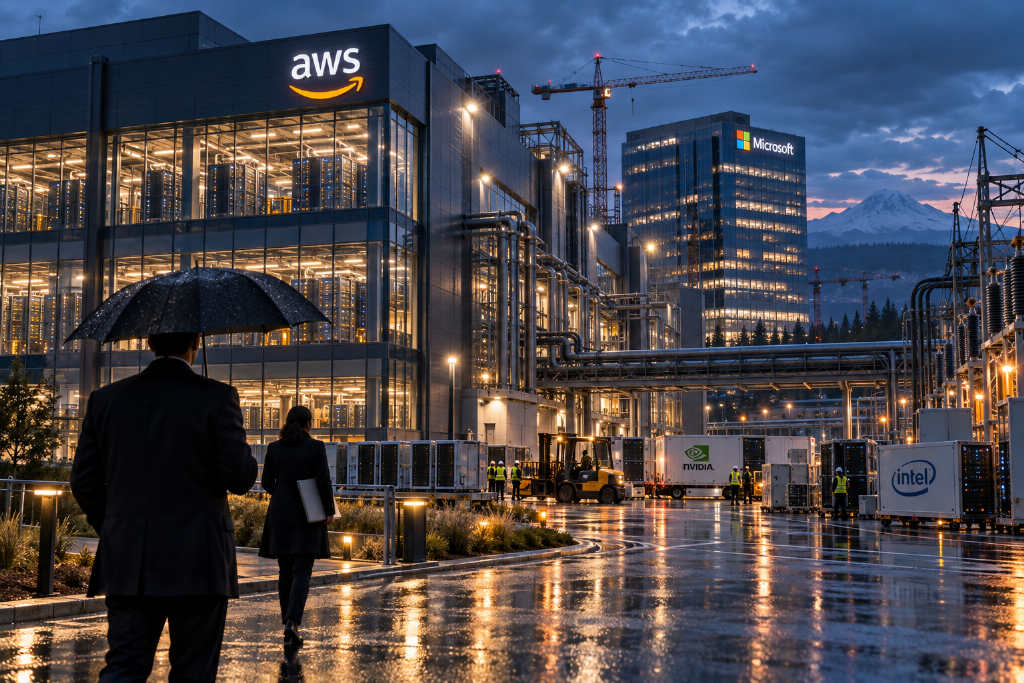
WhiteLine Daily, published under WuBlockchain, put the latest updates from Amazon, Microsoft, Nvidia and Intel under one theme: AI demand is still lifting cloud and server businesses, but revenue growth, capital spending and cash recovery are moving on different timelines.
Amazon posts strong AWS growth, but free cash flow turns sharply negative
Amazon reported third-quarter revenue of $201.9 billion, up 12% from a year earlier. AWS generated $46 billion in revenue, up 39%, and delivered $17.8 billion in operating income.
The cash picture was much weaker. Over the 12 months ended Sept. 30, Amazon said operating cash flow reached $168.3 billion. Property and equipment purchases, adjusted to exclude proceeds from asset sales and incentives, were about $210.7 billion. That left free cash flow at a net outflow of roughly $42.4 billion, compared with a net inflow of $14.8 billion in the same period a year earlier.
Amazon said the increase in spending mainly reflected AI investment. It also maintained its cash capital expenditure outlook of about $220 billion for 2026.
WhiteLine Daily said the rapid rise in AWS revenue has not yet offset the cash drain created by infrastructure buildout, leaving a key question over whether new cloud revenue can eventually cover the ongoing cost of expansion.
Microsoft prices $25 billion in senior unsecured notes
Microsoft said it has priced a $25 billion offering of senior unsecured notes, with settlement expected on Nov. 4.
The deal includes both floating-rate and fixed-rate bonds with maturities ranging from 2028 to 2066. Among the fixed-rate tranches, the 2036 notes carry a 5.55% coupon, the 2056 notes carry a 6.25% coupon, and the 2066 notes carry a 6.35% coupon.
Microsoft said the proceeds will be used for general corporate purposes, which may include working capital, capital expenditures, stock repurchases, acquisitions and repayment of existing debt. The company did not limit the use of proceeds to AI infrastructure.
WhiteLine Daily noted that long-dated debt gives Microsoft funding it can use over many years, while also locking in interest costs above 6% on the 30-year and 40-year fixed-rate tranches.
Nvidia reportedly discusses credit support for Nscale financing
Reuters reported that The Information, citing people familiar with the matter, said Nvidia is in talks to provide several billion dollars in credit support to UK AI cloud provider Nscale.
The support would help Nscale secure debt financing for a data center in West Virginia, with the funding intended for power facilities and project construction. The site is planned to provide computing capacity to Anthropic, and Nvidia is also an investor in Nscale. Anthropic had previously reached about $45 billion in compute leasing agreements.
The report said the credit support agreement has not been signed and terms could still change. Nvidia, Nscale and Anthropic did not immediately respond to Reuters requests for comment at the time.
WhiteLine Daily said that if the guarantee is finalized, Nvidia's backing for Nscale would extend beyond equity investment into debt credit support, exposing it to financing and repayment risks tied to the data center project.
Intel sees data center and AI growth, but PC weakness remains
Intel reported third-quarter revenue of $16.5 billion, up 21% year over year. Revenue from its data center and AI segment rose 78% to $7.3 billion, while client computing and physical AI revenue fell 5% to $8.1 billion.
The company said its current focus is increasing supply of Xeon server processors to meet demand, but it expects the slowdown in the PC market to continue at least through the first half of 2027.
For the fourth quarter, Intel forecast revenue of $15 billion to $16 billion. At the midpoint, that would be about 6% below the third quarter. It also projected non-GAAP gross margin of 38%, down from 44.1% in the third quarter.
WhiteLine Daily said the split between server demand and PC demand shows that strong AI spending does not automatically translate into broad-based improvement across the whole business.
The common thread: growth is there, but funding and cash recovery matter
The roundup's central point was that AI demand is still driving cloud and server growth, yet the expansion in revenue is not moving in step with cash recovery.
Amazon is still absorbing a roughly $42.4 billion free cash flow outflow over the past year even after AWS revenue rose 39%. Microsoft is raising long-term debt. Nvidia is reportedly considering credit support for a data center borrower. Each structure can support buildout, but each also carries a cost, whether in interest expense or potential repayment exposure.
Intel's split performance between server and PC businesses adds another signal: strong AI demand does not mean every business line improves at the same time. For these companies, the comparison is no longer just about revenue growth or order growth. It also comes down to where construction funding comes from, who bears the financing cost, and whether new business can generate enough cash to cover sustained investment.


