


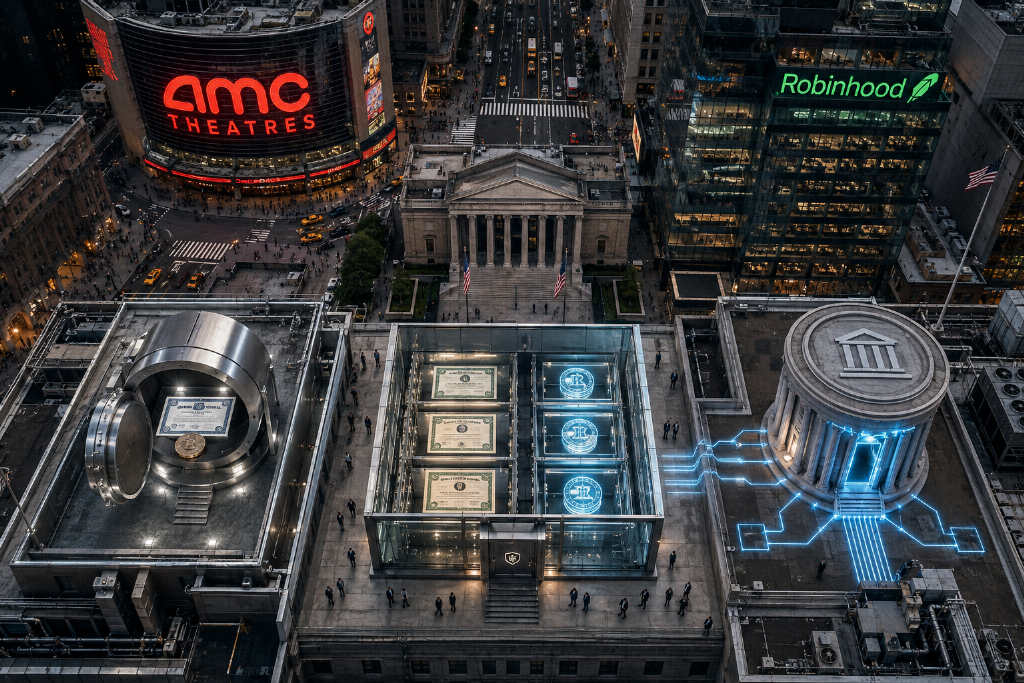
The public fight between AMC Entertainment Chief Executive Adam Aron and Robinhood over tokenized AMC shares broadened on Friday into an industry-level argument over which of three incompatible tokenized stock structures should become the standard.
The core disagreement is about what the holder actually owns. Robinhood’s stock tokens are debt securities issued by an unregulated Jersey entity and sold only to non-U.S. persons. They deliver economic exposure but no claim on the referenced company. Ondo, xStocks and Dinari use regulated intermediaries to hold the underlying shares and pass through the economics, with Dinari the only one of the three selling to U.S. investors. Securitize and Superstate take a different route, putting a company’s own registered shares onchain with the issuer and its transfer agent inside the transaction flow.
The U.S. Securities and Exchange Commission’s Division of Corporation Finance mapped those three categories in a Jan. 28 statement. The model chosen determines which securities laws apply and what a holder may be able to claim in a bankruptcy.
Tokenized stock market reaches $2.91 billion
Data from rwa.xyz shows tokenized stocks now stand at $2.91 billion, up 14.4% over 30 days across 2.67 million holders.
Ondo leads the sector with $869.6 million. It is followed by bStocks at $659.4 million, xStocks at $633.7 million, Securitize at $274.1 million, Bitget at $170.5 million, Robinhood at $133.2 million, Figure at $84.7 million, Superstate at $46.4 million and Dinari at $11.2 million.
Robinhood’s book is about one-sixth the size of Ondo’s, but its trading business is the largest in the group. According to DefiLlama, Robinhood Chain posted $1.56 billion in DEX volume over 24 hours, more than double the level from a week earlier. In late July, it moved past Solana in tokenized stock volume, driven by memecoin pairs.
Dinari opens the argument, Uniswap and Securitize respond
At 12:18 p.m. ET on Friday, Gabriel Otte, co-founder of Dinari, entered the debate under Robinhood Chief Executive Vlad Tenev’s defense of the product, in which Tenev wrote, 「We stand behind Stock Tokens.」 Dinari sells 1:1 custodial tokenized stocks to U.S. investors through an SEC-registered broker-dealer.
「Many took shortcuts to make ‘tokenized stocks’ that are synthetic and indisputably worse for the end investor than stocks,」 Otte wrote. He added, 「It's time for the industry to follow @DinariGlobal's lead and adopt the custodial model that protects investor rights.」
Six minutes later, he named both Robinhood and Ondo and separated his criticism from the securities-law issue Aron had raised. 「To be clear, it's not about legality, it's just that synthetic tokens like @RobinhoodApp stock tokens and @Ondo are just indisputably worse for the end investors than even common stocks,」 he wrote.
At 6:08 p.m. ET, Uniswap founder Hayden Adams replied. Uniswap’s AMM is the largest DEX on Robinhood Chain, and its memecoin pools have been the venue where the stock tokens have been priced. Adams wrote: 「They're not worse if you want programmability, or to trade at night/weekend/holidays, live outside the US, don't have a bank account, want to use them in DeFi apps/hold them in a crypto wallets.」 He added: 「End of the day, tokenized stocks are pretty similar to early stablecoins - are they exactly the same as dollars? No. But they are meeting a user demand in a way that nothing else is.」
Otte replied that the same user demand could be met 「without it being synthetic and being an inferior product with price dislocation.」
Dinari also amplified a version of the criticism made that morning by Chief Business Officer Anna Wroblewska, who wrote: 「The main problem here isn't tokenization. It's the marketing of a discretionary debt instrument, which functions essentially as an onchain CFD, as an investment in the US stock market.」
Securitize Chief Executive Carlos Domingo sided with Aron on Thursday night. 「I would also not want people creating offshore derivatives of our stock that trade all over the place,」 he wrote. He then said, 「This is why we tokenized our own stock natively and in the US, in a fully compliant way.」
The SEC’s three-category framework
The Corp Fin statement gives each structure a distinct legal form.
Issuer-sponsored tokens are the security itself, with the issuer or its agent maintaining the master securityholder file onchain. Third-party custodial tokens represent 「the holder's indirect interest in the underlying security via the security entitlement.」 The third category, which staff called linked securities, covers a token 「issued by the third party itself that provides synthetic exposure to a referenced security, but it is not an obligation of the issuer of the referenced security and confers no rights or benefits from the issuer of the referenced security.」
Robinhood’s developer documentation describes its stock tokens as 「tokenised debt securities issued by Robinhood Assets (Jersey) Limited」 and says they grant no 「legal or beneficial rights in, or against the issuer of, those underlying securities.」 Dividends are reflected through an onchain multiplier rather than a payment. Only one firm, BBVI, can create or redeem them.
Dinari’s dShares are held with FINRA-member broker-dealer Alpaca Securities in segregated custodial accounts, pay cash dividends in stablecoins and can be burned for redemption at market value. In April, Ondo and Broadridge added proxy voting to more than 250 Ondo tokenized stocks and ETFs through Ondo Global Markets, which is not available in the U.S.
The SEC staff also highlighted the counterparty issue raised by the AMC episode: holders 「may be exposed to risks with respect to the third party, such as bankruptcy, to which a holder of the underlying security would not necessarily be exposed.」
Issuer-native tokenization has its own backers
According to Securitize, the firm operates five regulated affiliates: a broker-dealer running an SEC-regulated alternative trading system, an SEC-registered transfer agent, an exempt reporting adviser, a fund administrator and an EU investment firm authorized under the DLT Pilot Regime. That setup allows it to act as the record-keeper for a tokenized security instead of acting as a counterparty to it. BlackRock’s BUIDL and funds from Apollo, Hamilton Lane, KKR and VanEck came onchain through that framework. Securitize says it has tokenized more than $4 billion in assets.
The company listed its own shares on the New York Stock Exchange under the ticker SECZ on July 2 after merging with Cantor Equity Partners II, and tokenized those shares on the first day. rwa.xyz tracks SECZ as the largest single tokenized equity.
Superstate is pursuing the same basic idea for companies that are already public. Its Opening Bell program appoints Superstate as a company’s digital transfer agent and issues the company’s registered shares directly onto Ethereum and Solana. The product page says, 「Tokenized shares are not derivatives, wrappers, or new share classes,」 and states that the tokens are recorded in the investor’s name and carry the same economic and governance rights as the shares traded on the exchange.
Galaxy Digital and Forward Industries have shares onchain through the program, and Forward Industries accounts for nearly all of Superstate’s $46.4 million listed on rwa.xyz. Founder and Chief Executive Robert Leshner, who also founded Compound, said SharpLink would be the first public company to tokenize its shares on Ethereum through the program in September 2025.
Best execution versus AMM slippage
Brian Huang, co-founder of onchain portfolio manager Glider and a former equities trader at XTX Markets, argued on The Defiant’s livestream on Friday that venue matters more than wrapper design.
「AMMs do not guarantee best execution for consumers,」 he said. He continued: 「In the US, we have protections around what's called the national best bid offer or best execution rules, where whether you're trading on Robinhood, Coinbase or any of the major apps or brokers in the US, you are guaranteed to get best execution. Now, that is not true via AMMs.」
Huang rejected the claim that holders do not get meaningful rights. 「You do get the voting rights through particular issuers,」 he said. 「Ondo has worked on this with Broadridge.」 He said Ondo’s request-for-quote design, in which a market maker sources the share offchain and the token is minted against it, is the structure the market will converge on. In his view, the price dislocations end once 24/7 creation and redemption exists on both sides. 「You will not see these dislocations a year from now.」
He made the same argument at RWA Summit on Wednesday, calling the claims from Dinari, Securitize and the NYSE 「propaganda.」 The Defiant previously reported his exchange with Adams over AMMs and correlated pairs on Aug. 18.
Supply constraints and broken price links
Binji Pande, a founding member of Ethereum R&D lab Ethlabs, said on the same livestream that the blowouts look more like a supply problem than a structural flaw. 「We kind of figured out how to program demand before we figured out how to program supply, and you kind of need both,」 he said.
Pande did not defend the price gaps. He called a $6 print in tokenized AMC 「bad market structure」 and said it was not good 「for any market.」
After tokenized AMC and Hims & Hers broke from their reference prices over the Aug. 29 weekend, Pande framed the issue as a loss of issuer control over how assets are used, similar to how publishers lost control over how information moved. By that point, a memecoin called BONER had cornered about half of the tokenized Hims & Hers float. On Wednesday, he predicted the pattern would spread to penny stocks.
Huang’s objection to memecoin pairings was more mechanical. 「When you put in a meme coin with the stock, they're not really correlated assets. You're exposing people to a lot of impermanent loss in those situations.」
Transfer agents and lawyers push the SEC to draw a line
Firms that keep shareholder records have asked the SEC to separate these structures in rulemaking. On July 21, Continental Stock Transfer & Trust told the agency’s crypto task force that third-party tokens 「do not establish a legal relationship between the token holder and the issuer」 and can 「confuse investors, impair issuer governance, create disclosure and market-integrity risks, and bypass the shareholder-record and corporate-action infrastructure.」 It asked the SEC to withhold regulatory relief unless safeguards are in place. A week later, Computershare asked instead for neutral treatment across all book-entry forms.
Ariel Givner, a corporate and intellectual property lawyer in fintech and founder of Givner Law, posted the investor-side version of that argument on Friday morning. The post drew 109,000 views. 「You bought economic exposure from an offshore affiliate that slapped someone else's ticker on a derivative,」 she wrote. 「That is NOT tokenization.」
AMC has filed nothing with the SEC on the dispute. As The Defiant reported on Friday, Robinhood Chief Legal Officer Dan Gallagher, who served as an SEC commissioner from 2011 to 2015, told Aron to 「send your lawyers and we'll educate them.」
Token and data snapshot
According to CoinGecko, ONDO traded at $0.3689, up 5.1% over 24 hours and 5.2% over seven days.
Figures cited in the report were sourced from rwa.xyz, DefiLlama and CoinGecko as of Sept. 5.