
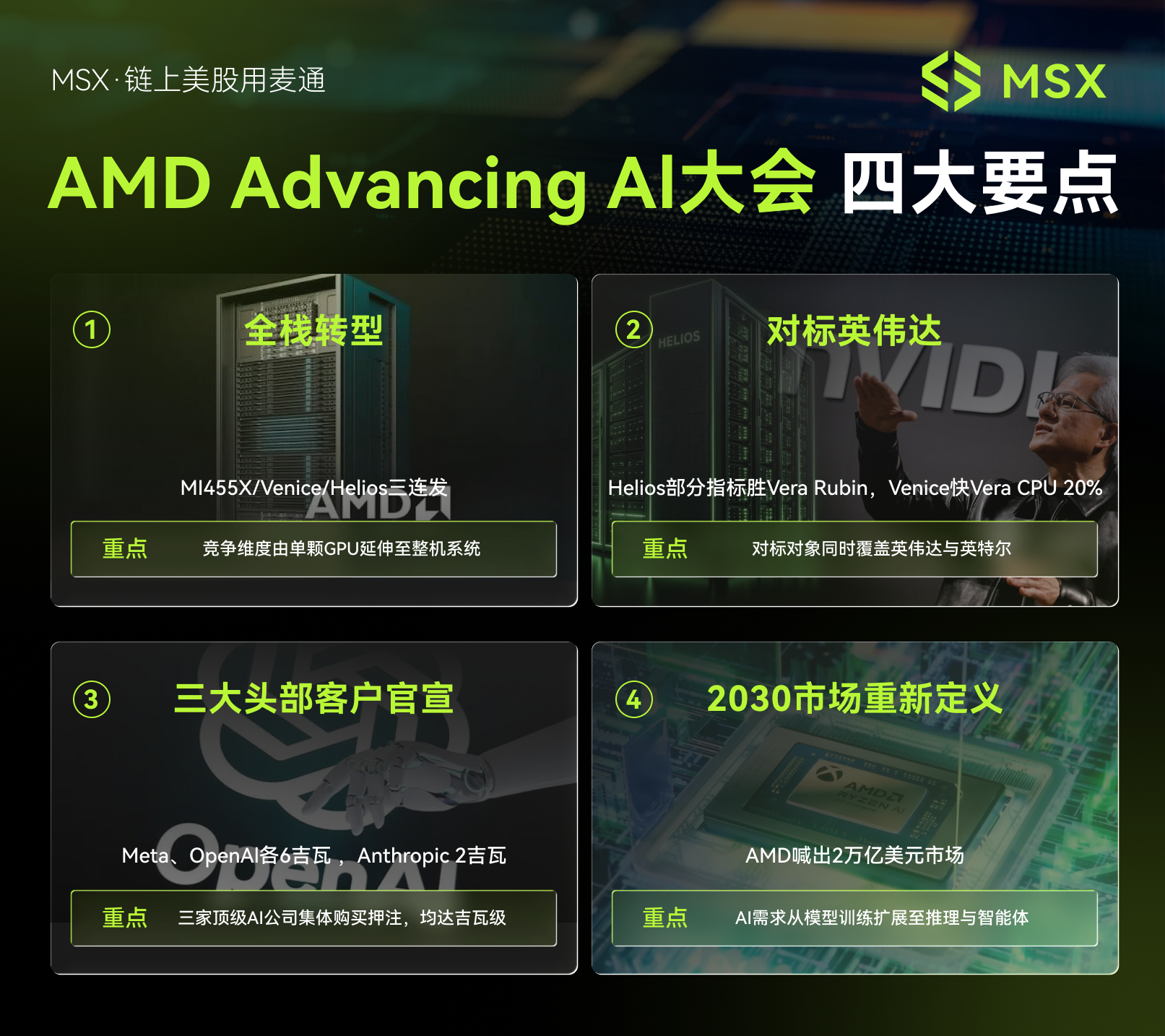
Advanced Micro Devices held its Advancing AI 2026 conference in San Francisco on July 22-23 and introduced three products in one sweep: the next-generation Instinct MI400 accelerator series, the EPYC "Venice" server CPU and the Helios rack-scale AI platform. MSX Research Institute said the launch marks a shift in AMD’s competitive focus, from chasing Nvidia with a single-GPU story to pitching a full-stack AI infrastructure offering that spans chips and complete systems.
At the event, AMD CEO Lisa Su reframed the company’s market opportunity. She said the total computing market will reach $2 trillion by 2030, with AI accelerators accounting for $1.4 trillion and data-center CPUs for $200 billion.
Three product lines took center stage
The announcement centered on three releases:
- the Instinct MI400 accelerator family
- the EPYC "Venice" server processor, based on Zen6 and scaling to 256 cores
- the Helios rack-scale platform, which can integrate as many as 72 MI455X accelerators
In MSX’s reading, AMD is no longer presenting itself only as an alternative supplier for Nvidia GPUs. It is pushing a broader platform position built around CPU, GPU, networking, software and full-system delivery.
AMD’s performance claims
According to the event details cited in the article, AMD said Helios, based on MI455X, can beat Nvidia’s next-generation Vera Rubin platform on some key metrics. It also said Venice can deliver up to 3.4x the performance of Intel Xeon and roughly 20% better performance than Nvidia’s Vera CPU.
MSX added an explicit caveat. Claims such as “beating Vera Rubin” and being “about 20% faster” came from AMD’s own presentation, while Nvidia’s next platform has not yet appeared in a direct side-by-side comparison. MSX said the actual gap will need to be tested through deployment results and third-party benchmarks.
Meta, OpenAI and Anthropic commit gigawatt-scale capacity
On the customer side, Meta, OpenAI and Anthropic have each locked in gigawatt-scale orders.
- Meta: 6 gigawatts
- OpenAI: 6 gigawatts
- Anthropic: 2 gigawatts
Meta and OpenAI each received warrants from AMD covering as many as 160 million shares, equal to about 10% of AMD’s equity each, according to the article. In Anthropic’s case, AMD may take a stake worth as much as $5 billion.
MSX said those commitments are the clearest support yet for AMD’s so-called “third path” narrative. In its view, the relationship goes beyond procurement because it also includes warrants and equity investment arrangements.
Delivery timeline and what the market is watching
Helios is already in production and will begin large-scale deployment within the year, the article said. Venice is already in full production, with servers using the chip expected to appear in the fourth quarter.
For customer delivery, OpenAI’s first 1 gigawatt is expected in the second half of 2026, while Anthropic’s first 1 gigawatt is expected in the first half of 2027.
MSX said AMD’s stock fell instead of rising on the day of the event, dropping nearly 5% intraday. The article added that the shares had already gained about 160% this year, leaving expectations elevated and making an “in-line” event insufficient to push the stock higher.
Its conclusion was direct: the market is less focused on headline performance claims from the stage and more focused on whether AMD can convert MI400, Venice and Helios into sustained real revenue, while narrowing Nvidia’s moat in the CUDA software ecosystem.
MSX platform note and risk disclosure
MSX described itself in the article as an RWA trading platform offering spot and derivatives trading for nearly 400 tokenized equities and Pre-IPO assets. It said its services cover U.S. equity spot and perpetual products, crypto-to-crypto trading, Pre-IPO exposure and research services.
The article ended with a risk warning stating that macroeconomic conditions and the U.S. stock market can be highly volatile, and that the material is for academic and research observation by MSX Research Institute only and does not constitute investment advice.