
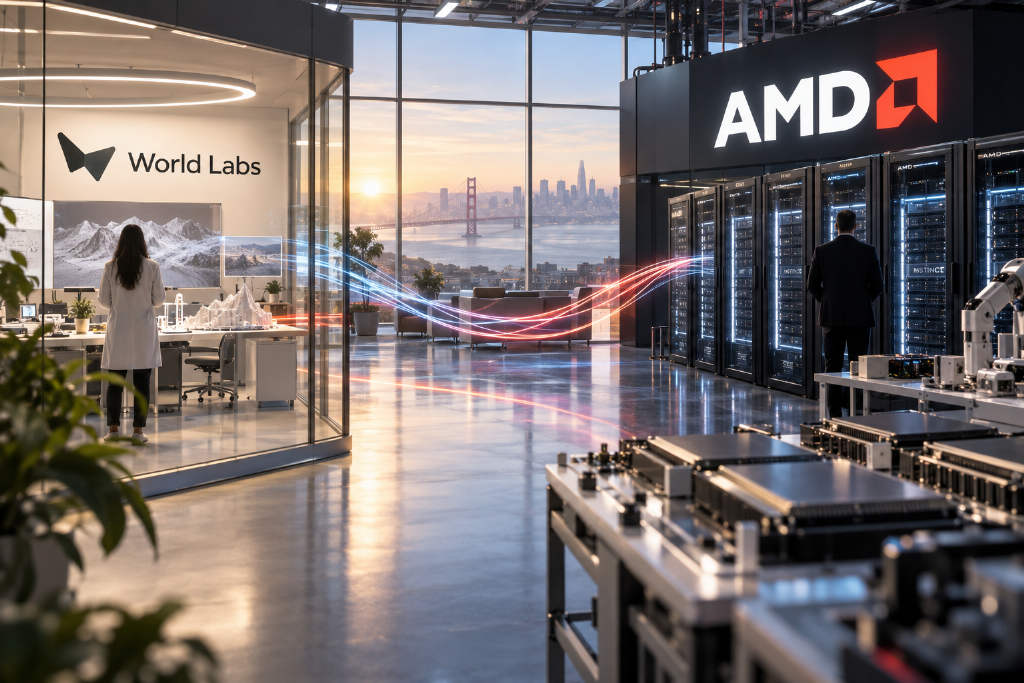
AMD said it will acquire World Labs, the startup founded by Fei-Fei Li, in an all-stock deal worth about $8.2 billion. Under the company’s Sept. 28 announcement, Li will join AMD after the transaction closes as executive vice president and chief scientist, reporting directly to Chair and CEO Lisa Su.
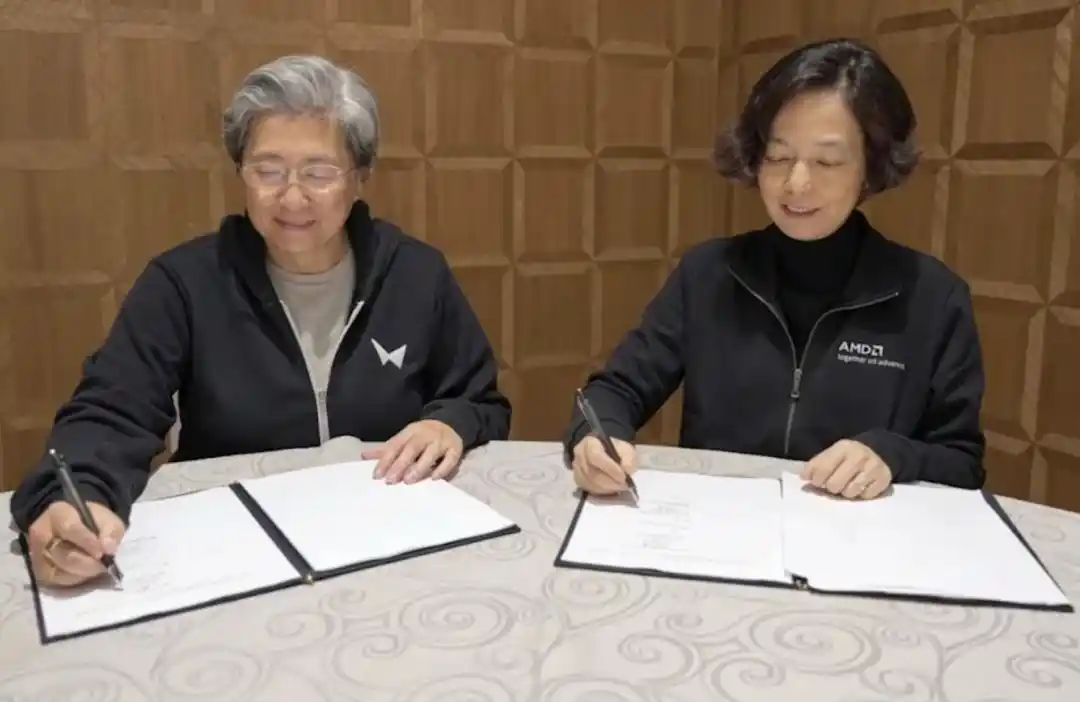
On the surface, the deal is a chipmaker buying an AI startup. Over a longer timeline, it brings together two paths that have been developing for more than a decade: Su’s effort to pull AMD back into the center of advanced computing, and Li’s work from large-scale image recognition to spatial intelligence and world models.
Lisa Su’s AMD turnaround centered on high-performance computing
Su took over as AMD’s CEO in 2014, at a time when the company had already spent years in decline and faced questions over whether it would be able to catch the next major cycle.
The numbers reflected that pressure. AMD posted about $5.5 billion in revenue in 2014, with a net loss of $403 million. In 2015, revenue fell again to $3.99 billion, while net loss widened to $660 million.
The competitive setup was straightforward. Intel held a dominant position in CPUs, while Nvidia had a firm grip on the growth tied to GPU computing. Rather than broadening AMD’s efforts, Su redirected the company’s limited engineering resources toward high-performance computing.
In 2017, AMD launched Ryzen processors based on the Zen architecture and introduced EPYC processors for data centers. Zen became the key product line in AMD’s return to high-performance computing. That same year, AMD’s revenue recovered to $5.33 billion and the company returned to full-year profitability.
From there, EPYC expanded into the server market, and the Instinct GPU line began taking on AI and high-performance computing workloads. AMD’s center of gravity gradually shifted from PC processors toward data centers.
By 2025, AMD’s annual revenue had reached about $34.6 billion. Data center revenue accounted for roughly $16.6 billion, up 32% year over year. Over more than a decade, AMD moved from the edge of marginalization to a central position in AI infrastructure competition.
The logic of Su’s strategy was clear: follow shifts in computing demand and move chips into larger computing markets. But chip design works years ahead of demand. If hardware development starts only after a new workload becomes consensus, the timing is often late. For a chip company, the harder problem is not chasing visible demand; it is identifying the next computing trend before the market fully agrees on it.
That helps explain why AMD would want visibility into which new tasks are becoming important before they are widely defined, and why World Labs fits into that effort.
Fei-Fei Li’s work began with teaching machines to see
Li’s connection to AI can be traced through ImageNet. Around 2006, she began leading the project.
At the time, much of computer vision research was focused on helping machines identify objects in images. A system might detect whether a cat was present in a photo, yet struggle with richer visual understanding. ImageNet eventually accumulated more than 15 million images across about 22,000 categories.
The images were collected from the internet, while classification and labeling required large amounts of human labor. Li’s team used Amazon Mechanical Turk to break the annotation work into smaller tasks and distribute them to a large global pool of temporary workers. The Amazon crowdsourcing platform made that workflow possible.
The work was tedious, but it laid essential groundwork for later progress in deep learning. In 2012, AlexNet delivered a breakthrough result in the ImageNet image recognition challenge, pushing deep neural networks into the center of computer vision research.
One of ImageNet’s most important contributions was showing researchers that large-scale data could itself become a major driver of machine learning progress. From that point, image recognition advanced quickly. Faces, objects, scenes, and text all became forms of visual information that algorithms could increasingly process.
Li did not stop at the question of what machines can see. Her work moved toward the spatial relationships behind vision.
From image recognition to spatial intelligence
A computer vision system can identify that a photo contains a table. In the physical world, that is only the start. A machine also has to determine where the table is, how far the surface is from a robot, where a cup sits on that surface, whether moving forward two steps would hit a corner, and what else might be affected if the robot picks the cup up.
Those are spatial problems.
Li later extended her research toward spatial intelligence. In 2024, she co-founded World Labs with Justin Johnson, Rob Fergus, Christoph Lassner and others, with the goal of enabling AI to build an understanding of the 3D world.
According to the article, models released by World Labs do more than generate 2D images from text. They can generate 3D environments from text or images and make those environments explorable and editable.
That changes the kind of relationships a model has to process. Language models work on relationships between words. Image models work on relationships between pixels. Spatial intelligence models go further and have to process objects, distance, position, time, and action inside one system.
In July 2026, World Labs also acquired spatial intelligence company SceniX, extending its work toward robotics and simulation. The direction became more defined: build models that can continuously understand, predict, and simulate the real world through an internal environment.
That matters in particular for robotics. Recognizing that an object is a cup is just the first step. A robot also has to know the cup’s position, shape, weight, how to grasp it, and what consequences its own movement may bring. If ImageNet addressed object recognition, World Labs is aimed at position, relationships, and change in 3D space.
World models change the underlying computing target
Large language models mostly operate on tokens. World models face a more complicated computational target, handling space, time, object relationships, and environmental change while also predicting what happens after an action.
That category of model needs large datasets and heavier training and inference. It also connects naturally to simulation, robot training, autonomous driving, game development, and digital twins.
If a model can predict changes in the real world from inside a virtual one, the tasks computers are asked to perform start to shift as well. In the past, computers mostly worked on rules defined by humans. World models attempt to let machines build their own internal representation of reality and then use it for prediction and decision-making.
That shift reaches into lower-level computing. The kinds of data GPUs process, memory requirements, training and inference architecture, and software stack design all move with the shape of the model. This is where the report says AMD has urgency: a chip company that designs only around current AI demand remains in a chasing position. One that can see the next class of computing task earlier has a chance to shape hardware and software around that task from the start.
In that sense, World Labs offers more than models. It gives AMD a view into possible future computing demand.
AMD moved from investor to buyer in six months
The relationship between AMD and World Labs did not begin with this acquisition. The article says World Labs completed a $1 billion financing round in February this year, with AMD participating. That round valued World Labs at about $5 billion.
There had already been technical collaboration. World Labs’ spatial intelligence models run on AMD Instinct GPUs, and the two teams had been working together to optimize training and runtime performance. For AMD, that offered direct visibility into how new model types behave in real computing environments: which steps consume the most compute, where memory becomes a bottleneck, and what that implies for system design.
AMD’s stated reason for the acquisition was direct. World Labs’ research can help AMD understand emerging AI workloads and influence next-generation hardware, software, and system design.
Put differently, AMD is not only buying a model team. It is trying to insert an understanding of future AI workloads directly into its product design cycle.
AMD is buying into a market that has not yet been fully defined
AI already has several computing demands that are easy to identify. Training large models requires massive GPU clusters. Running them requires efficiency. Cloud providers continue to build data centers. Chip companies can quantify those needs and plan product roadmaps around them.
World models are not there yet. It remains unclear whether they will first scale through robotics, autonomous driving, or games, whether they can generate meaningful revenue at scale, and how hardware should be configured around them. Even the definition of the category is still moving.
That uncertainty, in the article’s framing, is exactly what leaves an opening for a chip company. If hardware design begins only after world models become a mature industry, competition may already be underway.
By acquiring World Labs, AMD is effectively bringing an internal team dedicated to studying the next generation of computing demand inside the company. That is different from buying a conventional AI application. Applications bring users and revenue. A research team may create value years later in chip architecture, software stacks, and computing systems.
AMD previously used Zen to regain ground in CPUs, then moved into data centers and AI compute through EPYC and Instinct. World Labs points to a different question: what kinds of tasks will drive the next round of computing growth?
For AMD, the report suggests, it is better to keep the people studying that question close than to guess from the outside.
The original piece ends on an image: Lisa Su looking up, searching for the next mountain in computing, while Fei-Fei Li looks down and sees the real world at its base. The mountain has not fully formed yet, but someone has already started building the steps.