

Recent earnings from four major analog chipmakers showed revenue growth and operating metrics improving at the same time.
ON Semiconductor reported revenue of $1.604 billion, up 9% from a year earlier and 6% from the prior quarter. Texas Instruments posted $5.463 billion, up 23% year over year and 13% quarter over quarter, with its analog segment, which accounts for nearly 80% of company revenue, rising 26%. STMicroelectronics reported $3.487 billion, up 26% year over year and 12.7% sequentially. NXP Semiconductors posted $3.496 billion, up 19% from a year earlier and 10% from the previous quarter. All four companies guided for sequential growth in the third quarter.
Outside revenue, several operating indicators turned higher as well. STMicroelectronics said its book-to-bill ratio was close to 2 and that supply was tightening in some product categories. Texas Instruments said backlog kept growing in the second quarter, while lead times extended by several weeks from a level that had been below 13 weeks. NXP’s channel inventory fell to 11 weeks.
By the middle of 2026, the analog chip market had started to move into an upcycle.
Industrial demand moved first, with automotive joining later
Industrial was the first end market to recover. On the earnings call, Texas Instruments President and CEO Haviv Ilan said second-quarter industrial revenue rose about 30% year over year and about 10% sequentially, while data center revenue doubled from a year earlier and increased about 20% from the prior quarter. Automotive, which had lagged for an extended period, also turned higher, with year-over-year growth in the low teens and sequential growth close to double digits.
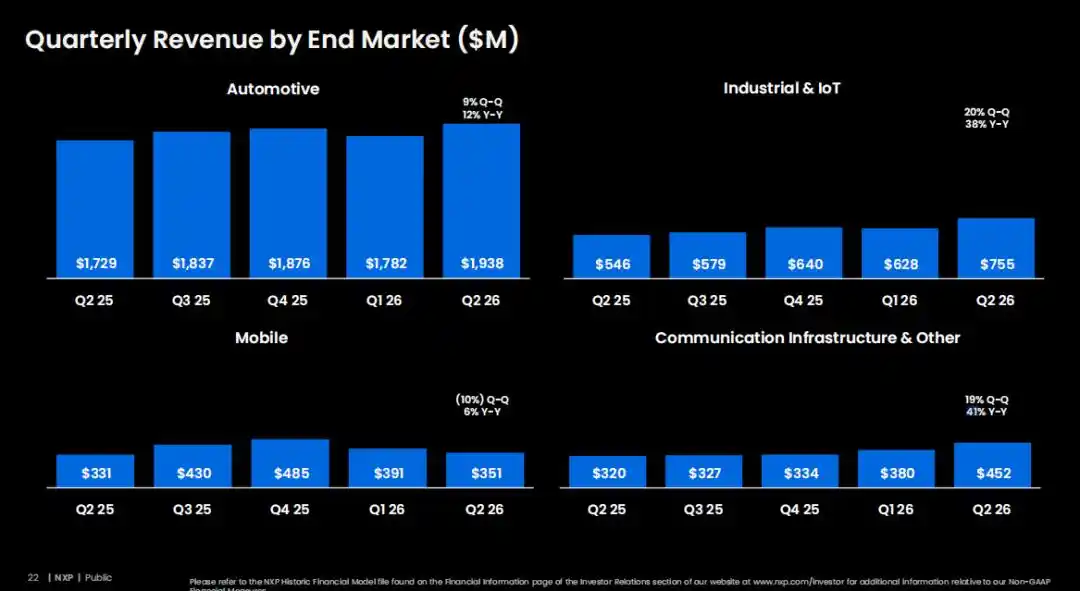
NXP’s revenue mix showed a similar shift. Its earnings report showed industrial and IoT revenue up 38% year over year and 20% quarter over quarter, automotive up 12% year over year and 9% sequentially, and communication infrastructure and other revenue up 41%. Mobile revenue fell 10% from the prior quarter, while consumer electronics remained relatively weak.
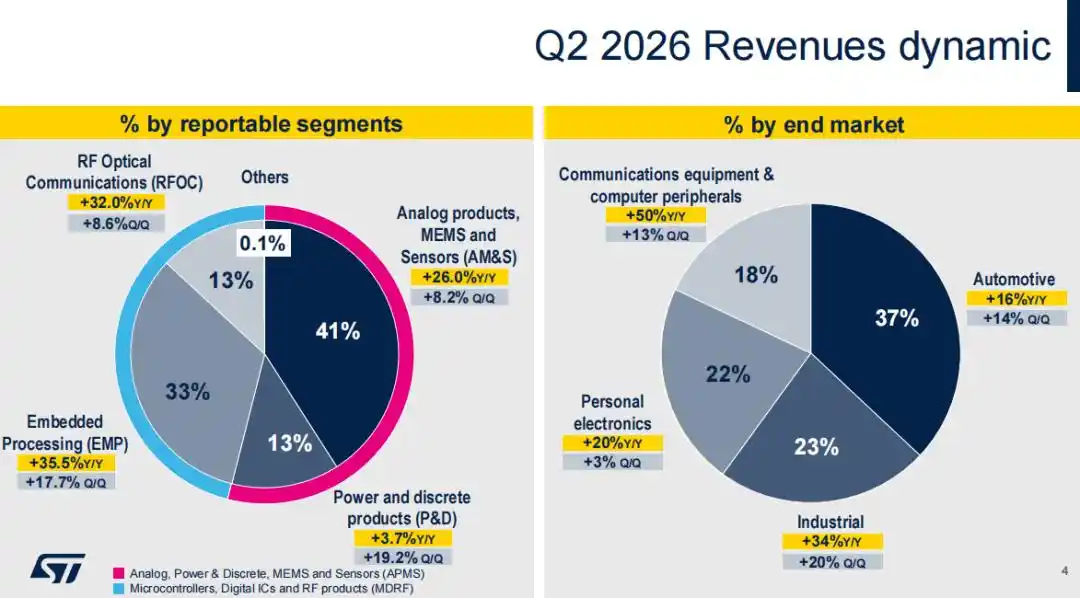
STMicroelectronics reported industrial revenue growth of 34%, automotive growth of 16%, and a 50% increase in communication equipment and computer peripherals. Revenue from analog, MEMS and sensors rose 26%, helped both by the acquired NXP MEMS business and by stronger industrial and automotive demand.
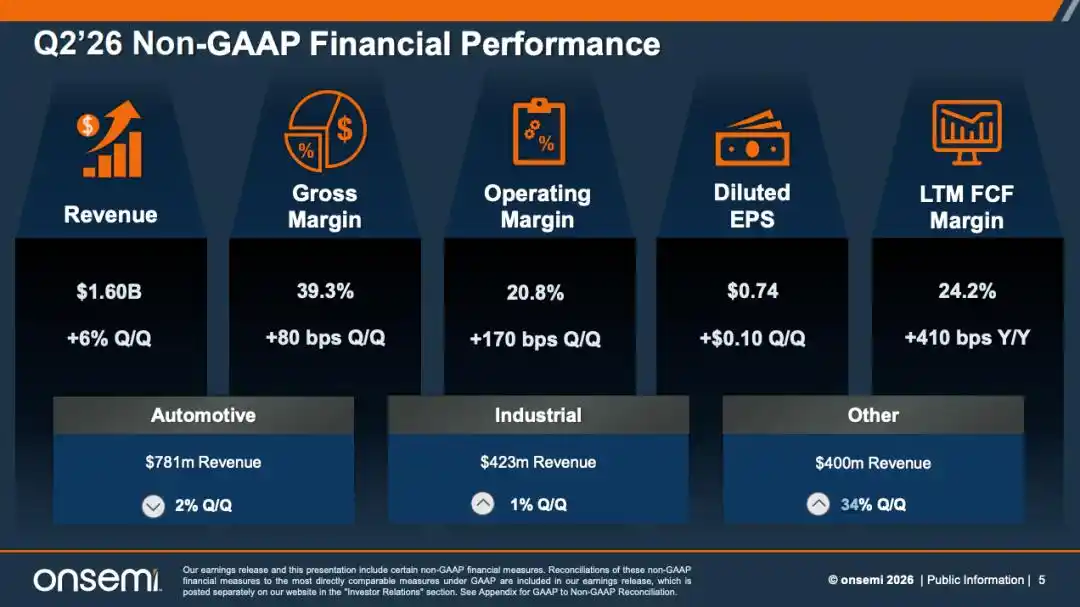
ON Semiconductor’s recovery was milder. Automotive revenue came in at $781 million, down 2% sequentially. Industrial revenue was $423 million, up 1% from the prior quarter. Other markets, including AI data centers, delivered $400 million, up 34% sequentially. By business line, power solutions revenue rose 19% year over year, analog and mixed-signal revenue fell 2%, and intelligent sensing grew 7%. The spread between product lines inside the same company was already clear.
Across the four companies, growth was no longer coming from a single market. Industrial led, data centers followed, and automotive improved visibly in the second quarter. Haviv Ilan said on the call that a broad-based upcycle may have just begun.
That did not mean every product category was improving in parallel. STMicroelectronics said revenue in power and discrete rose only 3.7% year over year, while operating margin stayed at negative 21.4%. NXP’s mobile business also failed to recover with the broader market. Demand had spread from isolated pockets to several end markets, but the gap between product categories remained pronounced.
The real inflection point came from inventories
That gap is easier to understand through the inventory position.
Analog chip demand is fragmented and product life cycles are long. A leading supplier may carry tens of thousands of stock-keeping units, serving customers in automotive, industrial equipment, home appliances and communications, with many parts selling for well over a decade. Compared with digital chips, where customers are more concentrated and product cycles move faster, analog inventories sit in a longer and more complicated chain.
Chipmakers hold finished goods. Distributors carry spot inventory. Automotive Tier 1 suppliers and equipment makers stock components. End customers may still be carrying equipment and finished products. In an upswing, duplicate ordering gets amplified at each layer. Once demand weakens, inventory clears only step by step. A drop in manufacturer inventory does not mean channels are already clean, and lower channel inventory does not prove equipment makers and end customers have resumed purchasing.
Haviv Ilan said on the call that customers had accumulated not only chips in the previous phase, but also equipment and finished products. End demand needed to work through those stocks before systems designed over the past four to five years could convert into fresh semiconductor orders. That helps explain why the industrial analog correction lasted so long: destocking was not confined to chip warehouses, but moved from original manufacturers through distribution, Tier 1 suppliers and end equipment makers.
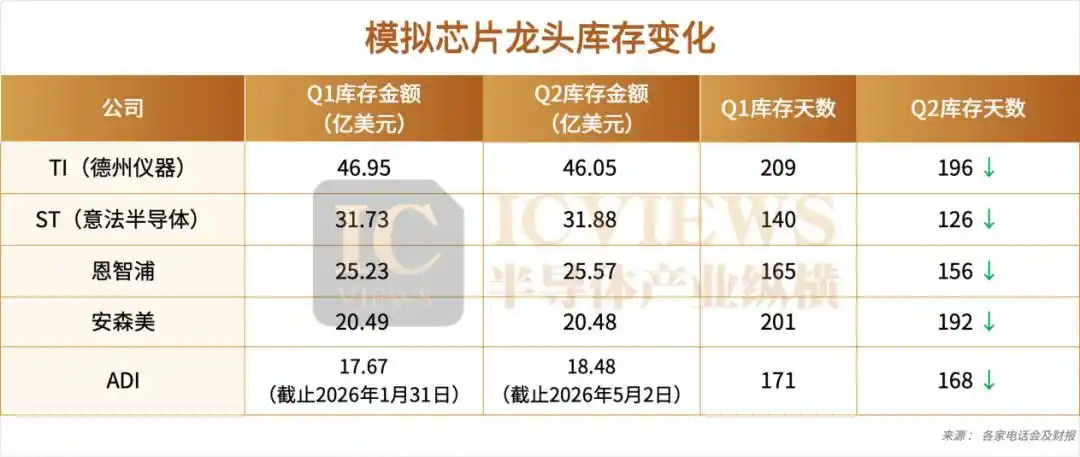
In the second quarter this year, inventories at different layers started to move back into normal ranges at the same time. STMicroelectronics cut days of inventory to 126 from 166 a year earlier, and said distributor inventory was already below its normal target. NXP’s channel inventory fell to 11 weeks, back to its long-term goal. Texas Instruments CFO Rafael Lizardi said on the call that TI reduced inventory value by $90 million sequentially and cut days of inventory by 13 days. Haviv Ilan was more direct in his read on downstream customers: industrial destocking was largely over, and automotive inventories had fallen to levels that would be difficult to sustain over time.
ON Semiconductor offered a different case study. The company reported second-quarter inventory of $2.0475 billion, almost unchanged from the prior quarter. Executive Vice President and CFO Thad Trent said on the call that days of inventory fell by 9 days to 192, while the company was still digesting strategic inventory built earlier for long-term customer demand. Flat inventory value with faster turns suggested that recovering shipments were absorbing existing stock, rather than inventory being pushed down simply by production cuts.
In that sense, the analog inventory cycle is moving through three stages: destocking, inventory normalization and the return of new order transmission.
Restocking started, but end demand is now part of the story
Once inventories fall to low levels, customers need to resume purchasing. Still, not all new orders come from final demand. In the second quarter, automotive, industrial and data center markets were all supported by a combination of restocking and real demand.
Automotive showed the clearest restocking pattern. Texas Instruments said automotive demand strengthened month by month in the quarter, with much of the increase coming from new energy vehicles and hybrid vehicles in China. At the same time, automotive customers had pushed inventories down very far. Even a modest rise in end-market sales meant the supply chain had to rebuild safety stock. Automotive orders therefore reflected both higher sales and chip content per vehicle, as well as purchases that had been delayed earlier.
Industrial looked closer to a recovery in final demand. Texas Instruments said every industrial sub-segment and region posted year-over-year and quarter-over-quarter growth, with contributions from energy infrastructure, aerospace, robotics and industrial automation. The company tied that increase to new equipment introduced in recent years entering volume production and to a higher number of chips required in next-generation equipment, not to price hikes. Haviv Ilan later added that systems designed over the past four to five years were now generating demand.
Order composition is changing as well. STMicroelectronics CEO Jean-Marc Chery said on the call that second-quarter book-to-bill ratios were above 1 across all end markets and close to 2 overall. Communication equipment and computer peripherals were well above 2, mainly driven by optical interconnect and silicon photonics. Texas Instruments said its backlog increased in both near-term delivery and long-term delivery demand.
Near-term orders usually point to low inventory and urgent replenishment. Long-term orders reflect customer visibility on future production plans. Growth in both suggests this rebound has moved beyond a pure channel restock. Restocking lifted orders off the bottom; end demand will determine how long the upcycle lasts.
Price increase notices do not mean broad shortages
As orders recover, channels react quickly to pricing. Since the start of the year, news has circulated frequently about price adjustments by Texas Instruments, STMicroelectronics and Infineon, and some quoted increases have looked notable. Transaction data in earnings reports, though, was much more restrained.
From Texas Instruments’ perspective, Haviv Ilan said overall pricing in the first half of 2026 was roughly flat. Analog chip pricing usually trends down slightly each year, so the fact that prices stopped falling already pointed to better supply-demand conditions. TI is also pushing through another round of price changes, but with a large customer base and different contract cycles, negotiations are happening account by account. Some changes will take effect in the third quarter, some in the fourth quarter, and some in next year’s pricing discussions. TI expects third-quarter revenue growth to come mainly from volume, with price contribution “almost negligible.” Price increase notices show suppliers are regaining some pricing power, but they do not mean quotes have broadly turned into recognized revenue.
Lead-time signals tell a similar story. TI’s second-quarter lead times remained below 13 weeks, though they have recently extended by several weeks. The company still has cleanroom space that can be equipped and ramped, and it also keeps inventory for rapid delivery. STMicroelectronics said some categories were tightening, yet it still absorbed $37 million of idle capacity charges in the second quarter, and its third-quarter gross margin guidance still included about 70 basis points of idle-capacity impact.
Chinese fabless chip designers are feeling tighter conditions sooner. Asked about 8-inch foundry capacity, 3PEAK said overall foundry capacity upstream was tightening as downstream demand recovered, and the company was seeking more capacity from core suppliers. JoulWatt said wafer and packaging tightness may be related to AI demand crowding out capacity and the shift of overseas orders. Awinic said higher mature-node foundry pricing was already pressuring gross margin.
The difference comes from business models. IDM players such as Texas Instruments and STMicroelectronics have their own wafer manufacturing capacity, and unused cleanroom space and idle capacity act as supply buffers. Most domestic analog companies rely on external foundries, making them more exposed to structural tightness on 8-inch lines. Tightness can appear first at the foundry level without yet becoming a shortage across all end products.
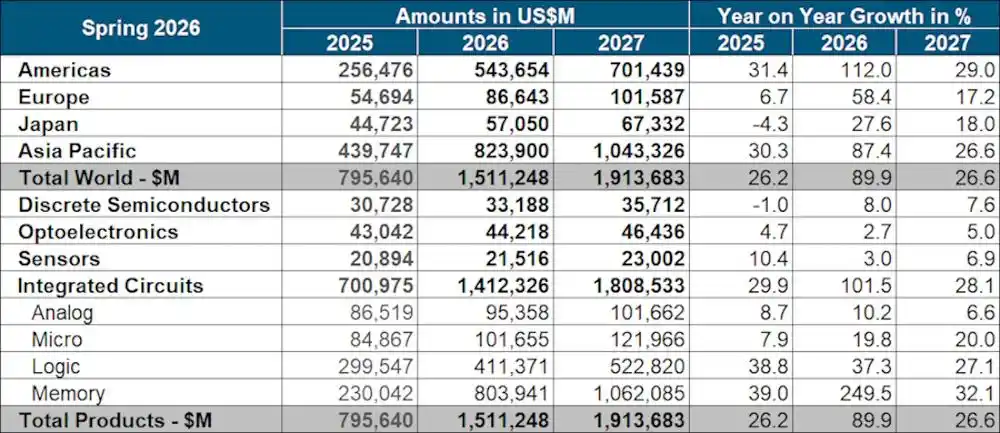
WSTS’s spring 2026 forecast also highlighted the spread across semiconductor categories. It projected the global semiconductor market would grow 90% in 2026 to $1.51 trillion, driven mainly by an about 250% increase in memory. Analog is expected to grow about 10%, discrete 8%, and sensors and optoelectronics about 3%. Analog has entered an upcycle, but it is not the hottest part of the broader semiconductor market in this round.
For now, tight products are concentrated in automotive analog, power management, AI server power chains, optical module analog front ends and some sensors. General-purpose parts, consumer electronics and part of the power and discrete market are still stuck in price competition.
AI is pulling analog chips into the main investment narrative
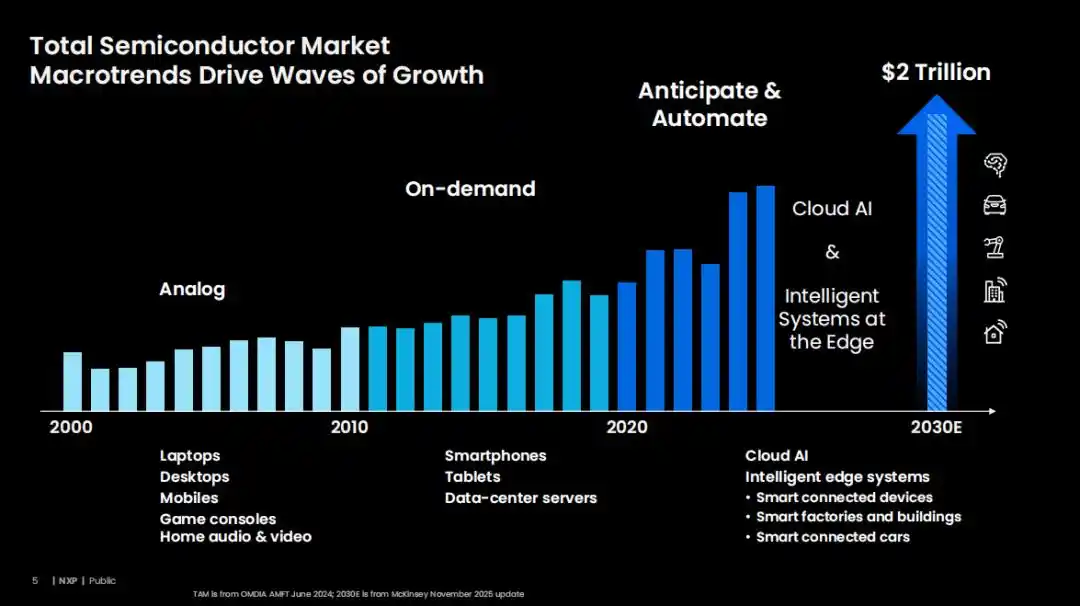
For a long time, AI hardware attention centered on GPUs, HBM, advanced process nodes and high-speed interconnects. As computing clusters push power and density sharply higher, power conversion, thermal management and signal transmission are becoming system constraints. That is moving analog chips from peripheral components toward core bill-of-materials items.
Cloud AI creates the first growth path: data center power supplies, optical modules, energy infrastructure, cooling and environmental monitoring. An AI data center has to convert grid AC step by step into the different voltages needed by GPUs, CPUs, memory and networking chips, while continuously monitoring current, temperature, energy consumption and faults. From AC-DC conversion to intermediate bus, board-level power and point-of-load delivery, each layer uses power management, power devices, current sensing, isolation, hot-swap, temperature sensing and control chips. The higher the compute density per rack, the more complex the power system becomes, and the more analog content value rises per cabinet.
Optical modules require transimpedance amplifiers, drivers, clocks, data conversion and power management. Chinese suppliers have already generated revenue in this chain. Naxin Micro said its AI server power business covers multiple leading customers, with related digital power revenue in the first quarter growing rapidly both year over year and quarter over quarter. Its products are used in both primary and secondary power stages and include digital isolation, drivers, interfaces, sampling and current sensors. The company said its high-voltage GaN driver chips have already shipped in volume, and its medium- and low-voltage GaN integrated products have completed sample testing.
BPS also said its digital multiphase controllers, DrMOS, POL and eFuse products had entered mass production and scaled sales. In 2025, the company’s high-performance computing power chip revenue reached 96 million yuan, up 122.26%, and customers for the next generation of graphics cards started shipping in large volumes. 3PEAK said several optical module chips had reached scaled delivery, while its analog front-end products for high-speed optical modules were supplying customers steadily. SG Micro said revenue tied to optical modules was growing quickly.
The second path comes from Physical AI, meaning AI moving into automobiles, robots and industrial equipment. Robots need to sense their surroundings, control motors, manage batteries and maintain safe operation. Vehicles require radar, sensors, battery management, body control and powertrain systems. Industrial equipment relies on real-time control, predictive maintenance and edge computing. Processors handle computation, while sensors, analog front ends, isolators, motor drivers and power management chips connect that computation to the physical world.
Large international suppliers have laid out clear targets across those two paths. STMicroelectronics raised its 2026 data center revenue target to more than $1 billion and said it expects to exceed $2 billion in 2027. Texas Instruments said data center revenue doubled year over year in the second quarter. NXP described data centers and Physical AI as new growth engines alongside automotive and industrial.
ON Semiconductor President and CEO Hassane El-Khoury said on the earnings release that AI data centers had become the company’s fastest-growing business and that 2026 revenue from the segment was expected to more than double year over year. The company also said it had expanded power supply business within the NVIDIA MGX ecosystem and had won design slots for EliteSiC, silicon MOSFETs and controllers on AI data center platforms from Great Wall, a Chinese cloud infrastructure power supplier.
Still, the benefit from AI has clear limits. What it raises is the content value of analog chips in high-power-density, high-reliability and high-speed signal scenarios. General consumer products are unlikely to benefit to the same degree. Companies exposed to those areas are gaining a growth curve that does not depend on the traditional consumer electronics cycle, and the split in products and profitability is likely to widen with it.
Domestic suppliers expanded product lines, but profit conversion is the next test
In recent years, Chinese analog chip companies have broadly expanded product lines, increased R&D spending and pushed further into automotive, industrial, communications and high-performance power markets.
SG Micro said at a late-July earnings briefing that orders in the second half were higher than in the first half. Supply was normal for most products, though lead times had lengthened for some items where demand was rising quickly. Its broad product and customer mix allows it to capture recovery in industrial, computing and automotive markets at the same time.
Naxin Micro measures product expansion by chip value per vehicle. It said its mass-produced automotive chips can currently cover about 1,700 yuan of value per vehicle, rising to nearly 2,000 yuan when products under sample verification are included. Its long-term goal is 3,000 to 4,000 yuan. The company’s product set now covers the three-electric system, body control and lighting, smart driving and cockpit, and chassis and safety.
3PEAK said its module analog front-end products have moved from development into stable delivery. Automotive audio bus chips are shipping steadily to some carmakers, the power battery BMS AFE has completed customer technical validation, and customized lidar products remain in development and delivery.
Even with inventories bottoming, there is still a timing gap between cost increases and selling prices for domestic analog companies. Naxin Micro has issued a price increase notice and is negotiating with customers. JoulWatt said it would adjust pricing only when cost transmission became necessary. Awinic said it adjusted pricing on some products in the first quarter to defend market share while also absorbing higher mature-node wafer prices, which put pressure on blended gross margin. The company’s stated path to improvement is to raise the share of higher-margin industrial and automotive business. Market recovery tends to reach revenue first. Whether it reaches profit depends on the speed of price increases, product mix and cost control.
This analog chip downturn forced out inventories successively at original manufacturers, distribution channels, Tier 1 suppliers and end equipment makers. In the second quarter, industrial, automotive and data center markets recovered at the same time, inventory levels moved back into normal ranges, and orders began flowing back to chipmakers. Some automotive analog, power management and optical communication products are already showing longer lead times and price increase signals, while general-purpose products and part of the power device market still face supply pressure.
For now, the bottom in analog inventory is becoming visible.
The article was originally published by the WeChat public account “半导体产业纵横” (ID: ICViews) and written by Jiulin.