
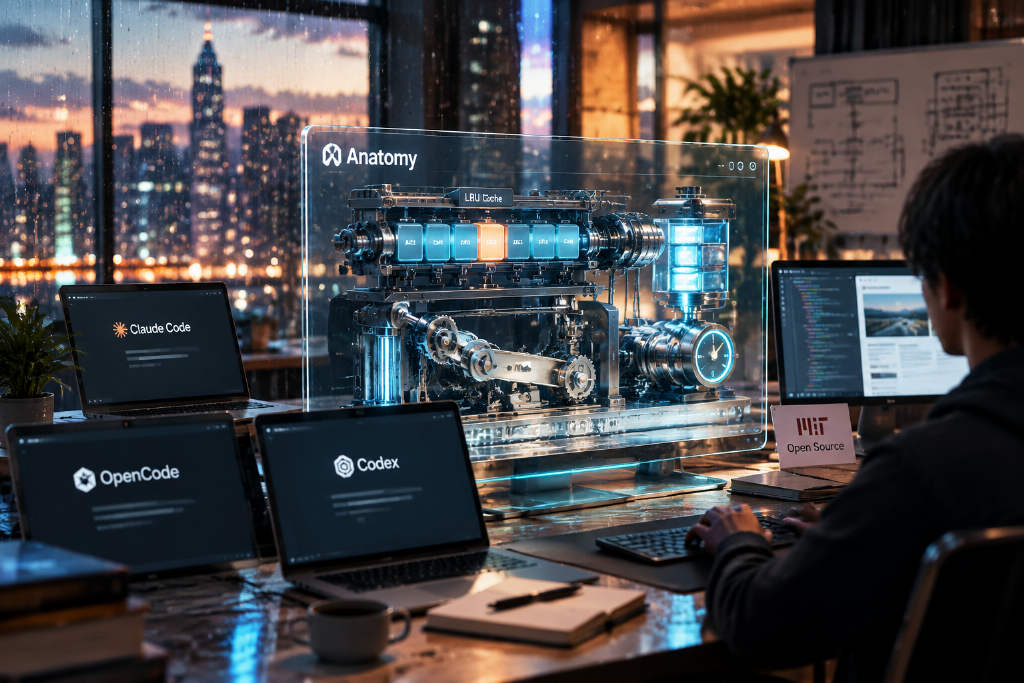
Anatomy goes open-source, turning one-line prompts into interactive machines that explain technical concepts

Anatomy goes open-source, turning one-line prompts into interactive machines that explain technical concepts

N
News Editor
2026-10-12 08:36:56
Developer Ryan has open-sourced Anatomy, an AI drawing skill that currently works with Claude Code, OpenCode, and Codex. The tool lets users describe a technical concept in a single sentence, then generates a machine whose moving parts visually explain how that concept works. The resulting output is interactive, with support for mouse and keyboard input, and can be edited as web code, opened on its own, or embedded into a website. Examples shown so far include an LRU cache represented as a bookshelf that moves books, a mechanical watch that can be wound and disassembled, and a Raptor rocket engine used on SpaceX Starship that can be split into 11 component groups and simulate ignition. Anatomy first studies the underlying principles and parameters, then designs parts, draws graphics, and adds animation. Motion and numerical readouts are driven by the same computational model, so they update together during interaction. The project also includes automated checks for issues such as part overlap and occlusion errors. Ryan has packaged existing works into a component library for developers, and the project is available under the MIT license. The developer said detailed builds still take time: the mechanical watch took nearly two hours, while the Raptor engine took more than 10 hours. Its 3D feature remains in testing.

Developer Ryan has open-sourced Anatomy, an AI drawing skill that currently supports Claude Code, OpenCode, and Codex. Users can describe a technical concept in a single sentence, and the system will design a machine on its own, using moving parts to show how the concept works. The generated pieces are also interactive and can be controlled with a mouse or keyboard.

How Anatomy builds the visuals

According to the description, Anatomy first studies the relevant principles and parameters, then designs the parts, draws the graphics, and adds animation. The motion on screen and the numerical readouts are driven by the same computational model, so both update together during user interaction. It also includes automated checking tools to catch issues such as parts intersecting each other or visual occlusion errors.

33 featured works are already on display

One example is an explanation of an LRU cache, where the least recently used data is cleared first. For that case, the AI designs a bookshelf that moves books around. To explain how a mechanical watch works, it can generate a mechanical device that can be wound, speed-adjusted, and taken apart gear by gear. More complex examples include the Raptor rocket engine used on SpaceX Starship. That model can be broken into 11 groups of components and can also simulate ignition. The official site currently shows 33 main works.

Editable web output and reusable components

The final output is editable web code that can be opened as a standalone page or embedded into a website. Ryan has also packaged existing works into a component library so developers can use them directly. The project has been released under the MIT license.

Detailed builds still take significant time. Ryan said the mechanical watch took nearly two hours to make, while the Raptor rocket engine took more than 10 hours. The 3D feature is still in testing.


This article was originally published by Bit.Fan. For more cryptocurrency news and market insights, visit www.bit.fan.
6500

Disclaimer:

The market information, project data, and third-party content displayed on this platform are for industry information sharing only and do not constitute any form of investment advice or return commitment.

Cryptocurrency trading carries high risks. Users should fully assess their risk tolerance and make independent decisions. All profits, losses, and legal responsibilities are borne by the users themselves.

Anatomy goes open-source, turning one-line prompts into interactive machines that explain technical concepts | Bit.Fan
