

Anthropic’s economics team, together with scholars from the Massachusetts Institute of Technology and Stanford, has released three scenarios for the US economy in 2030, focusing on how artificial intelligence could affect growth, employment, wages, and income distribution.
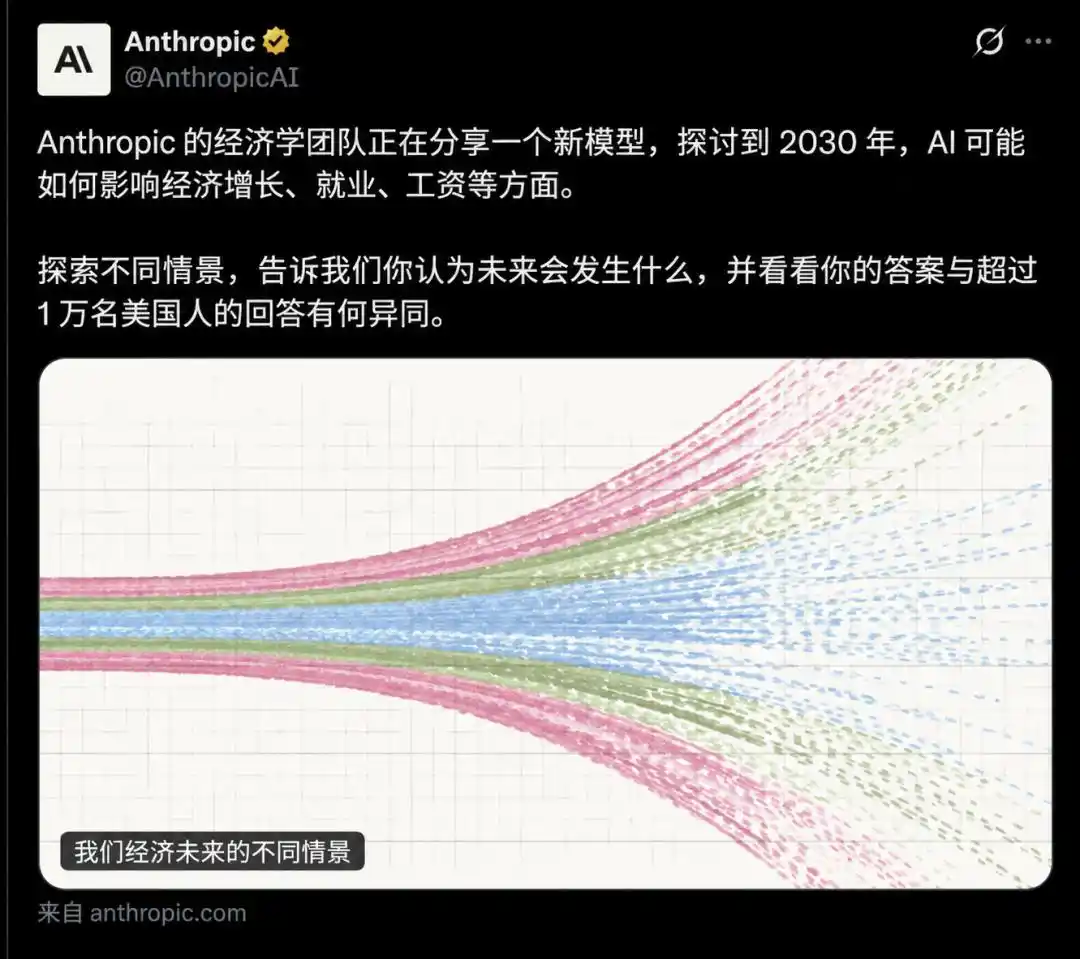
The sharpest outcome in the report is stark. US GDP rises by more than 32% versus baseline by 2030, while unemployment among knowledge workers reaches 17.9%, and capital captures close to 55% of the gains. Anthropic also worked with Morning Consult on a survey of 10,980 US adults. The median response landed around the second scenario and tilted slightly toward the third, with nearly 10% of respondents endorsing the most extreme case.
How the three scenarios were built
The team said it used a task-based labor model, breaking down a large set of occupations from the US Department of Labor into thousands of smaller tasks. It then assessed which tasks AI could enhance, which it could fully replace, and which remained outside its reach.
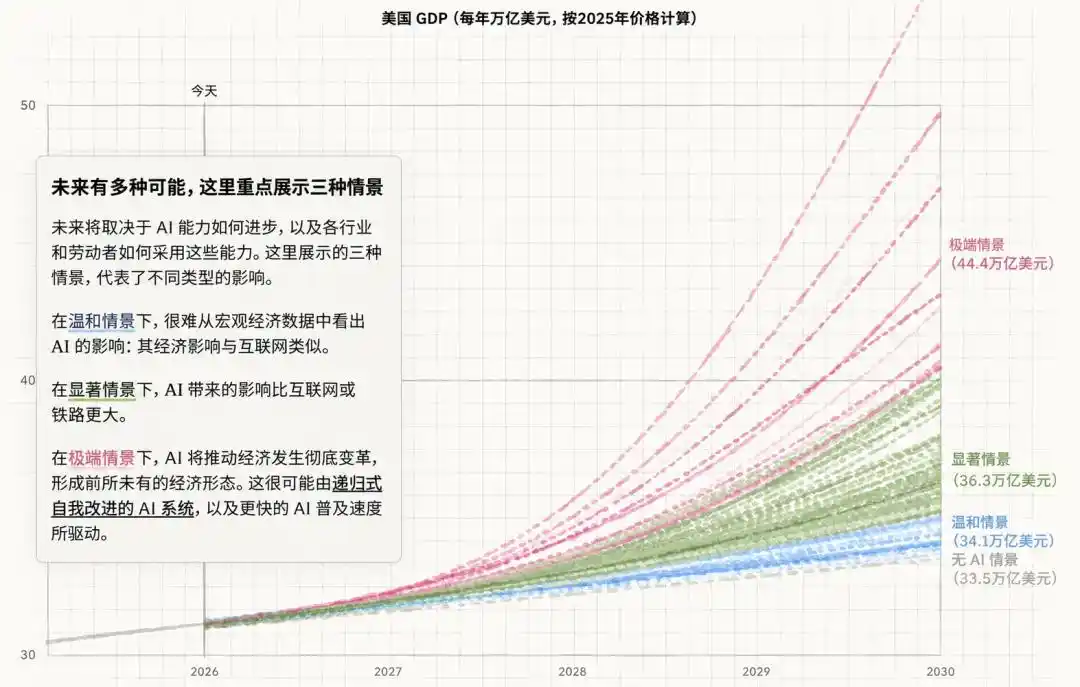
From there, the researchers mapped three paths to 2030 based on different assumptions about technical progress and deployment speed: a mild scenario, a significant scenario, and an extreme scenario. The report shifts attention away from benchmark scores and toward practical measures such as GDP, unemployment, wages, and the split between labor and capital income.
Mild scenario: 1.6% extra GDP growth and little labor-market disruption
In the mild case, AI adoption runs into real-world friction, including compute bottlenecks, regulatory limits, and rigid corporate structures. Anthropic compares the productivity effect here to the internet in the 1990s.
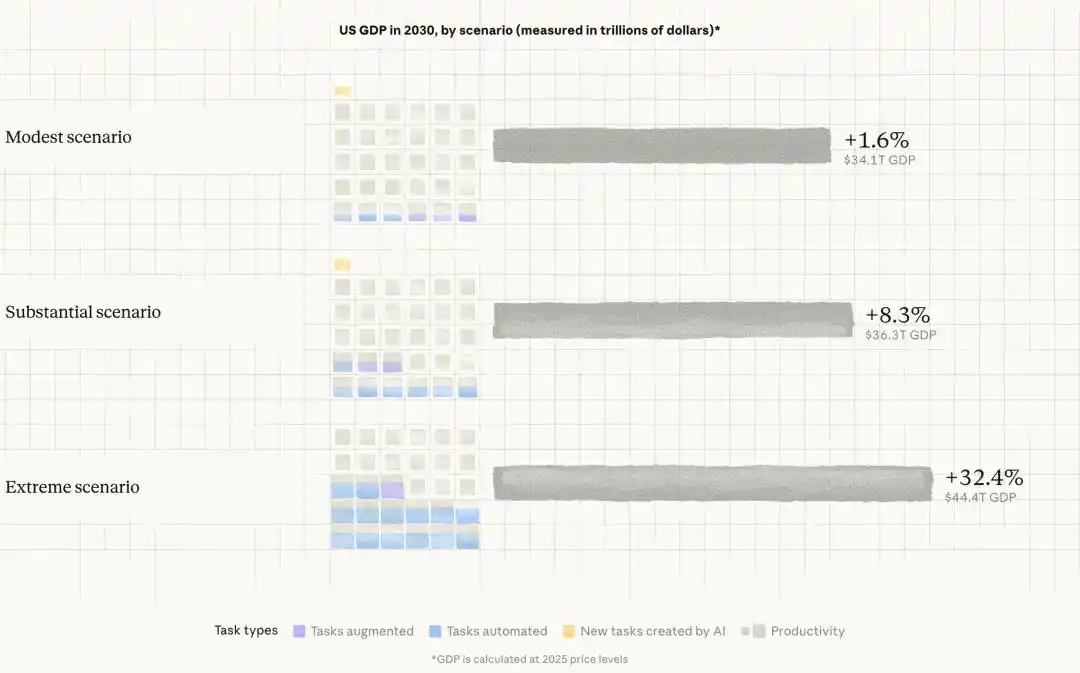
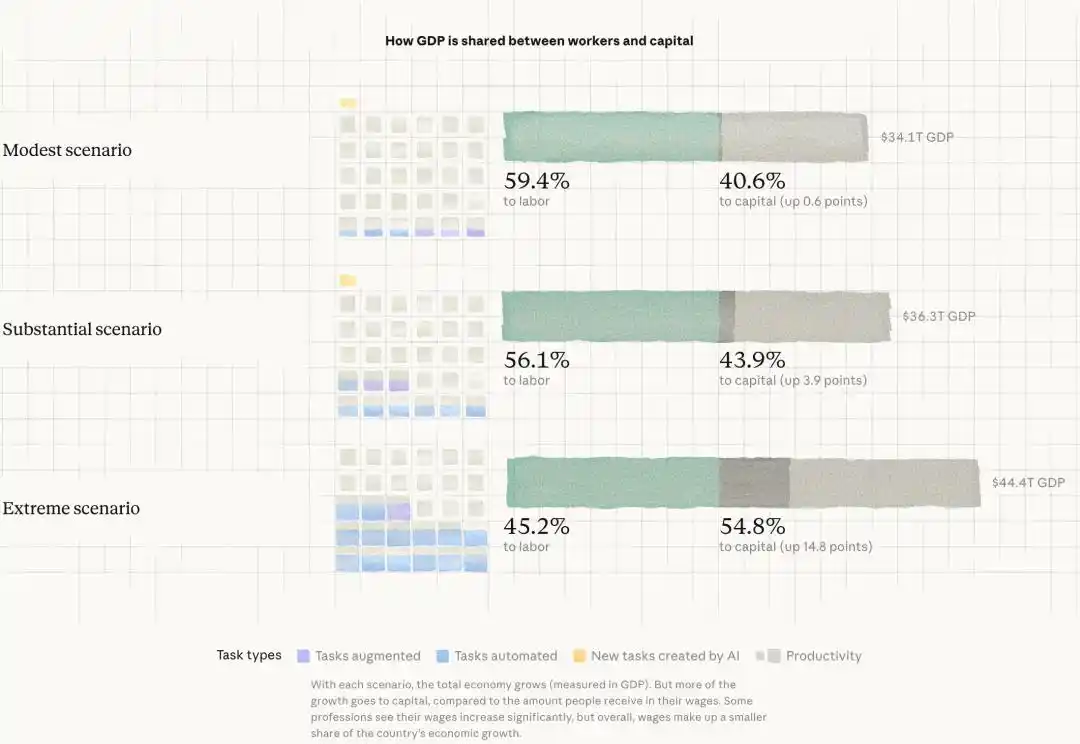
Under that scenario, AI adds about 1.6% to US GDP by 2030, taking the economy to $34.1 trillion. Labor-market conditions change only slightly. Overall unemployment rises by just 0.1%, and labor income remains around 60% of national income.
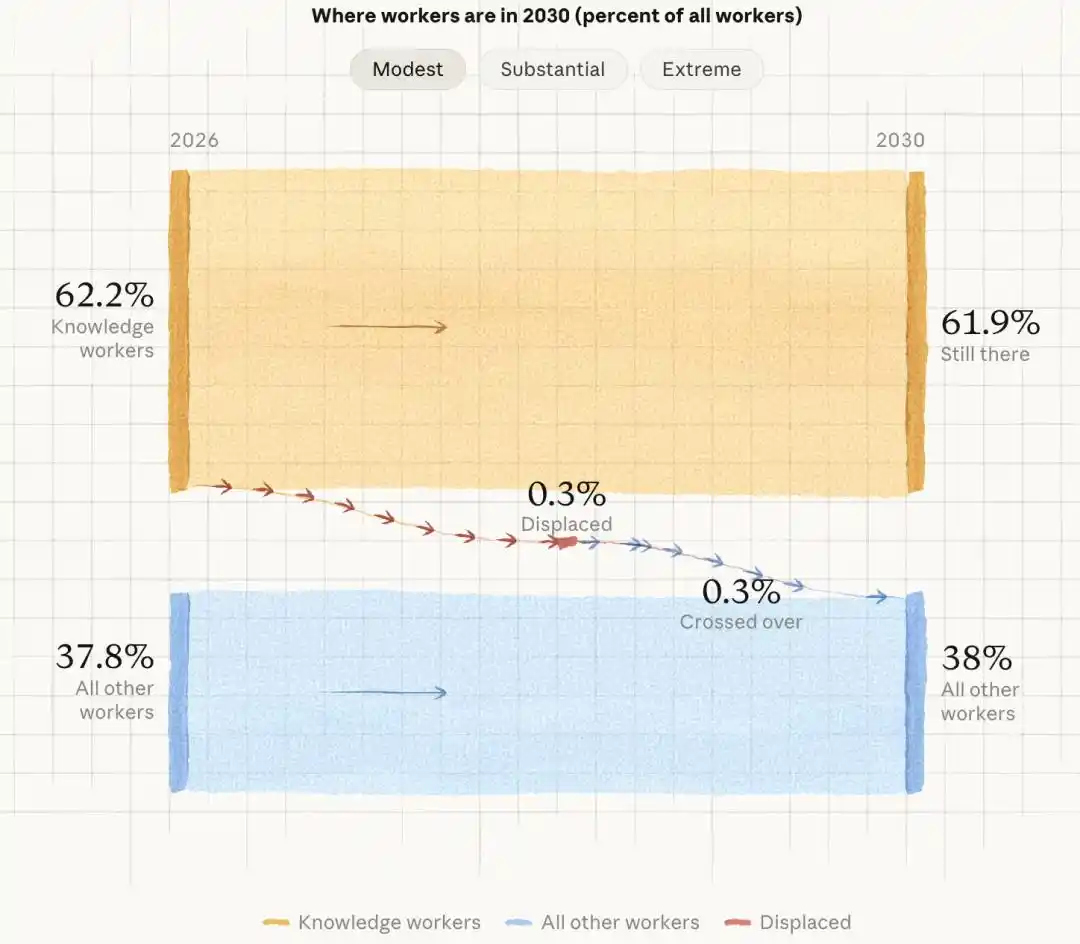
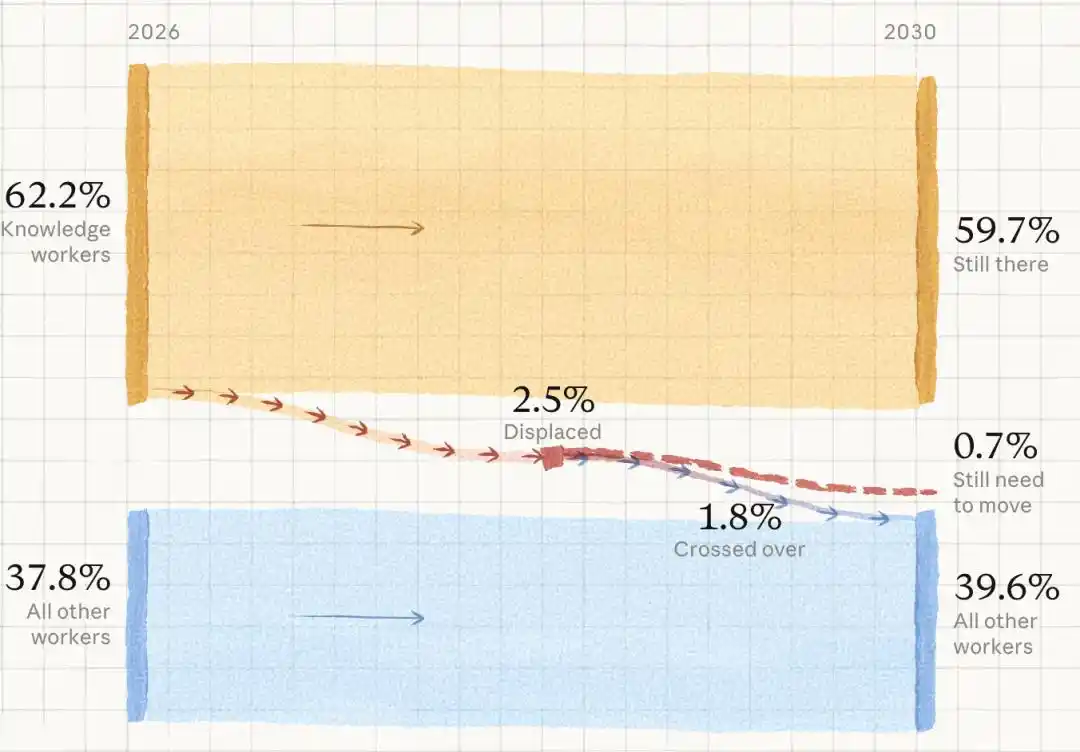
The report adds that only 0.3% of knowledge workers would switch into other industries. In this version of 2030, AI looks more like an upgraded Office suite: widely used, but not a force that removes jobs at scale.
Significant scenario: white-collar wage stagnation, stronger pay for in-person work
In the second scenario, AI moves beyond assistance and becomes a direct substitute for a large share of cognitive work. The report says AI systems in this case can independently complete nearly half of human knowledge tasks, including basic coding, routine legal contract review, financial auditing, entry-level copywriting, and data analysis.
By 2030, AI contributes an additional 8.3% to GDP in this scenario, lifting the economy to $36.3 trillion. Productivity rises sharply and firms become much more efficient.
The gains are uneven. Wages for knowledge workers are close to flat, and hiring demand for cognitive roles shrinks by about 4%. The report points to entry-level analysts, copywriters, and ordinary programmers as examples of jobs under pressure.
At the same time, blue-collar and in-person service roles do not follow the same path. Pay rises for plumbers, electricians, heavy machinery operators, nurses, and elder-care workers. The report’s logic is that physical work and emotionally intensive care remain difficult for AI and robots to absorb in the near term, while higher overall wealth increases demand for those services.
Extreme scenario: GDP up more than 32%, knowledge-worker unemployment at 17.9%
The third scenario is the most aggressive. Anthropic says AI in this setting crosses a threshold where most cognitive labor is fully taken over, operating at near-zero marginal cost in data centers around the clock.
The macroeconomic result is extraordinary growth. Annualized GDP growth reaches 15%, the US economy expands to $44.4 trillion by 2030, and output rises by more than 32% versus baseline. The report says the economy would double roughly every 4.5 years.
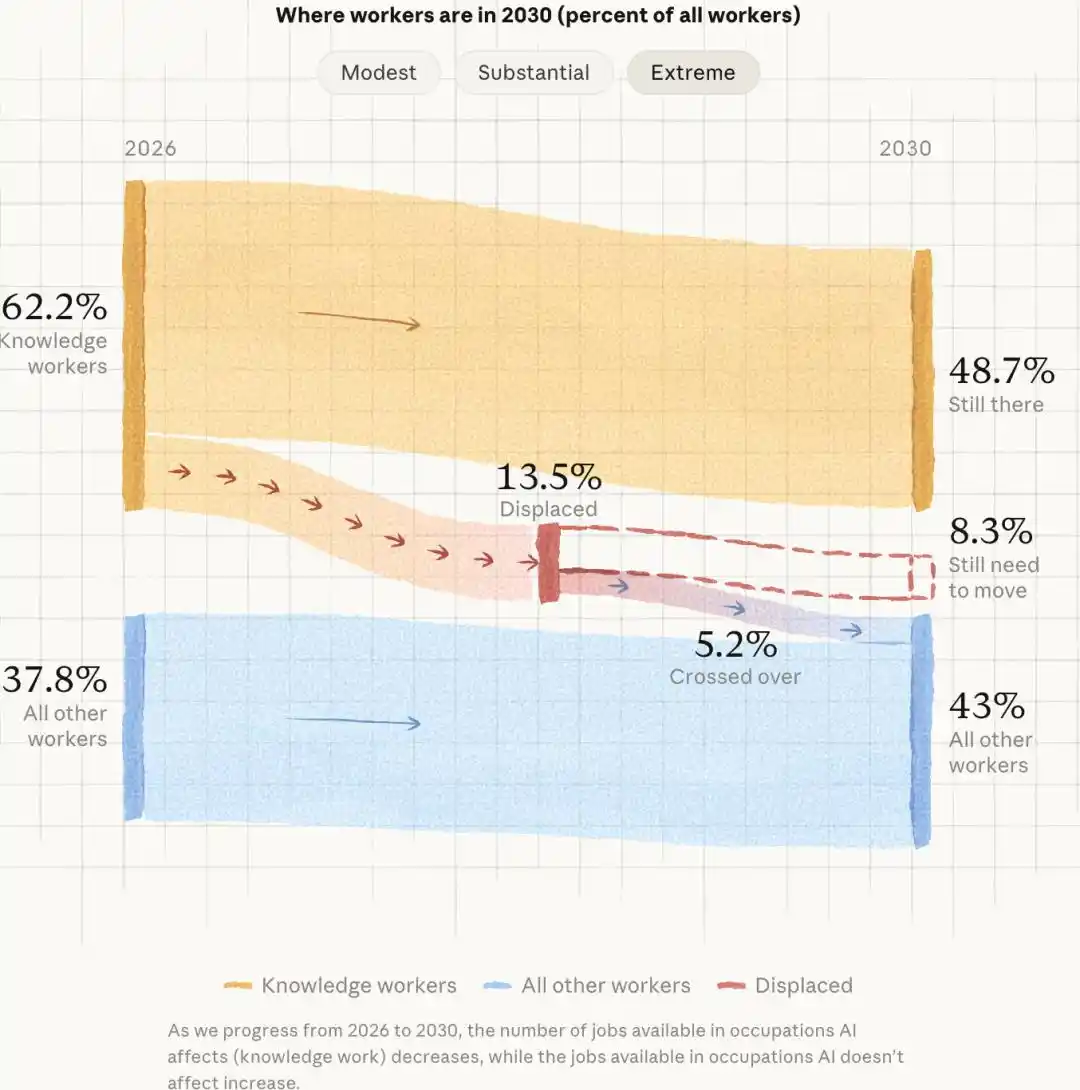
The labor-market and distribution effects are severe. Unemployment among knowledge workers climbs to 17.9%. Some 13.5% of white-collar jobs are replaced, and 8.3% of knowledge workers may have to fully transition into other lines of work. Even those who remain employed see wages fall by more than 10%.
The income split changes as well. Labor’s share of total income drops from nearly 60% to 45.2%, while capital’s share rises from 40% to close to 55%. The report’s implication is clear: the economic pie gets larger, but control over how it is divided shifts toward owners of compute, models, and core capital.
Survey of 10,980 adults points closer to scenarios two and three
To gauge public expectations, Anthropic and Morning Consult surveyed 10,980 adults across the United States.
The median expectation fell within the range of the second scenario and leaned somewhat toward the third. Nearly 10% of respondents directly backed the most extreme version. In the source article’s framing, that suggests many workers are already seeing warning signs through hiring slowdowns and cost-cutting mandates.
The report also highlights a reversal from the pattern seen over the past two centuries. Machines historically replaced physical labor first, often benefiting knowledge workers. In the AI era, the report argues, highly cognitive and information-processing jobs may be easier to automate, while work that requires physical presence, hands-on execution, and direct human interaction remains harder to replace for now.
Anthropic says the work is meant to inform policy
Anthropic said it plans to use the findings to support policy research aimed at making AI-driven gains more broadly shared. At the end of the report, the team wrote: 「Our goal is not to create panic, but to help society see the direction of policy and distribution before the future hardens into place.」
The source article argues that when a leading AI lab that makes money from large models starts talking about broad distribution of AI gains and pushes policymakers to study redistribution mechanisms, the central question is no longer only whether AI can do the work, but who benefits once it does.
The report feeds a wider redistribution debate
The article says the extreme scenario would point to a more polarized outcome, with a small group controlling models, compute, and capital on one side, and a large pool of middle-class workers losing pricing power over their labor on the other.
Against that backdrop, debates over an AI windfall tax, public dividends tied to compute assets, and universal basic income, or UBI, are moving from the edge of academic discussion into mainstream policy work. Anthropic’s scenario exercise is presented as a quantitative frame for that debate.
What the source article says individuals should watch
The source article closes by noting that only about four years remain until 2030 and offers several takeaways for individuals: rely less on work centered on pure knowledge storage and processing, move closer to the physical world and trust-based human relationships, and pay more attention to ownership of assets and compute rather than depending only on labor income.
The Chinese source article was published by the WeChat account Xinzhiyuan, credited to ASI Qishilu and edited by David. It cited an Anthropic webpage and a PDF report as reference materials.