
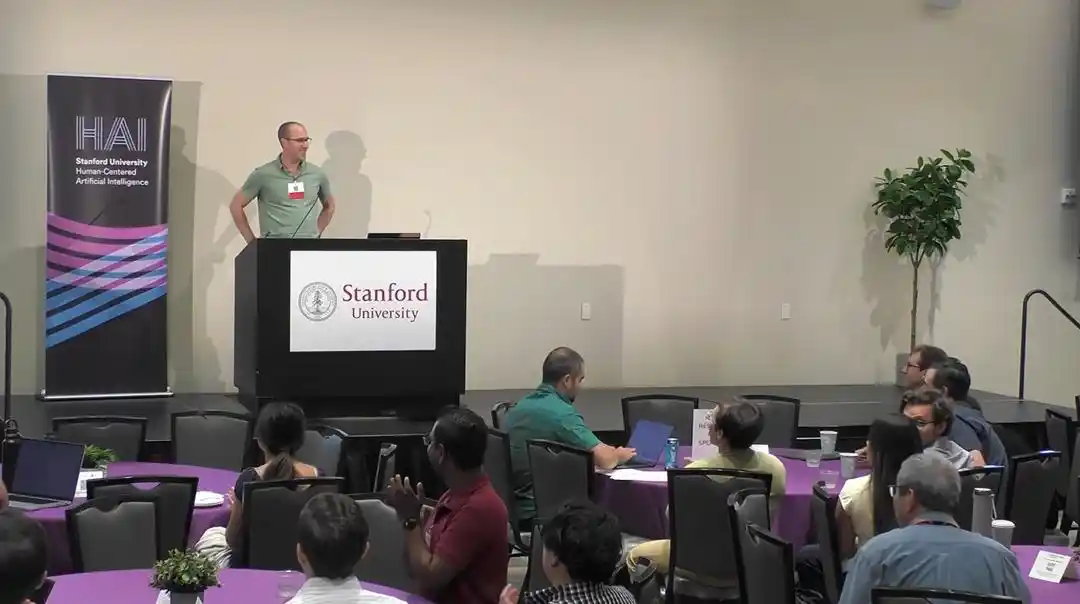
Anthropic researcher Jascha Sohl-Dickstein told an audience of top PhD students that conventional career planning may no longer make sense if artificial general intelligence, or AGI, is approaching on the timeline many in the field now discuss.

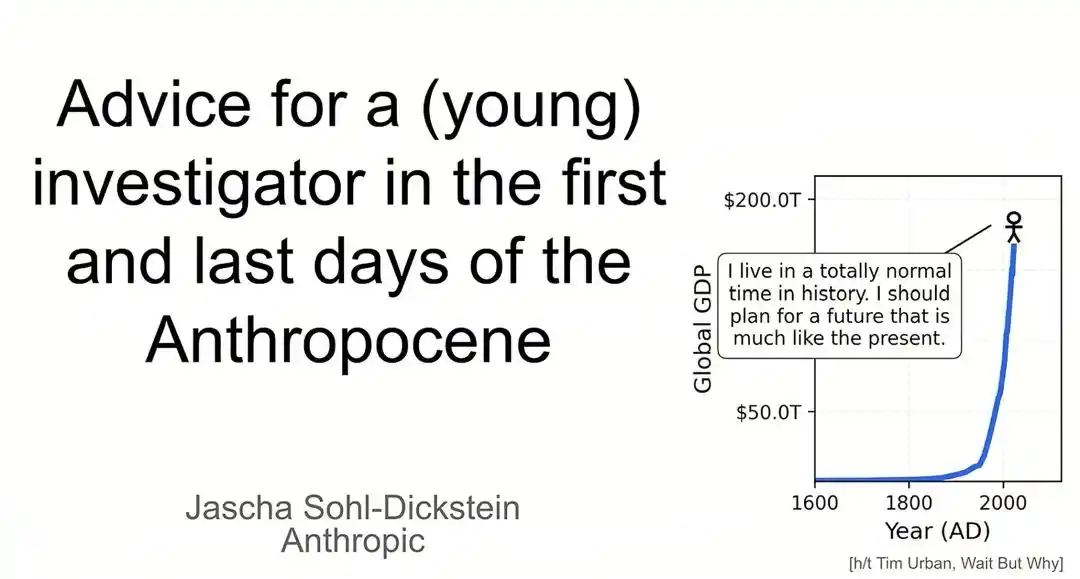
In a talk titled The End of the Anthropocene, Sohl-Dickstein built that case with a string of technical claims and projections. His central point was simple: people tend to imagine the future as a linear extension of the present, while AI progress is moving on an exponential curve and humanity is still near the beginning of it.
From linear intuition to exponential curves
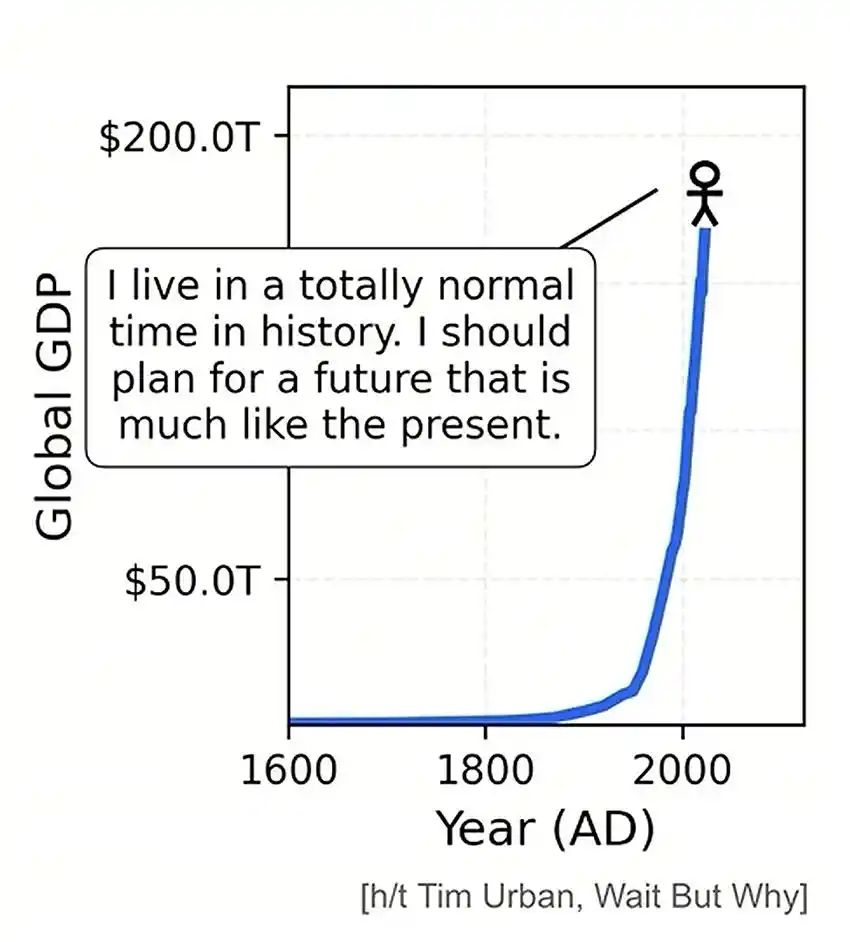
At one point in the presentation, Sohl-Dickstein pointed to a chart of GDP over time to illustrate what he described as a "linear illusion." Someone standing near the top of the curve, he said, may feel the world is normal and the future will look like a straightforward continuation of the present. In his view, that assumption breaks down once exponential growth takes over.
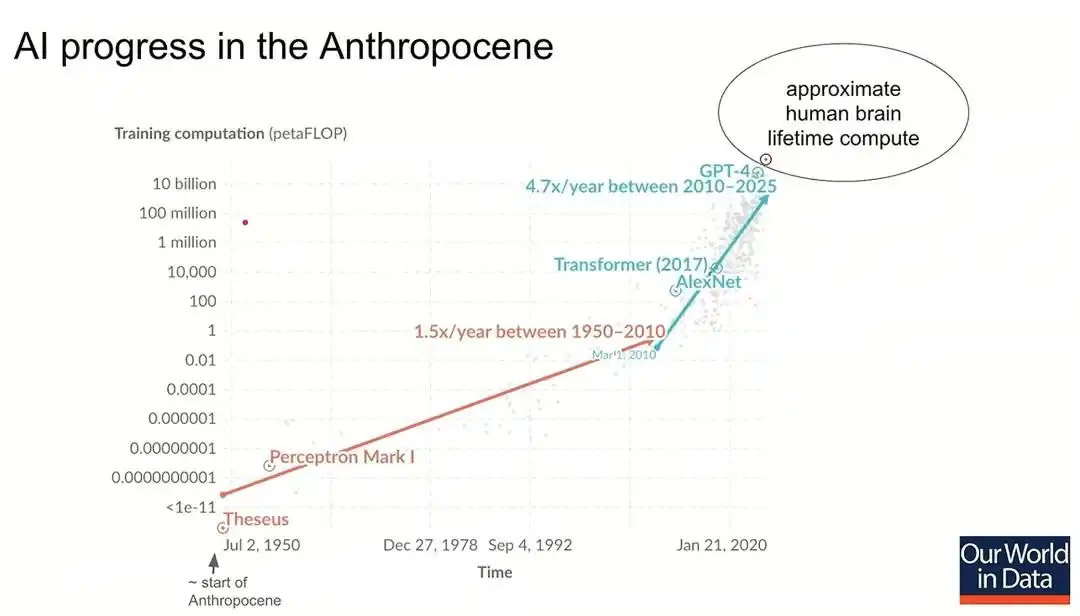
He then turned to AI training compute. Over the past decade, he said, the amount of compute used to train frontier models has increased by 10 million times. He also marked what he described as an upper bound on the total computation performed by a human brain over a lifetime, putting that figure at roughly 1 trillion petaflops. On his telling, AI training runs are now approaching, and in some dimensions exceeding, that benchmark.
The time span of tasks AI can complete is stretching fast
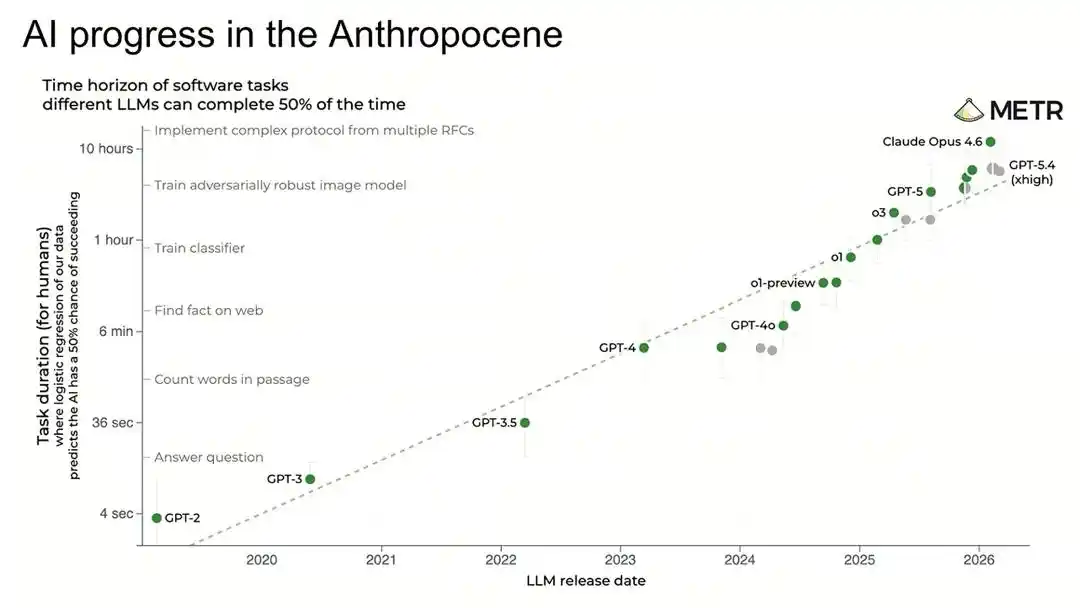
Sohl-Dickstein also showed a chart on AI performance across software tasks. The relevant time scale, he said, is not how quickly a model finishes a task, but how long a human would normally need to complete the same software work.
By his account, the duration of tasks that AI can complete independently with a success rate above 50% has been rising exponentially. Less than a year ago, when he gave a similar talk, he expected models would not be able to handle the equivalent of a full day of a software engineer’s work until 2026 or 2027. Now, less than a year later, he said that metric has increased tenfold and has already crossed that threshold.
His rebuttal to the "training set only" argument
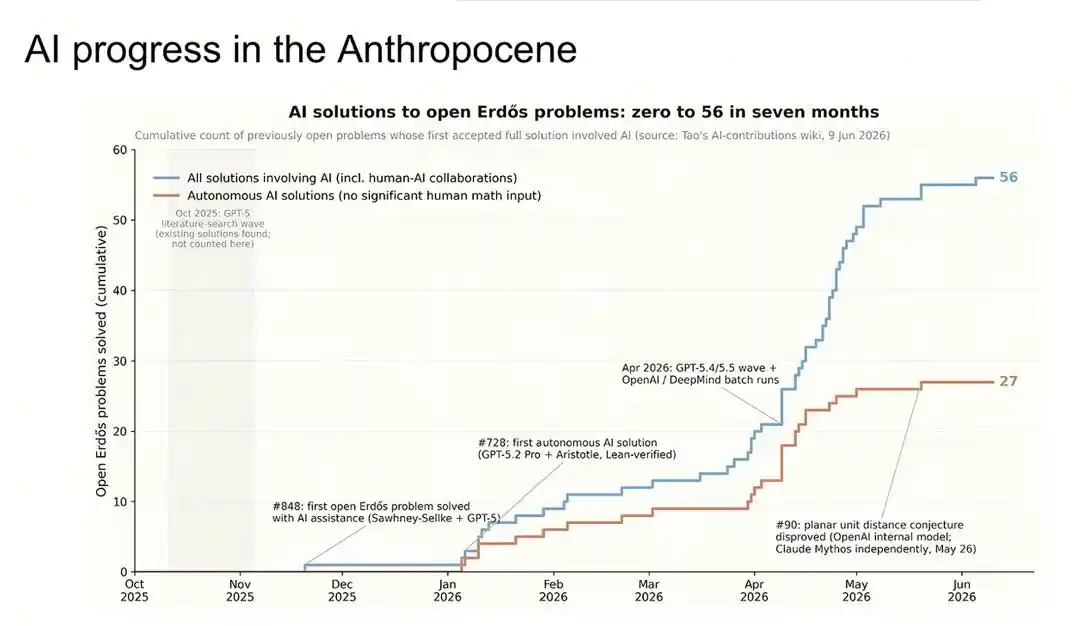
Sohl-Dickstein pushed back on a common reassurance about AI: that models lack real creativity and can only solve problems they have effectively seen before. He cited the unresolved mathematical conjectures associated with Paul Erdős and said that, over the past seven months, AI models have begun solving some of those hard problems.
He presented that as evidence that AI is not merely repeating patterns from a training set, but pressing against the boundary of known mathematics.
AGI timelines in Silicon Valley, in his telling, have compressed to years
He said that within Silicon Valley’s core technical circles, the working assumption is that AGI arrives within years, not decades. Even people who describe themselves as conservative on the timeline, he said, often mean only that AGI will come within 10 years.
Sohl-Dickstein added a striking projection of his own: by 2030, global available compute will be 10,000 times the 2025 level. In his framing, humanity has not even passed the bend in the steep part of the curve yet and remains at the start of the exponential climb.
"The end of the Anthropocene" and a shifting Overton window
In the talk, Sohl-Dickstein extended the idea of the Anthropocene beyond geology. In the geological sense, human activity has already altered the planet so deeply that radioactive isotopes from nuclear explosions may remain in the strata billions of years from now as evidence that humans once existed.
His argument was that the Anthropocene as an era shaped primarily by humans as the dominant intelligence may be brief.
He said that less than a year ago, after giving a similar talk at Harvard, he received a hostile email calling the idea insane. He used the sociological term "Overton window" to describe what has changed since then. A year ago, he said, publicly arguing that AGI was close and humans could be displaced sat outside the range of views many people considered acceptable. Now, he said, that discussion has become much more ordinary.
To show how far that shift has gone, he listed remarks from political and technology figures. U.K. Prime Minister Rishi Sunak said, "The race for AGI that can exceed human cognitive abilities is of fundamental importance." Barack Obama said, "AI is more disruptive than mobile technology, and it is arriving faster. It is replacing what we think of as high-end cognitive labor." Former Google chief executive Eric Schmidt was quoted as saying, "Within three to five years, we will see AGI as smart as the very best humans; within six years, superintelligence beyond the sum of all humans will appear. Society is not prepared."
A blunt message for PhD students
Sohl-Dickstein’s conclusion for the students in the room was direct: their existing PhD career plans may already be over.
He described a conversation with a doctoral student who agreed AGI might arrive within three years, yet still planned to finish the PhD in two years, do a postdoc, and then apply for a faculty job. Sohl-Dickstein said he found that logic hard to process.
"I don’t know what academic work will look like in 10 or 20 years," he said. "I don’t even know what any work will look like in 10 years, but I am very sure it will not look like it does today." In his view, that uncertainty cuts across fields rather than stopping at any one discipline.
Three rules he offered for researchers and workers
1. Work on things that scale with compute
Sohl-Dickstein invoked the well-known "bitter lesson" in AI: general methods that can absorb more compute tend to beat carefully designed human-crafted approaches in the long run.
His warning was practical. The outcome to avoid, he said, is spending two years making linear progress on a problem only to watch someone else write a prompt for a large model and get a better result before the work is finished. That means reshuffling research priorities, dropping topics likely to be crushed by scalable compute, and moving toward areas that become stronger as compute grows.
2. Stop treating stable careers as real safety
He argued that many people make life choices by giving up upside in exchange for lower perceived risk, such as aiming for institutional stability or tenure. But if AI triggers large-scale social restructuring, he said, the baseline level of risk in society is already too high to escape. In that case, what looks like a safe choice may not be safe at all; it may simply sacrifice upside without buying meaningful protection.
His answer was not caution for its own sake. If there is no true retreat, he said, people may as well pursue work that is genuinely interesting and carries high risk with high reward.
3. Get on the exponential curve
Sohl-Dickstein said he works with Claude every day and described the experience as having an extremely eager, highly talented super-graduate student whose research taste is still imperfect. He added that he no longer writes code himself.
His advice was to force daily use of AI tools, treat them like subordinates, and practice defining tasks and communicating expectations clearly. People who do not use AI, he said, risk being left far behind by the curve.
He paired that with a warning: "Writing is thinking. Please don’t let AI write your first draft. You can let it help you find mistakes. But if you outsource the writing, you outsource the thinking."
Why he still thinks individuals have leverage
For all the severity of the talk, Sohl-Dickstein did not argue that individual choices no longer matter. He said the opposite: because the world is still very early on the exponential curve, individuals retain unusual leverage.
He pointed to historical examples where small decisions early in a technological wave had lasting effects. In 1980, two scientists standardized the protocol for email, making modern email possible. Messaging software was standardized a decade later, and the result, he said, is that walls still stand between different apps. The inventors of the Haber-Bosch process made it possible for Earth to feed billions of people while also enabling the production of the deadliest explosives.
In that frame, seemingly narrow choices can carry outsized consequences: what problem to study, whether to describe a technology as a capability or a risk, and whether to support open-source or closed systems. At this stage, he said, those decisions can ripple through future business, social, and political structures.
A short golden age, then a loss of human uniqueness
Sohl-Dickstein ended with a picture of the future that mixed opportunity with decline. In the near term, he said, there may be a brief golden age in which humans act as complements to large numbers of agents and unlock what those agents can do. In that period, a person might achieve in a week what once would have taken an entire career.
After that, he said, a period is likely to arrive when humans no longer possess any uniquely valuable direction that AI cannot replace, and no longer unlock intellectual work that AI cannot do on its own.
He closed with a line that captured both the urgency and the melancholy of the talk: "So please enjoy this last golden age that is still led by humans." He followed it with a more speculative flourish, urging the audience to do things they could one day look back on with pride "from a Dyson-sphere villa wrapped around the sun."
The talk referenced in the article is available on YouTube. The original Chinese write-up was published by the WeChat account Xinzhiyuan, written by Aeneas.



