
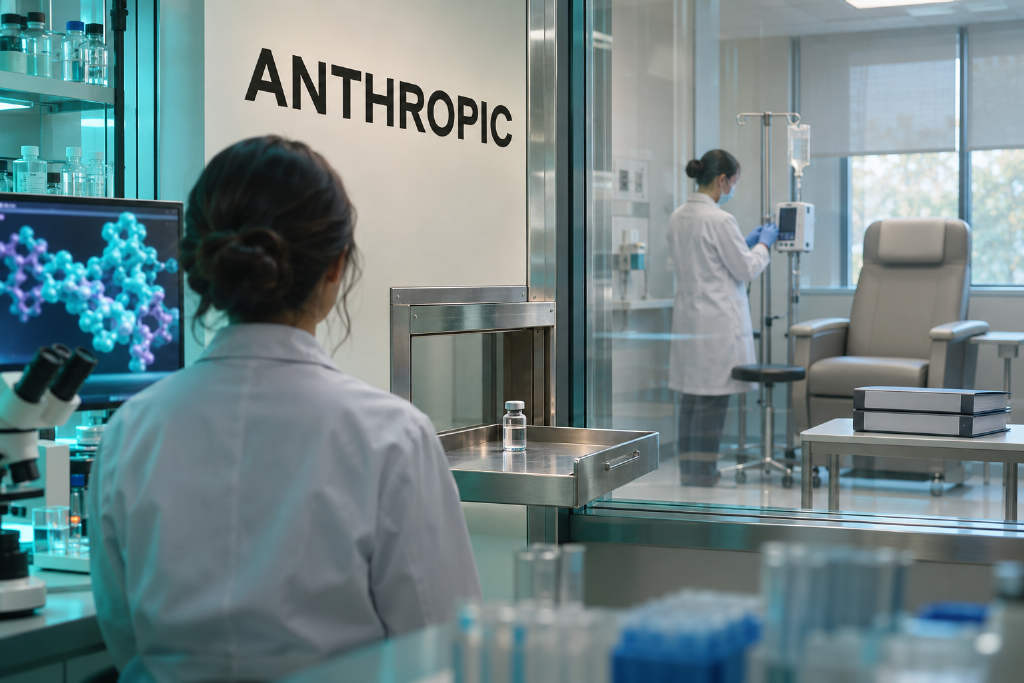
Anthropic CEO Dario Amodei said in an IPO roadshow video released on Nov. 10 that cancer, Alzheimer’s disease, heart disease and mental illness could become diseases of the past in less than 10 years. The statement was notably stronger than the language in the company’s written IPO materials.
A public letter from Anthropic’s founder to investors said only that AI could potentially cure those diseases. It did not set a deadline. The practical timetable for drug development is also longer than the roadshow claim suggests: a new medicine takes an average of 10.5 years to move from the beginning of human trials to approval, and the AI-designed drug that has advanced the furthest has only recently reached Phase 3.
The roadshow claim went beyond Amodei’s earlier wording
Amodei made a related forecast in his 2024 essay, “Machines of Loving Grace.” He wrote that AI could compress 50 to 100 years of biomedical progress into five to 10 years. His clock, though, was meant to start after the arrival of “powerful AI,” not necessarily from the present day.
Amodei defines powerful AI as a system that is more intelligent than Nobel laureates in most fields and can independently complete tasks that would normally take people days or even weeks. He has said such a system could arrive as early as 2026, though it could also come much later.
The four diseases in the essay were described with separate qualifications. For cancer, the forecast concerned eliminating “most” cancers, leaving open the possibility of rare and difficult-to-treat forms. For Alzheimer’s disease, the focus was prevention; brain damage in people who already have the disease could be difficult to reverse. Heart disease was discussed in terms of “improved treatment,” while “most” mental illnesses were described as potentially curable.
The IPO filing also framed the prediction as a condition. Decades of scientific progress could be compressed into a few years only if powerful AI were applied to the hardest problems and its risks were controlled. During a June appearance at Anthropic’s science event, Amodei told a STAT reporter in an on-stage interview that the company still could not make progress equivalent to 10 years in a single year.
The roadshow video presented a less qualified version. It turned “most,” “prevention” and “improved treatment” into the broader phrase “become diseases of the past,” and treated the timeline as if it began today rather than after powerful AI emerged.
Clinical development makes a ten-year timeline difficult
Clinical testing is divided into three stages. Phase 1 focuses mainly on safety. Phase 2 begins to test whether a drug works. Phase 3 enrolls a larger number of participants and provides the final confirmation before approval.
The Biotechnology Innovation Organization, or BIO, examined 12,728 drug-development programs from 2011 through 2020. Only 7.9% of drugs that entered Phase 1 eventually received approval from the US Food and Drug Administration. The rate for cancer drugs was lower, at 5.3%. The average time from Phase 1 to approval was 10.5 years, excluding research conducted before a drug entered human testing.
Using that average, a drug entering Phase 1 today would reach the market around 2037. The estimate is not a forecast for any individual medicine, but it illustrates why a ten-year window is difficult even after a candidate reaches human trials.
The most advanced AI-discovered drug is rentosertib, developed by Insilico Medicine. AI identified both the drug’s target and its molecule. The drug is being developed for idiopathic pulmonary fibrosis, a lung disease rather than cancer. Insilico announced the start of a Phase 3 trial in July and dosed the first participant in September. No country has approved rentosertib so far.
AI-designed molecules have shown stronger results in early testing. A 2024 analysis by researchers at Boston Consulting Group found that molecules identified by AI had a Phase 1 success rate of 80% to 90%, compared with a historical range of 40% to 65%. Their Phase 2 success rate was about 40%, close to the historical average. The sample included only more than 20 molecules, limiting what can be inferred from the comparison.
The figures suggest that AI-selected molecules may be more likely to clear the safety stage. They do not yet show a clear improvement in whether a medicine works in humans. Many drug candidates fail at that point, during the efficacy testing in Phase 2.
Karl Lauterbach, a former German health minister and epidemiologist, wrote on X that AI would certainly help with these diseases but that curing them within 10 years was not possible.
What the evidence supports
There is a defensible basis for the broader direction of Amodei’s argument. Cancer mortality in the United States has already been falling. The American Cancer Society says the US cancer death rate has dropped 34% from its 1991 peak. By 2023, the cumulative number of deaths avoided was about 4.8 million, with smoking cessation, earlier screening and treatment advances cited as the main drivers.
The burden remains large. The United States is still expected to record 626,140 cancer deaths in 2026. The more immediate opportunity for AI is to make the existing downward trend steeper, rather than to establish that cancer will disappear within a fixed period.
AI is also speeding up the earlier stages of research. Claude mined 1.9 billion pieces of data and found an enzyme similar to the gene-editing tool CRISPR. Its hit rate for designed proteins reached 35%. Those results remain preclinical, before testing in humans, while the trial stage is the part of development that usually takes the most time.
For a ten-year timeline to work, Amodei has pointed to several requirements. Powerful AI would have to appear first. It would need to produce medicines with large enough effects to make trials smaller and faster; he has cited the nine-month approval process for COVID-19 mRNA vaccines as an example. Drug candidates would also need to be developed in parallel at much larger scale.
In June, he identified three reasons the company could not yet make a year of work equal to 10 years of progress: the models need to improve, researchers need to learn how to use them, and infrastructure and regulation need to change with the technology.
Those conditions have not yet been met. Anthropic acquired a rare muscular atrophy drug being developed by a one-person pharmaceutical company and is developing it directly. The drug is not expected to enter human testing until 2028 at the earliest. At the average development pace, approval would come in the late 2030s.



