

Compute efficiency falls back in the third quarter
Anthropic’s updated prospectus has put a specific operating metric at the center of its IPO discussion: how much revenue the company generates for each dollar spent on compute and infrastructure. Chiltern Capital calculates the figure by dividing quarterly revenue by compute and infrastructure costs, including spending on both training and inference. In the third quarter of 2026, Anthropic generated about $17 billion in revenue against roughly $9.9 billion of compute costs, producing approximately $1.72 of revenue for every $1 spent on compute.
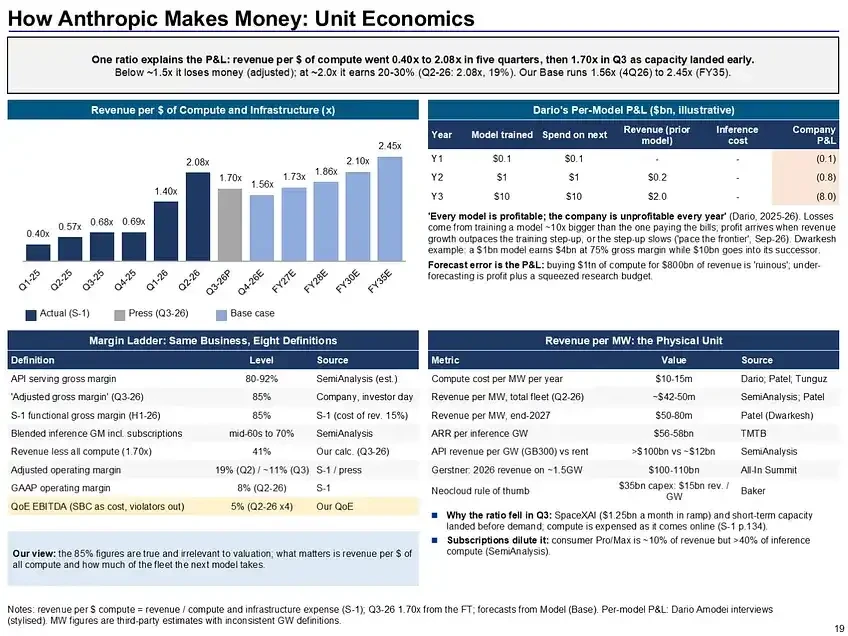
The ratio was only $0.40 in the first quarter of 2025. It rose to $2.08 in the second quarter of 2026 before falling back to $1.72 in the third quarter. Compute and infrastructure costs declined from 160% of full-year 2025 revenue to 57% of revenue in the first nine months of 2026. Anthropic’s adjusted operating margin also slipped from 19% to 15% in the third quarter.
About $5 billion of the quarter’s roughly $9.9 billion compute bill came from more expensive short-term capacity. Quarterly revenue growth slowed from 144% to 47%, while the increase in quarterly revenue fell from $6.8 billion to $5.4 billion. The next phase of the business will depend on whether long-term capacity can lower unit costs and whether customers use enough paid capacity to fill the new supply.
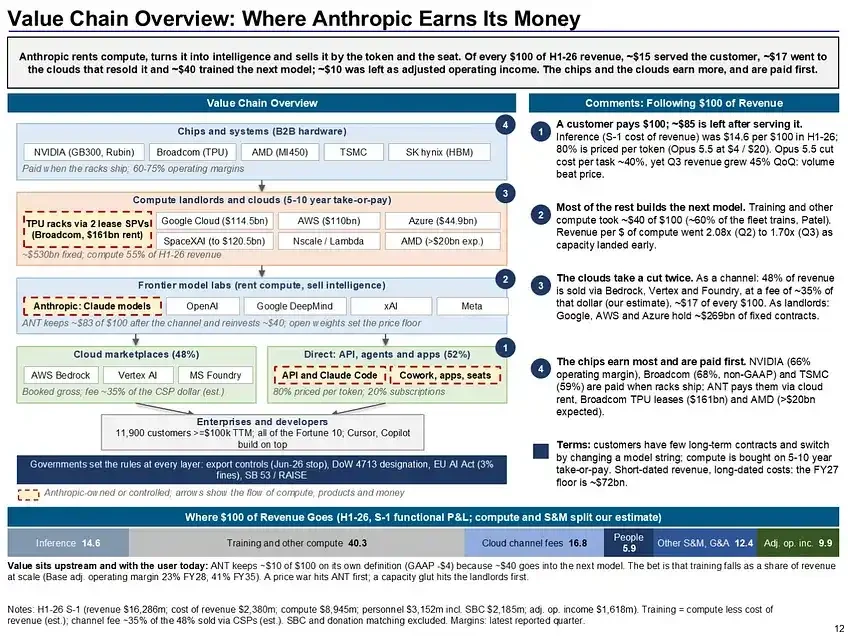
Chiltern’s cost breakdown estimates that about $15 of every $100 in revenue goes toward inference, meaning the operation of models and the handling of customer requests. About $40 goes to training and research compute. More expensive next-generation models and faster iteration cycles leave Anthropic with less time to recover its training investment.
Anthropic reported a net loss of about $104 billion in the first nine months of 2026. Roughly $94 billion came from non-cash fair-value changes in convertible debt and other financing instruments. Operating cash flow was approximately positive $6.6 billion over the same period. A view of ordinary operating profitability still has to account for training costs, channel fees and stock-based compensation.
Claude Code lifts usage while lower prices reduce revenue per call
Anthropic’s revenue grew from $41 million in 2023 to $4.6 billion in 2025, then reached $33.2 billion in the first nine months of 2026. Claude Code has been a major contributor to that expansion. The product can carry out multi-step tasks inside code repositories. Once a company connects permissions, project context and engineering workflows, the same employees can assign more work to the model.
According to company disclosures, Claude Code’s annualized revenue run rate rose from about $500 million in September 2025 to more than $2.5 billion in February 2026. The run rate is an annualized estimate based on recent revenue.
About 80% of Anthropic’s revenue is usage-based. Enterprises and developers pay according to the tokens that models read and generate, with a token serving as a processing unit for text and other content. Subscriptions account for most of the remaining 20%. The structure allows revenue to grow even if seat counts change little, as tasks become more numerous or longer. It also leaves revenue exposed to model pricing and customer purchasing decisions.
As of the end of September, Anthropic had $13.8 billion in remaining performance obligations, about three-quarters of which it expects to recognize within one year. The five largest customers accounted for 36% of revenue in the first quarter and 21% in the third quarter. Migration among large customers can still affect individual quarters.
Anthropic launched Opus 4.5 in November 2025 at a price about 67% below its predecessor. Revenue growth in the following two quarters reached 132% and 144% sequentially. Chiltern views the figures as evidence that lower prices released additional demand. Anthropic estimated that the price cut reduced third-quarter 2026 revenue by about $600 million.
New usage has to offset the lower price per call and cover the additional inference cost generated by that usage before revenue per dollar of compute can improve. The balance between volume growth and pricing remains central to the economics of the model business.
Cloud marketplaces change the revenue presentation
Distribution channels also affect the calculation. About 44% of Anthropic’s revenue in the first nine months of 2026 was sold through the cloud marketplaces of AWS, Google and Microsoft. Anthropic records the related sales on a gross basis and records channel fees separately.
Chiltern estimates that revenue for the past 12 months would have been about 15% lower under net reporting, while EBITDA would have remained unchanged. The accounting treatment matters when investors compare revenue multiples across model companies.
New models account for most revenue, keeping the technology premium under pressure
The prospectus says that more than 80% of Anthropic’s third-quarter 2026 revenue came from model versions released in the previous six months. Benchmarks compiled by Chiltern put Opus 5.5 ahead on combined capability measures from Artificial Analysis and Epoch.
In an Artificial Analysis test, Opus 5.5 cost about $5.98 per task, compared with about $0.72 for GPT-6.1 Sol. The two models were separated by six points on the score. How many tasks enterprises are willing to pay that price premium for will affect Anthropic’s ability to recover its next training investment.

Open-weight models account for roughly 70% of token usage on the OpenRouter and Vercel gateways. Closed models still account for 73% and 77% of spending on the two gateways, respectively. Anthropic’s share of spending on Vercel fell from 64% in August to 44% in September. Vercel’s customers lean toward startups, so a single month is not necessarily representative. If cheaper models continue to narrow the capability gap, Claude will need to retain a premium through higher-value workloads.
Safety reviews, export restrictions and corporate governance can also affect the timing of new model releases. The prospectus says a long-term benefit trust can appoint four of the seven directors, while founder entities hold a fixed 50.1% of the voting power. Chiltern says delays to releases or limits on how widely a model is opened could change the company’s revenue trajectory. It identifies Cowork, industry tools and international markets as potential growth sources, while its base case is mainly supported by businesses already generating sales.
Long-term commitments lock in payments, leaving demand to determine capacity utilization
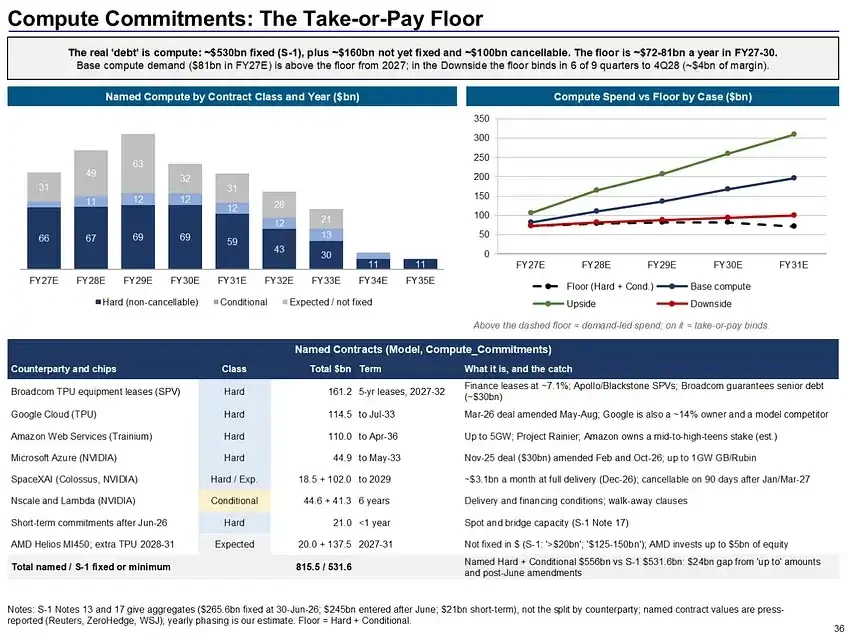
The revised prospectus lists total contractual obligations of about $900.9 billion, nearly all related to compute and infrastructure. The figure includes roughly $112.3 billion of commitments signed after the end of September. Anthropic expects to pay about $70.7 billion during the 12 months beginning at the end of September. The filing also says that about $186.2 billion of commitments are conditional or can be terminated before they begin.
Chiltern estimates that about $452 billion will come due cumulatively by the end of 2030. After excluding cancellable commitments, it estimates annual minimum payments of roughly $77 billion to $82 billion from 2027 through 2030.
Unused capacity still produces contractual costs when demand falls short. In Chiltern’s model, Anthropic would lose money on an adjusted basis if revenue per dollar of compute stayed below about $1.50. Its base case sees the ratio falling first to 1.51 in the fourth quarter as compute is delivered in concentrated batches, then recovering to 1.87 in 2028.
Funding and compute supply often come from the same companies. Google is an investor and also leases TPU capacity to Anthropic. Amazon is both an investor and a supplier of Trainium capacity. Broadcom has agreed to provide as much as $42 billion in note financing, with the funds restricted to related rental payments.
Chiltern expects Anthropic to hold about $216 billion in cash at year-end after the IPO. Its stress test assumes that revenue remains at a fourth-quarter annualized rate of $86 billion. Under that assumption, Anthropic would still have about $147 billion of liquidity at the end of 2031. The model shows growth stagnation first reducing profit and valuation.
At $74, the investment case depends on a recovery in compute efficiency
Anthropic plans to list on Nasdaq at $70 to $78 per share. At $74, Chiltern estimates a fully diluted equity value of about $1.33 trillion. Google and Nvidia are each expected to subscribe for $10 billion, while seven strategic investors are set to subscribe for a combined $26 billion. The companies providing capital to Anthropic are also selling it chips, compute and cloud services.
At $74, Chiltern estimates that Anthropic’s enterprise value equals 8.4 times its projected 2027 revenue, compared with a median of 6.6 times for 16 listed peers. The firm values usage-based operations against AI compute companies and subscription operations against high-growth software companies. That segment-based approach produces a value of $69 per share, while its base discounted-cash-flow valuation is $98 per share.
Working backward from the base-case margin, a $74 share price implies roughly $406 billion of revenue in 2035 and a compound annual growth rate of about 25% from 2026 through 2035. Chiltern’s base case projects revenue of $133 billion in 2027 and $194 billion in 2028, with adjusted operating margin rising to 25%.
- Base case at a year-end 2028 exit: about $120 per share;
- Optimistic case: about $279 per share;
- Price-war case: about $34 per share;
- Severe case involving a loss of technology leadership: about $18 per share.
Chiltern assigns weights of 45%, 20%, 25% and 10% to those four cases, respectively. The result is a probability-weighted exit price of about $120 and a 35% probability of loss.
The firm is willing to build half of its planned position within the $70-to-$78 offering range, representing about 0.8% of portfolio net asset value. Its fourth-quarter base revenue estimate is $21.5 billion. Revenue above $22.5 billion, a recovery in revenue per dollar of compute to more than $1.80, or a share price below about $66 could support an additional purchase.
If the stock reaches about $92 on its first day, Chiltern’s expected annualized return falls to 13%, below its 15% threshold. Anthropic’s first post-listing earnings report will show whether Claude usage can bring revenue per dollar of compute back toward $2 as long-term capacity gradually replaces more expensive short-term supply.



