
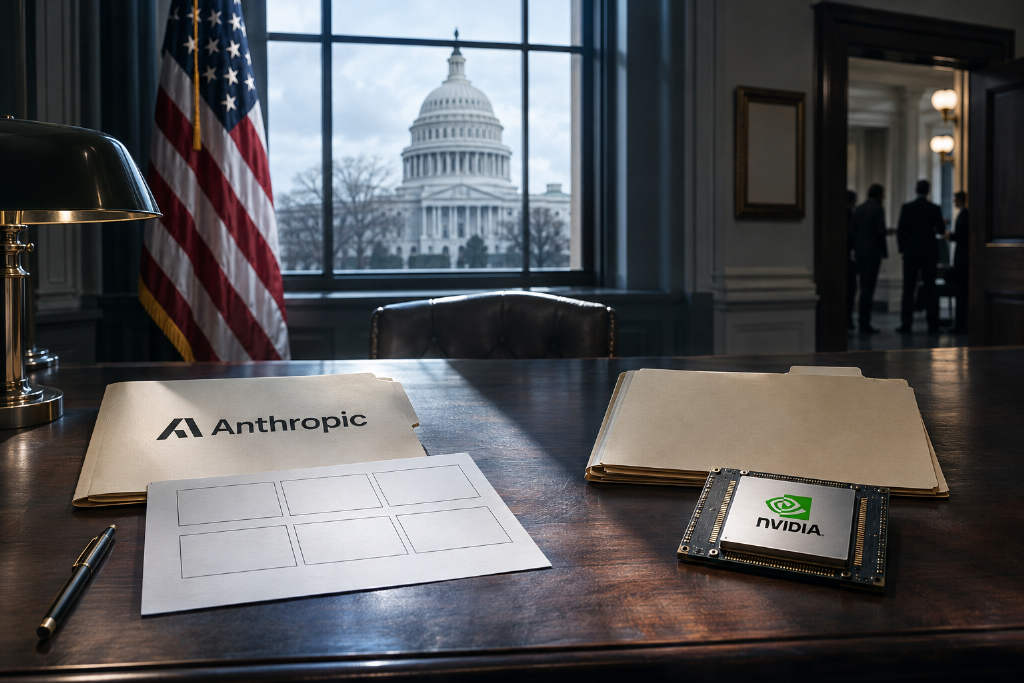
Anthropic donated $40 million this year to Public First Action, an American AI policy group whose advertising plan named two lawmakers who later called on former Nvidia CEO Jensen Huang to answer questions in Congress about national security.
There is no evidence that Anthropic participated in or directed the lawmakers’ inquiry. The timeline drew attention after X user Liang Yimeng (@Dream1984Tube) published a post listing links between Anthropic and several people critical of Huang, and asked whether the connections were coincidental. BlockTempo said the dates and amounts could be traced to Anthropic announcements, a Public First Action press release, House letters and Federal Election Commission (FEC) filings.
Two donations and an advertising campaign
Anthropic announced a $20 million donation to Public First Action on February 12, 2026, describing it as a newly formed bipartisan 501(c)(4) organization. Such groups can engage in policy advocacy and generally do not have to disclose their donors.
On July 17, Public First Action announced a $15 million Conservative AI Consensus Initiative. The group said it would initially spend more than $7 million on ads featuring Senators Josh Hawley, Tom Cotton and Ashley Moody, as well as Representative Byron Donalds.
Over the following month, the group planned to roll out ads for more than 10 other Republican House members. The list included Representative Brian Mast, chair of the House Foreign Affairs Committee, and Representative John Moolenaar, chair of the House Select Committee on Strategic Competition between the United States and the Chinese Communist Party.
The initiative also included long-term polling on conservative voters’ views of AI safety, transparency and export controls. The press release did not identify the initiative’s funders.
Four days later, on July 21, Anthropic announced another $20 million donation, bringing its total to $40 million. The company said both contributions could be used only for public education and policy advocacy, not to influence the election of any federal, state or local candidate.
Lawmakers seek closed-door interviews
On November 4, Mast, Moolenaar and Representative Rick Crawford, chair of the House Permanent Select Committee on Intelligence, wrote to Huang seeking a closed-door briefing on November 18. They asked about Nvidia’s measures against foreign espionage and Huang’s dealings with former Megaspeed executive Alice Huang.
U.S. officials have determined that Alice Huang was recruited by China’s Ministry of State Security. Jensen Huang previously said their interactions were business-related, while China’s Foreign Ministry called the reporting a smear.
Nvidia announced Huang’s resignation on November 12. The three lawmakers wrote again that day, asking Huang to sit for a closed-door interview on December 1 with a transcript.
In a separate letter, they asked Nvidia general counsel Tim Teter to attend a closed-door interview on December 2. The listed topics included AI chip smuggling, the use of Nvidia products by the militaries of hostile countries, and reports that Nvidia had allegedly interfered with U.S. export-control policy and investigations. Both letters requested written responses by 8 p.m. Eastern Time on November 13, warning that the Foreign Affairs Committee would issue subpoenas otherwise.
Mast separately wrote to Jeffrey Kessler, the Commerce Department undersecretary responsible for export controls, asking him to attend a Foreign Affairs Committee hearing on December 3. In a press release, the three lawmakers called on Congress to include the AI OVERWATCH Act, Chip Security Act, MATCH Act and Remote Access Security Act in the National Defense Authorization Act (NDAA) and pass them immediately.
Export-control positions and political donations
Anthropic said in its July donation announcement that it supported tighter export controls on advanced chips and semiconductor manufacturing equipment. Huang has long opposed tighter restrictions and said publicly in 2025 that U.S. chip export controls were a failure.
Mast’s AI OVERWATCH Act would require Congress to review advanced AI chip exports using a process modeled on arms-sales reviews. Bloomberg reported that Mast and Nvidia have long disagreed on export controls.
FEC filings show that AnthroPAC, Anthropic’s corporate political action committee, donated $2,500 to Mast’s campaign committee and $1,000 to Crawford’s campaign committee on July 7. The filings contain no record of a donation to Moolenaar.
Around the same time, AnthroPAC also donated to dozens of lawmakers, candidates and party campaign organizations from both parties. Most individual contributions to candidates ranged from $1,000 to $3,500.
As of the afternoon of November 13, Taiwan time, Anthropic, Public First Action and the offices of all three lawmakers had not publicly responded to the timeline. Huang has agreed to testify before Congress before Thanksgiving, though the exact date remains under negotiation. A subpoena would be issued if talks broke down; the proposed timing is earlier than the December 1 date in the letter.



