

Anthropic’s rumored Fable 5.5 model is moving closer to public view, at least through a growing trail of demos, code artifacts, and naming leaks. Posts circulating on X describe a system that does not rely on conventional image generation or external asset libraries, but instead writes Python code on its own, compresses the output into a single HTML file, and runs the finished animation with audio directly in a browser.

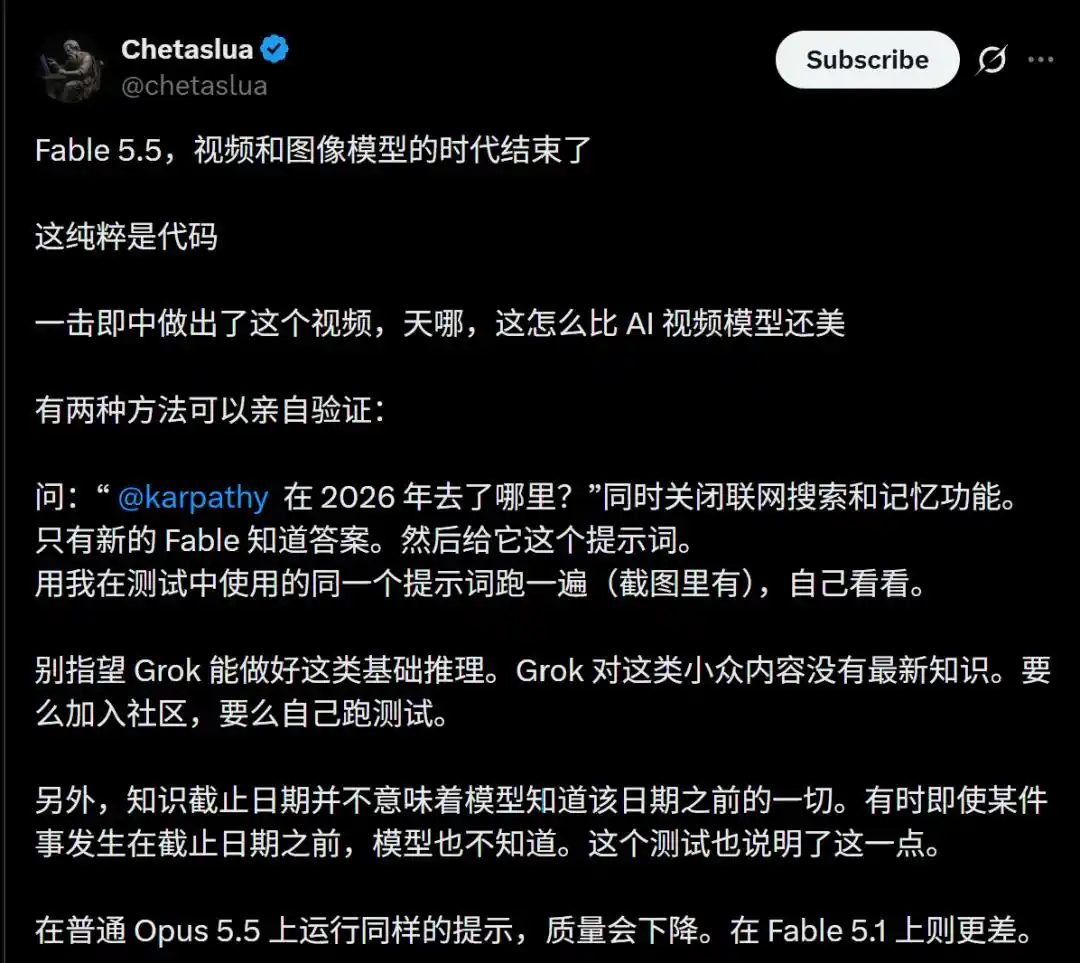
The source material says these signs are appearing as Anthropic approaches an IPO. A number of high-profile X users have posted test results and reactions. Chetaslua shared a one-shot video made with Fable 5.5 and said the result looked better than output from some AI video models. Another user, Chubby, wrote that Fable 5.5 would "completely change the game" and said the result left him speechless.
Code-generated animation is at the center of the discussion
The main claim in the circulating posts is not standard text-to-video generation. The article says the showcased outputs used no image generation, no outside asset library, and no frame-by-frame rendering workflow. Instead, the model reportedly wrote Python code autonomously, condensed the project into an HTML file, and produced a playable result inside a browser.
That framing led the original article to describe the shift as moving from text-to-video toward something closer to "code creates everything." In that telling, Fable 5.5’s edge comes from programming, reasoning, and self-debugging rather than pixel prediction.

Chetaslua also shared what the article described as a 66-second animated short generated by Fable 5.5. According to the post, the model worked autonomously for 2 hours and 40 minutes. Every frame and every sound in the piece was said to have been generated through Python code written by the model itself. The article says the system handled its own reasoning, debugging, and packaging without human intervention, then delivered the result as a single HTML file that could be opened in a browser like a self-contained screening room.
The source also says Fable 5.5 acknowledged that the result was "not yet at Ghibli level," though the demonstrations were still presented as strong enough to unsettle people working in animation and related fields. One of the more aggressive claims quoted in the article was that in six months, no one would care about new video or image models. That line reflects the view of users posting the demos, not a confirmed statement from Anthropic.
Comparisons with GPT-6.2 Astra and Opus 5.5 kept appearing
A second thread running through the discussion is direct comparison with GPT-6.2 Astra and Opus 5.5. The article says users posted side-by-side animation examples involving GPT-6.2 Astra and Fable 5.5, arguing that Astra trailed Fable 5.5 in animation detail and script design.
Jazil posted his own tests and said Fable 5.5 produced an animation that felt like AGI to him in about one hour. He also said the result was generated entirely through code, with no external assets. His verdict was blunt: Fable 5.5 would "crush everything."
In another set of demos, Jazil shared a battle animation and a "bicycle riding a pelican" example, calling both impressive and adding that "Astra 6.2 has no chance." The article says he also posted a comparison involving Opus 5.5. Another user shared a clip described as a pelican carrying a bicycle while riding a horse, with the motion quality again praised as stronger than Astra 6.2.
The source goes further and says Fable 5.5 outperformed Opus 5.5 across the board, then mentions a coming "four-model showdown." It does not, however, provide the full details of that four-way comparison in the supplied text.

A social test for identifying the latest model also spread
The article says @chetaslua proposed a way to test whether a user had access to the newest model. The method was to disable web search and memory, then ask: "Where did Andrej Karpathy go in 2026?"
According to the source, the question was chosen because it referred to a niche event on a new timeline. Opus 5.5, Fable 5.1, and Grok reportedly failed the test, while the newer Fable 5.5 answered correctly. As with the other examples, the article presents this as a social-media claim rather than an independently verified benchmark.
A Hugging Face repository points to a possible Mythos-class model
Beyond the X demos, another major clue came from Hugging Face. The article says rumors around Fable 5.5 and a larger Mythos-class model are not appearing out of nowhere, because a recent leak claim pointed to a Hugging Face repository that may expose traces of the system.

The repository named in the article is https://huggingface.co/burner22/numbat. The source says it contains the following details:
- 14 trillion parameters
- 1,224 MoE experts
- 7.72 TB of weights
- 772 weight shards
- A hybrid GDN + MLA architecture
The article also says the repository lists model architecture code, configuration files, and training metadata. At the same time, it explicitly notes that there is still no independent verification showing these are genuine Anthropic weights. That caveat is central to the story. The numbers may be present in the repository, but they cannot yet be treated as confirmed Anthropic specifications.
Timeline clues point to Fable 5.5 and Mythos 5.5
The source lays out several dates tied to the rumored release path.

- Oct. 13: LiteLLM reportedly found an entry called azure_ai/claude-fable-5-5 in the Azure East US 2 directory, and the listing was even marked "GenerallyAvailable."
- Oct. 14: One day later, the entry disappeared and requests returned 404 errors.
- Oct. 31: A developer identified as ChrisGPT said he found the phrase "Claude Claude Mythos 5.5" in hidden Anthropic webpage titles and image descriptions while checking archived pages.
Taken together, those clues form the backbone of the current speculation: social-media demos on one side, repository metadata and website traces on the other.
The article frames this as a bet on coding and reasoning
The source argues that major AI companies have spent much of the recent cycle competing in image and video generation, trying to simulate the physical world through pixel prediction. Anthropic, in that framing, may have chosen a different route by concentrating on coding and reasoning models, then using code to generate animation and interactive output.
The article contrasts pixel-generated video with code-generated animation, saying the former can produce physical errors while the latter is governed by variables and logic. On that basis, it suggests Fable 5.5 could affect film, gaming, and front-end development if the showcased capabilities hold up.

For now, though, the material in hand remains a mix of social posts, repository findings, and website clues. The supplied source does not include a formal Anthropic launch announcement, and it does not provide independent proof that the Hugging Face weights belong to an official Anthropic model.
The references listed in the source are the Hugging Face repository at https://huggingface.co/burner22/numbat and X posts at https://x.com/chetaslua/status/2117224839010459987, https://x.com/notjazii/status/2117221957104239010, and https://x.com/chetaslua/status/2117169796290916732. The article was originally credited to the WeChat account Xinzhiyuan, written by ASI Qishilu and edited by Aeneas David, then published by MarsBit.



