
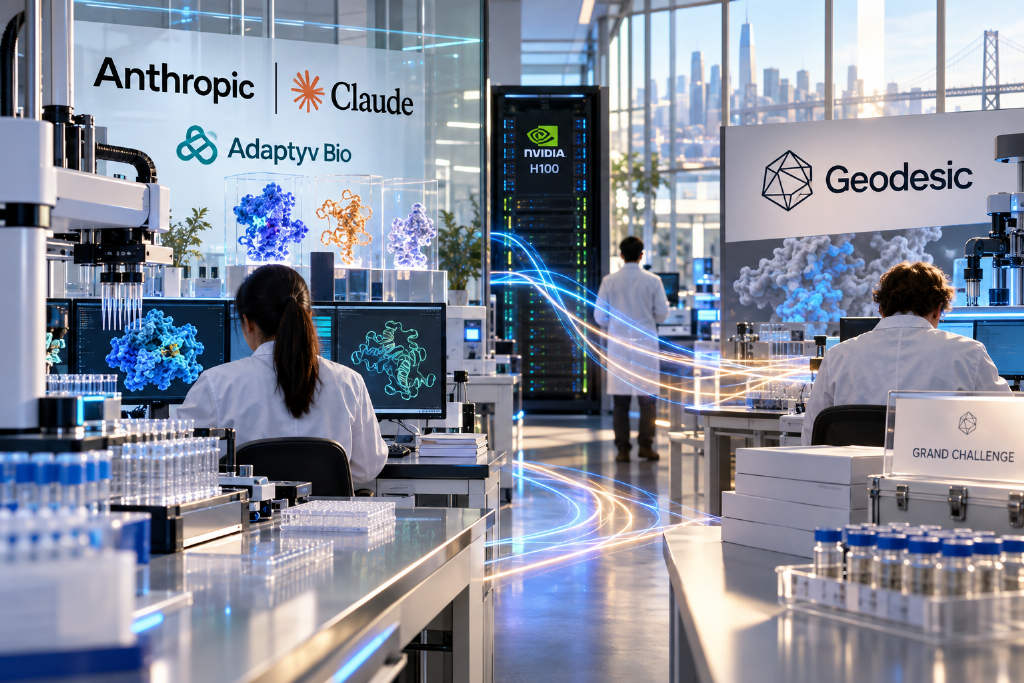
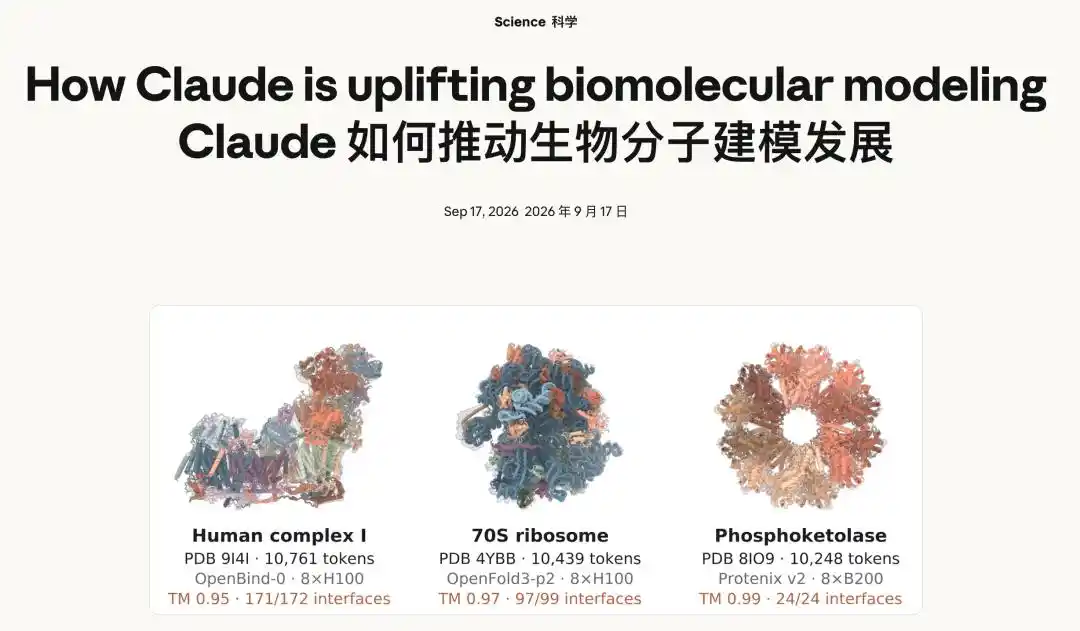
On Sept. 17, Anthropic said it was stepping harder into biology research. Its claim: Claude optimized more than 30 open-source biomolecular models in under four weeks, lifted inference speed by roughly 4x on average, and added a low-memory mode able to run biomolecular system predictions above 10,000 tokens on a single NVIDIA H100 GPU node.
The company also rolled out a public protein design competition with Adaptyv Bio. It is built around five frontier design problems. The plan is to validate more than 5,000 designs in Adaptyv’s automated lab and hand out as much as $1 million in Claude credits.
But the timeline in the article tells a different story about who got there first. Anthropic was not first to launch a challenge at that scale. A day earlier, on Sept. 16, AI drug discovery startup Geodesic Intelligence had already announced its own initiative. Different angle, though. Rather than rewarding answers first, it started by asking the public to surface the hardest problems in drug discovery.
Geodesic moved first with a million-dollar challenge structure
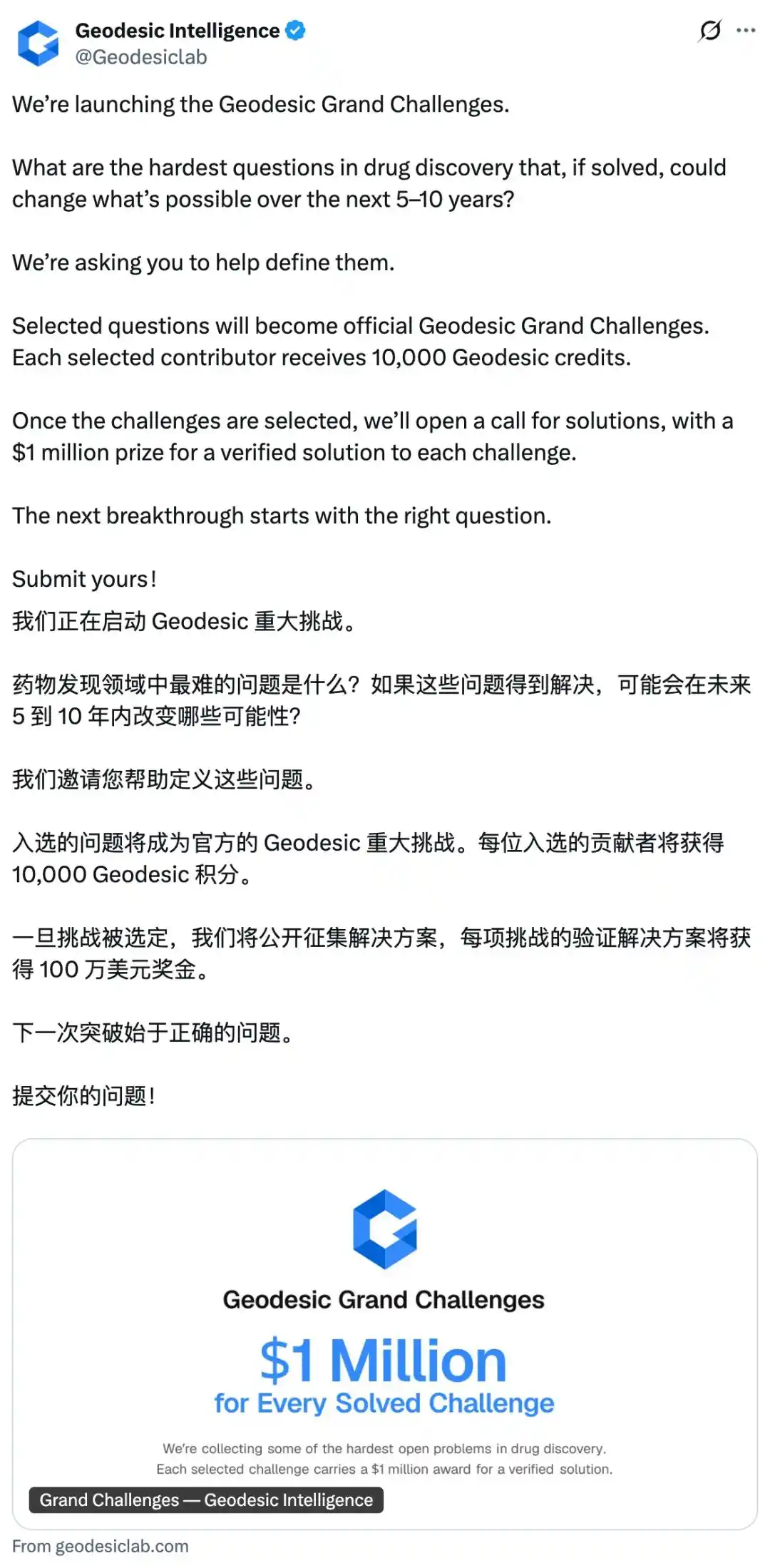
Geodesic Intelligence is asking for what it calls the hardest questions in drug discovery. The bar is tight and ambitious at the same time: a chosen question should be one that, if solved, could reset the industry’s capability frontier over the next five to 10 years. Its scientific committee will examine submissions one at a time, and every selected question gets 100,000 Geodesic credits.
Then comes the next stage. After the questions are picked, Geodesic says it will open a separate round for solutions. For each formal challenge, anyone who submits a validated answer can receive $1 million in cash. Cash, the article stresses. Not platform credits.
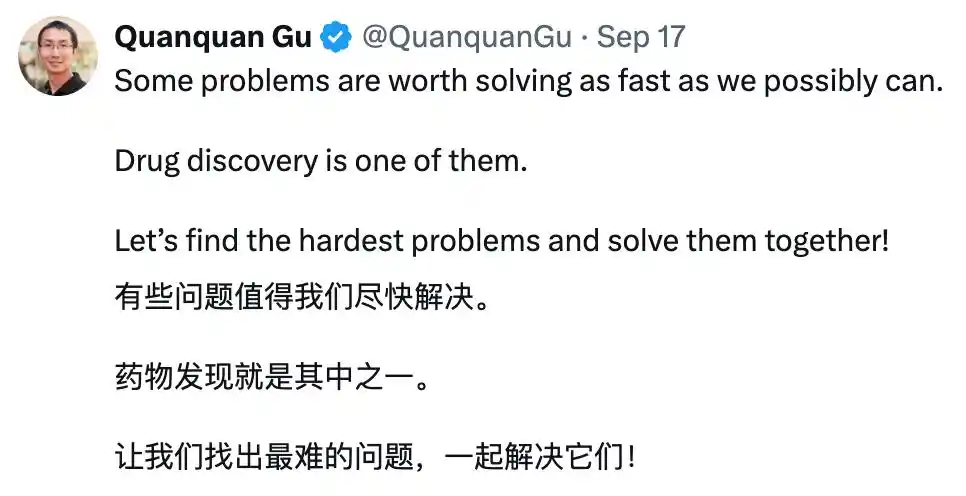
Founder Gu Quanquan wrote in a repost: "Some problems deserve to be solved as fast as possible, and drug discovery is one of them. Let's find the hardest questions together and solve them."
Two different models: one funds validation, the other starts with the question
The article sets Anthropic and Geodesic side by side.
The Anthropic and Adaptyv Bio protein design competition runs on a one-design-problem-per-week format, with attention fixed on whose binder designs can actually be made and measured in the lab. Under the official terms cited in the article, there is no cash prize. That $1 million headline number is mostly Claude credits plus wet-lab expenses.
Geodesic’s Grand Challenges program takes another path. The $1 million cash reward is held for validated answers, but the opening move is to ask the public which questions even deserve solving. On timing alone, Geodesic announced its plan one day before Anthropic.
Eligibility rules became a point of contrast
The article also zeroes in on a basic issue: who gets to join.
The homepage for the Anthropic × Adaptyv protein design competition says it is "Open to everyone and free to enter." But Section 3.1 of the official contest rules names restricted jurisdictions. Entrants cannot be legal residents of, or entities registered in, Belarus, China, Cuba, Iran, Myanmar, North Korea, Russia, Sudan, Syria, Crimea and other listed regions.
So under those rules, researchers in China cannot participate in the competition. The article says that leaves a gap between the homepage wording and the legal terms.
Geodesic’s Grand Challenges page says something else: "Anyone is welcome to submit questions, whether you are a researcher, clinician, drug developer, student, or simply someone with a deep interest in the future of drug discovery." Based on that language, the article says question submissions are open to researchers, clinicians, drug developers and students, without nationality or identity being used as a threshold.
Who is Geodesic Intelligence
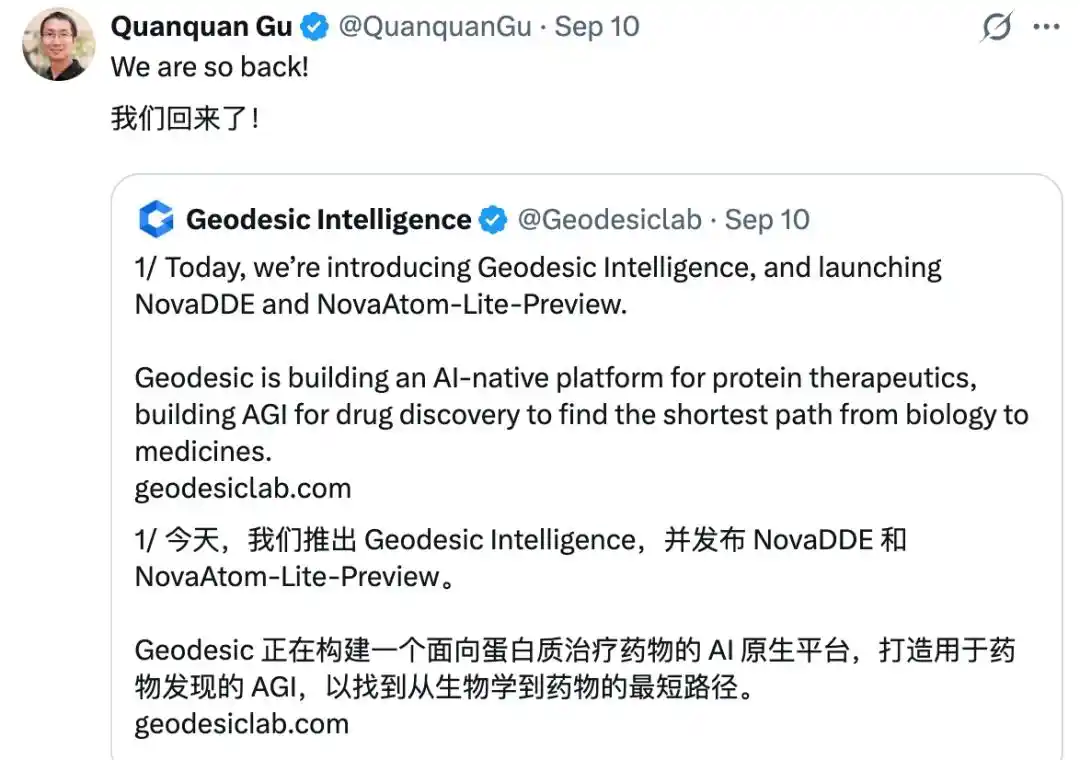
According to the article, Gu Quanquan announced Geodesic Intelligence on X on Sept. 10 and introduced two products at the same time. The company homepage puts its goal in one sentence: "Build AGI that discovers the shortest path from biology to medicines."
To chase that goal, Geodesic built what it calls the Nova Stack. Three layers. Software, models, and lab infrastructure.
NovaDDE: an agent workspace for scientists
NovaDDE is presented as Geodesic’s agent workspace. It pulls literature review, biological evidence lookup, molecular structure analysis, computational model runs, and result evaluation into one platform. AI agents plan tasks, call models, and judge outputs, while each decision is logged along the way.
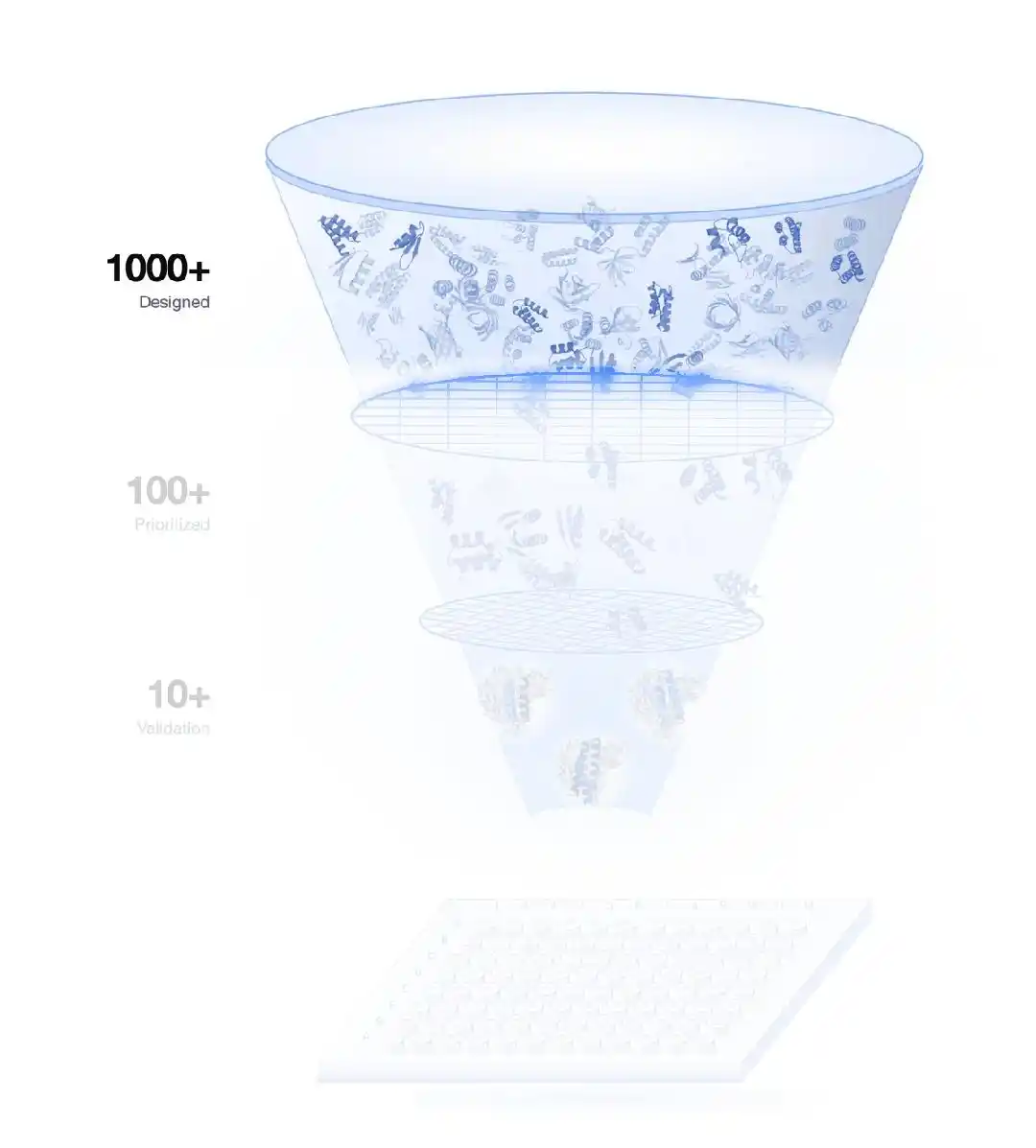
Users can describe the experimental decision they want in natural language. Or they can jump straight into design mode by marking a target surface and asking the system to generate a binder of about 80 amino acids. The funnel shown on the company website is simple: design more than 1,000 candidate molecules, trim that to more than 100 high-quality options, then send more than 10 into lab validation.
The article also flags a data-policy detail. Target data belongs to the user, is not used to train the model, and will be deleted if the user asks for it.
NovaAtom: an all-atom structure prediction model
NovaAtom-Lite-Preview is Geodesic’s in-house all-atom structure prediction model and the first member of the NovaAtom family. In plain terms, it takes a set of molecular sequences and predicts the 3D coordinates of every heavy atom.
The article gives three core features.
- It does unified prediction across proteins, DNA, RNA, and small molecules, instead of predicting each separately and patching the outputs together later.
- It supports complex constraints, including cyclic peptides, drugs that need to form covalent bonds with a target, and specified binding positions.
- It comes with confidence labels. For each target, the model returns five ranked predictions and indicates how confident it is about each structural region.
The version available now is a lightweight, faster model. A larger version is still being trained.

NovaLab: turning designs into wet-lab validation
NovaLab is Geodesic’s in-house wet-lab validation system, built to turn computational designs into physical experiments. The article says each binder faces seven checks: can it be made, was it made correctly, does it bind, how strongly does it bind, does the signal hold up when measured again on a different instrument, does it show drug-like potential, and does it actually work.
Those experimental results then go back into the AI system to train the next generation of models. The article boils the loop down to this: AI, then design, then experiment, then learning, then another round.
And it adds one more point. AI drug discovery companies are not rare, but it is unusual for a startup to build the whole chain itself, from AI agents and foundation models to an in-house wet lab. Many peers focus on models or on experiments. Geodesic is trying to do both from day one.
Drug discovery is starting to pay for the question itself
The article ends by putting these moves inside a bigger fight over scientific direction. It says OpenAI spent millions of dollars in compute to attack mathematical problems and later offered a million-dollar prize. Anthropic, for its part, committed million-dollar-scale resources to a protein design competition so more designs could make it into lab validation.
Geodesic is trying something else: ask the world which problems matter most before paying for the answer.
In the article’s framing, Anthropic is tackling the cost of validation, while Geodesic is tackling whether the field is aiming at the right target. The two approaches do not clash. But the piece argues that the party defining the problem first may hold the stronger hand in shaping the industry’s next decade.
This article was sourced from the WeChat public account "New Intelligence" and edited by Solomon.