
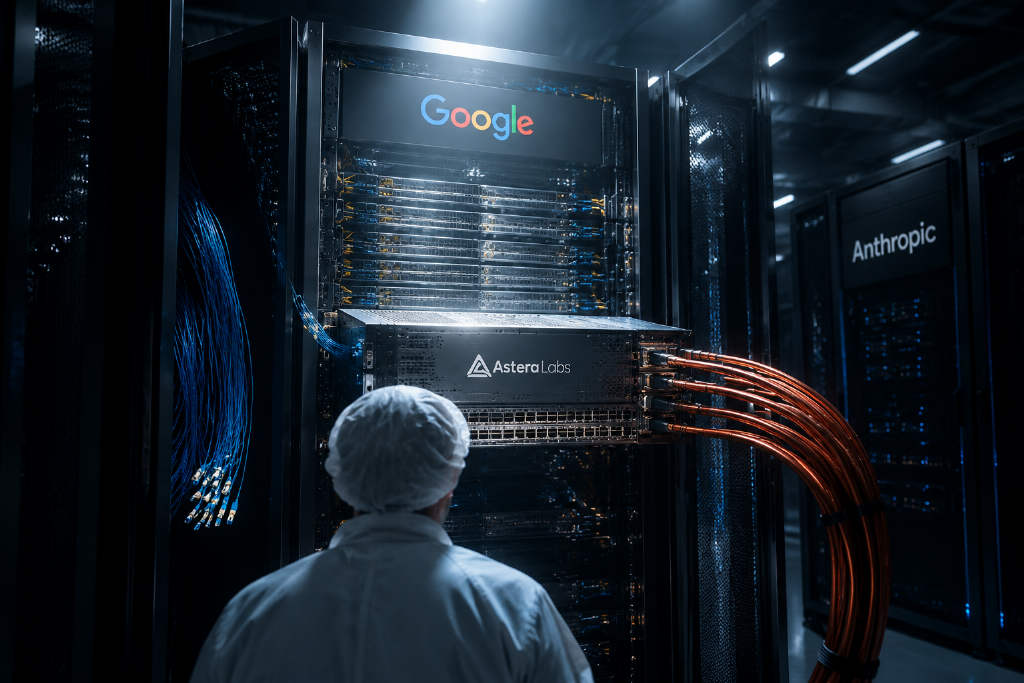
Anthropic is reportedly pressing Google to change the network architecture for its custom version of the next-generation TPUv9i AI accelerator, codenamed Triggerfish, and abandon the optical circuit switching technology used across multiple TPU generations. The proposed replacement is a full electrical switching design built around Astera Labs’ Scorpio-X, a shift that could alter Google’s optical interconnect stack and introduce new uncertainty for the broader optical communications supply chain.
Rumor targets a core part of Google TPU design
SemiAnalysis said Google’s current TPU clusters use a 6D-Torus topology for inter-chip interconnects, paired with dynamic optical circuit switching, or OCS. That setup allows TPU Pods to carry out near all-to-all dynamic optical path reconfiguration and, in theory, pushes past the bandwidth and distance limits that come with traditional electrical switching.
OCS has long been treated as one of the main architectural advantages Google TPU holds over NVIDIA GPU systems and AWS Trainium. The report says Google TPU is also the only mainstream AI accelerator platform currently using OCS.
Industry rumor now says Anthropic wants Google to remove both Boardfly and OCS from its dedicated Triggerfish SKU and replace them with an inter-chip interconnect based on full electrical switching. If that happens, it would mark a direct challenge to a networking approach Google has built up over several generations.
Astera Labs Scorpio-X is cited as the replacement path
The reported alternative is an upgraded version of Astera Labs’ Scorpio-X PCIe switch chip, with several major specification changes.
According to the report, the upgraded Scorpio-X would expand radix to 320 and raise SerDes speed from 128G to 336G, which would amount to about a 2.6x increase in transmission speed. SemiAnalysis also said this version could be open to manufacturing by multiple vendors. That would give Astera Labs a chance to define the specification at the design IP level while adding more manufacturing sources to improve supply-chain resilience.
Why Anthropic may prefer electrical switching
The article lays out both technical and commercial logic behind the reported push.
One factor is die area efficiency. Current TPU chips need routing cores to handle network packet forwarding. If those routing functions are offloaded to external electrical switching chips, that silicon area could instead be used for matrix multiply units, or MXUs, or for HBM memory stacks. The report argues this would directly improve compute density per watt or memory bandwidth, which would be especially meaningful for large language model workloads.
The second factor is architectural consistency. Anthropic spreads training and inference workloads across Google TPU, AWS Trainium, and NVIDIA GPU platforms. Among those three, only Google TPU uses OCS. That means Anthropic has to maintain separate networking management and scheduling systems. If TPU moved to an electrical switching architecture, the three accelerator environments could share a unified interconnect fabric, reducing operational complexity and improving procurement leverage across the supply chain.
Optical interconnect names could come under pressure
If the rumored shift becomes real, optical interconnect suppliers would be the most exposed.
The report specifically points to Ayar Labs, the U.S. silicon photonics unicorn focused on on-chip optical I/O. Its TeraPHY technology has been marketed on the idea that AI training clusters will eventually move toward fully optical architectures. OCS systems also require a large number of high-speed optical modules. If cluster design shifts toward electrical switching, the growth trajectory for that demand would need to be reassessed.
Astera Labs, by contrast, could cement its position in hyperscale AI cluster interconnects if it wins the design slot. That could also give the company a stronger reference point when pursuing additional customers.
Claims remain unconfirmed
For now, the report remains based on industry rumor. Whether the claims are accurate, and what the concrete effect would be on Google’s interconnect roadmap, Astera Labs, Ayar Labs, and optical communications suppliers, will depend on further disclosures and harder data.