
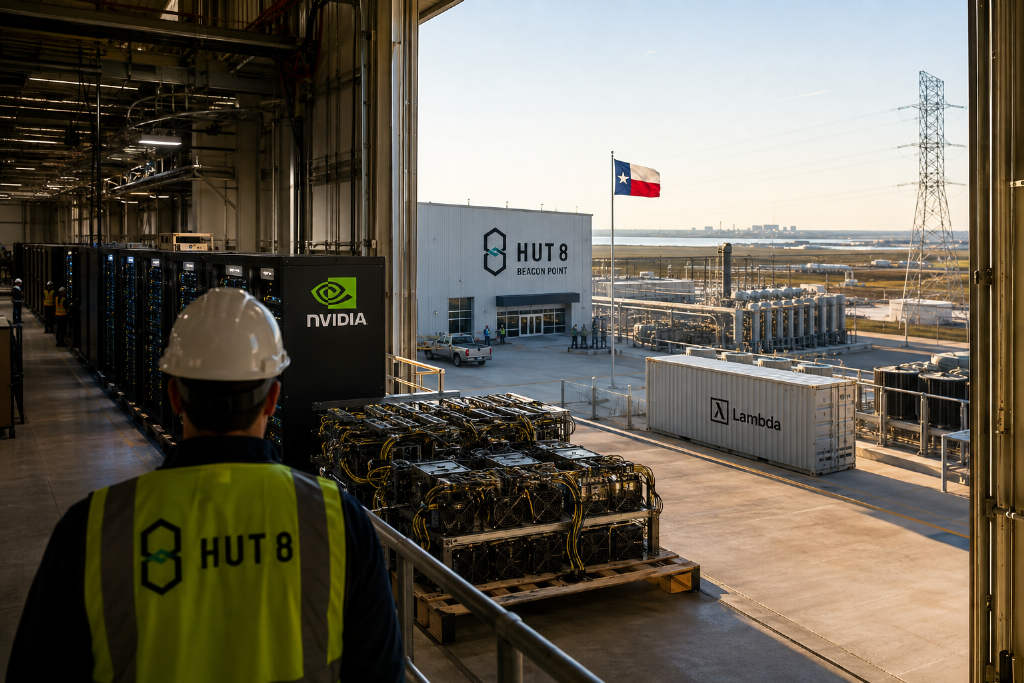
Anthropic has signed a $35 billion compute capacity deal with Lambda, an AI cloud company backed by Nvidia, and part of that capacity is set to run through Hut 8’s Beacon Point campus in Nueces County, Texas. The deal puts the spotlight back on the push by Bitcoin miners to reposition themselves as AI infrastructure providers.
According to a Wall Street Journal report published Monday evening, Anthropic is buying compute resources from Lambda. Lambda uses Nvidia chips at Hut 8’s Beacon Point facility to provide that computing output, which Anthropic then purchases. The report said Nvidia holds the lease for the facility, while Lambda sits in the middle as the AI cloud layer.
Beacon Point lease details point to a long-term buildout
Hut 8 had previously disclosed two long-term leases tied to Beacon Point without identifying the tenant. Based on a CoinDesk compilation, the main figures are as follows:
- Lease term: 15 years each
- Total IT capacity: 704 MW
- Total contract value: $19.6 billion
- Campus size: 525 acres
- Available power: up to 1 gigawatt
- Status: grid connection already in place
Hut 8 has not confirmed how much of the 704 MW leased at Beacon Point is directly linked to the $35 billion Anthropic-Lambda arrangement. CoinDesk said it had contacted Hut 8 to seek more detail.
Stock reaction was muted
Hut 8 shares jumped at one point after the news surfaced, though premarket trading later showed only a modest gain. HUT closed Monday at $80.68.
Why miners are becoming AI infrastructure suppliers
The report frames the shift as a result of hard supply-demand constraints. AI companies need very large amounts of power, and building a new site with several hundred megawatts connected to the grid can take years. Bitcoin miners, by contrast, have often already spent years securing relatively cheap electricity, building data center sites, and obtaining grid access. Those assets are now in demand from AI developers.
CoinDesk reported in March 2026 that public Bitcoin miners had already signed more than $70 billion in AI and high-performance computing agreements. Weaker mining economics, the report said, are pushing capital toward data center operations.
Peers are following the same path
Hut 8 is not alone. Other miners cited in the report have also landed large AI-related contracts.
- TeraWulf: In July, it signed a long-term agreement to provide about 401 MW to Anthropic at a former industrial site in Kentucky, while also converting part of its Lake Mariner mining campus in New York.
- Bitdeer: In August, it signed a 16-year, $4.7 billion agreement to lease 121 MW at its Tydal campus in Norway for Nvidia computing. The company still mined 1,190 BTC in July.
- IREN: Last year, it signed a five-year, $9.7 billion contract with Microsoft to provide about 200 MW of AI compute capacity from a Texas data center. Its AI cloud revenue reached $70.5 million last quarter, while mining revenue declined.
What the figures mean for Hut 8
According to Hut 8’s financial results for the second quarter of 2026, quarterly revenue for the June period was $74.93 million, up 81% from a year earlier. Once the two Beacon Point leases are fully operational, they are expected to generate average annual operating revenue of $1.31 billion.
On that basis, the $19.6 billion total contract value is more than 260 times Hut 8’s latest quarterly revenue. The report uses that gap to show how much long-term weight AI contracts could carry in miners’ financial statements. If Beacon Point comes online as planned, mining could make up a much smaller share of Hut 8’s revenue mix.
Two issues to watch in the mining-plus-AI model
For now, Hut 8, TeraWulf, and Bitdeer are pursuing a dual-track model rather than abandoning Bitcoin mining altogether. Two questions stand out.
The first is power allocation. Total power capacity is limited, and every additional AI lease leaves less room for mining. If Bitcoin prices pull back sharply, pressure on mining margins would make AI contract income a more important buffer.
The second is lease structure. Terms of 15 to 16 years amount to a very long commitment, while AI hardware changes quickly. The report notes that GPU refresh cycles run about three to five years. Whether these leases include upgrade provisions, and whether rent per unit of power steps up as technology advances, will shape the long-term value of the contracts.
With more than $70 billion in industry contract value, a 704 MW Texas campus, and a $35 billion order from Anthropic, the move by Bitcoin miners into AI infrastructure is no longer just a market narrative in this report. It is already showing up in signed contracts and operating plans.