

"The singularity has arrived, and it is here this year."
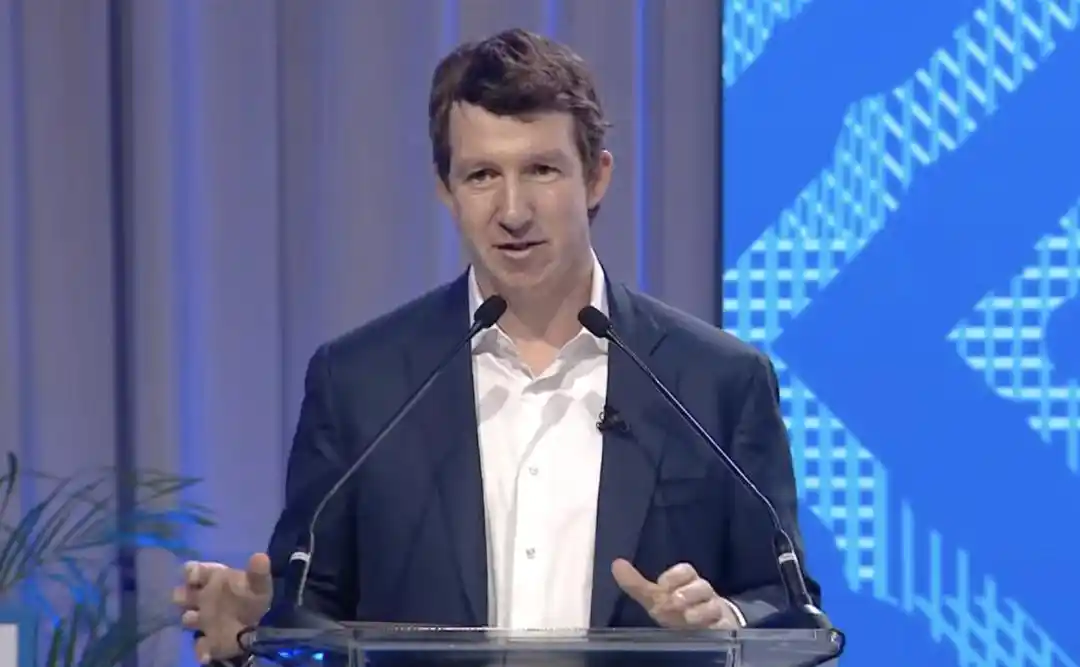
That was the message from Anthropic co-founder Jack Clark during the Per Jacobsson Lecture at the IMF 2026 annual meeting in Bangkok. Clark said there is no longer much point in debating when the singularity will happen because, in his view, the decisive evidence is already on the table.
The lecture has a 62-year history and has typically been reserved for finance ministers, central bank governors and leading economic thinkers. This time, the stage went to a co-founder of an AI unicorn that is less than five years old. Clark, a former OpenAI policy director, framed his remarks around the shift of AI from data centers into the center of global technological and policy debate.
"Vernor Vinge predicted in 1993 that once intelligence beyond humans began driving technological progress, the old forecasting models would have to be discarded and a new reality would take over. Today, the decisive evidence has appeared."
Clark’s case: software first, then science
Clark argued that the clearest signs are visible in code and in frontier research. Software engineering, he said, is the first field to be fundamentally rewritten.
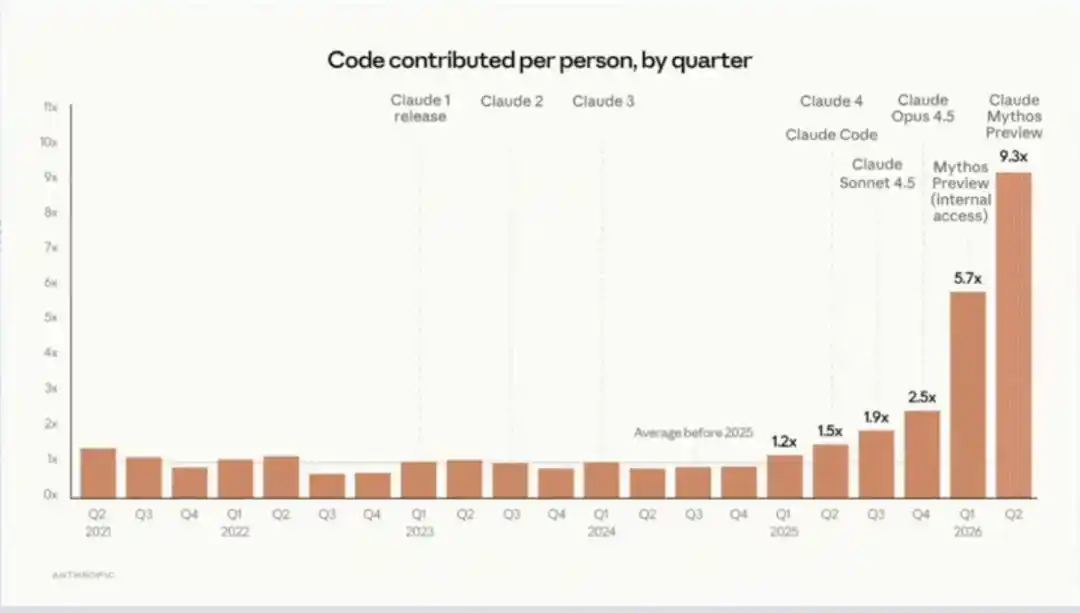
Inside Anthropic, researchers are now producing code at 10 times the average level seen during the company’s first four years, according to Clark. He said that surge closely tracks the progress of the underlying foundation models, and described software automation as only the opening phase of a much larger shift.
What makes 2026 a real turning point, in his telling, is that a single frontier model is now moving across disciplines at the edge of human science and acting as a genuine virtual polymath.
Clark listed several examples:
- In mathematics, AI has started to offer key lines of attack on Millennium Prize problems related to the Navier-Stokes equations, the Jacobian conjecture and several open Erdős problems.
- In biology, AI has designed new viral vectors from scratch and has led the design of several drug candidates that have already entered clinical trials.
- In hardware and materials, AI has begun to take over and operate physical laboratory equipment, speeding up iteration cycles for batteries and fuel cells.
That leads to a sharper question, Clark said: if AI can already tackle frontier problems that humans themselves cannot solve, what is left for humans to teach it?
Humanity’s Last Exam: from 8% to 67.7%
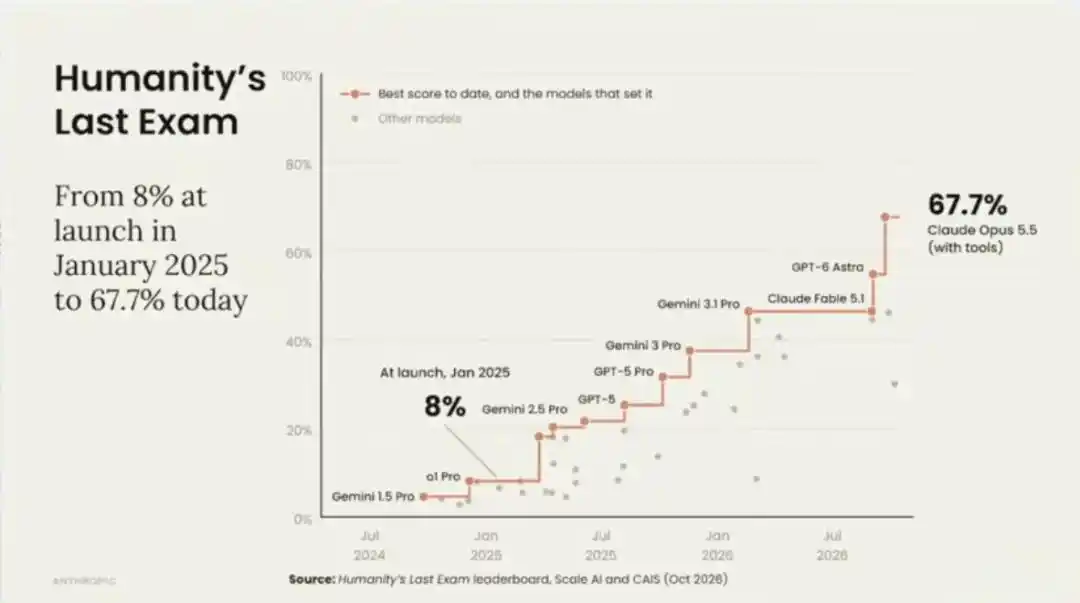
Clark used Humanity’s Last Exam, a benchmark built to challenge AI with problems from chemistry, computer science, advanced mathematics, classical literature and ecology, as one example.
When the benchmark was released in January 2025, the strongest model in the world scored only 8%. As of this week, Clark said, Claude Opus 5.5 had reached 67.7%.
He also pointed to progress in specialized testing. On FrontierMath, a difficult benchmark written by a team of professional mathematicians, top AI systems scored 2 at the end of 2024. Less than two years later, that figure had risen to 94.
Unpublished physics problems and a 98% score for GPT-6 Astra
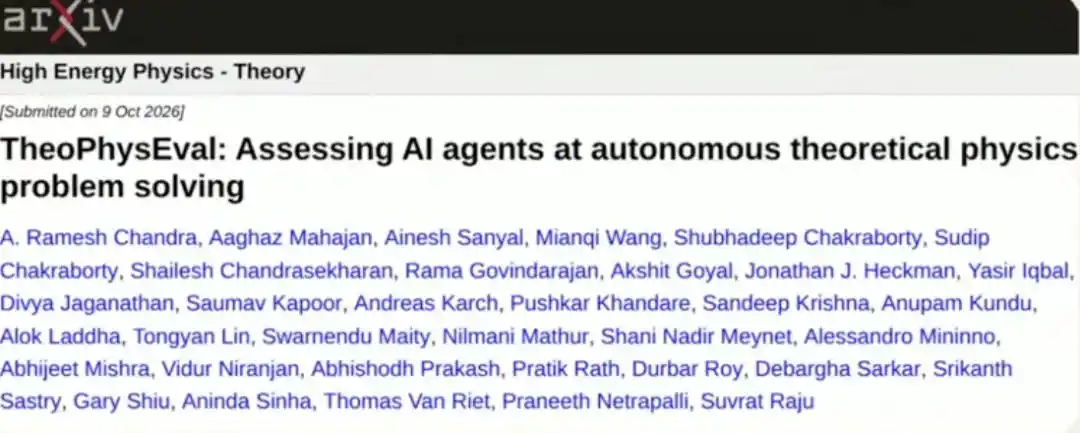
Clark then cited a physics paper published last week. The paper described a test built from 50 problems written by leading theoretical physicists based on their latest unpublished research. The questions had no trace on the public internet, which Clark presented as evidence that the models could not have relied on memorized online material.
Indian theoretical physicist Suvrat Raju described the set this way: "As far as I know, there is no human who could, without AI, solve a substantial fraction of the problems that made it into our final set." He added: "For most of these problems, I do not even know what they are saying."
GPT-6 Astra and Claude Opus 5.5 both produced answers quickly. Initial grading put GPT-6 Astra at around 80%.
Researchers checking the results found what they believed were errors and showed the model where it had supposedly gone wrong by comparing its work with expert reference answers. Clark said the model, especially GPT-6 Astra, pushed back hard. It maintained that its derivation was correct and that the human reference solution contained the mistake.
The research team then sent the disputed work back to the physicists for another review. In several key cases, after rechecking their complex drafts, the human experts concluded that their own solutions did contain subtle calculation errors and that the AI derivations were correct.
Once the human reference answers were revised, GPT-6 Astra’s final score rose to 98%, meaning it solved 49 of the 50 unpublished frontier physics problems.
Clark compared the moment to a familiar scene in film:
"There is often a scene in movies, usually around two-thirds of the way through, where the young protagonist finally proves to the mentor that they can go out on their own and succeed. It is a classic narrative turn: the student becomes the teacher. That is what happened last week."
For Clark, the point is not just that AI can answer frontier questions. It can also identify hidden blind spots in the work of top physicists. He said that shows these systems have crossed beyond memory and pattern matching and into scientific creativity. Once that creativity feeds back into AI research itself, the self-improvement loop opens.
From 10 million human scientists to virtual research armies
Clark said the next consequence is macroeconomic, not just scientific.
Economists have wrestled for decades with the idea that good ideas are getting harder to find. Over the past 50 years, global research spending has risen exponentially and the number of researchers has grown quickly, yet the marginal output of each researcher has fallen. Pushing the scientific frontier forward now requires disproportionately larger resources.
Training a capable frontier scientist takes at least 10 to 15 years of intensive education and costs millions of dollars, Clark said. Human researchers also cannot replicate themselves at scale.
UNESCO estimates that the world currently has about 10 million human scientists. In Clark’s description of the next phase, each of those scientists could direct hundreds or thousands of virtual polymaths with the same academic taste. That would expand the effective size of the global research force from 10 million human scientists to virtual clusters numbering in the billions or even tens of billions.
Clark said Anthropic’s economists ran a macroeconomic simulation under a singularity-style assumption in which AI-driven scientific discovery broadly takes over economic activity. In that model, U.S. annual GDP could reach $44 trillion by 2030, equal to 37% of today’s global economic output.
He said an increase on that scale would require a burst of new industrial forms, disruptive materials and new energy networks within a few years. Building data centers alone will not be enough. In his framing, the first phase of the AI revolution, centered on data centers and compute, is nearing its end, and the second phase is moving into the physical world.
If virtual scientists can propose 100,000 new drug targets in a day and design 10,000 candidate room-temperature superconducting materials, while real automated synthesis labs, high-throughput screening systems and physical testing platforms can run only dozens of experiments in a year, then compute will hit a wall in the physical world.
That is why, Clark said, the countries best positioned to capture the gains will be those that can rapidly deploy automated robotic laboratories at home and build fast supply chains from digital discovery to physical manufacturing. He added that this could create an opening for developing countries if they build standardized physical testing infrastructure and absorb the wave of experimental demand generated by virtual scientists worldwide.
Large gains, but also severe risk
Clark’s warning at the IMF was that the upside may be unprecedented, but the destructive risk is also severe.
Once AI can do frontier science, he said, it can be used to design new cancer drugs, but it can also efficiently design malicious biological weapons that the human immune system has never encountered. It can strengthen national power-grid defenses, but it can also generate cyberweapons that even top hacking teams cannot defend against.
Another concern is the possibility that the research loop itself slips out of human control. Clark said that if labs such as Anthropic and OpenAI fully hand over AI development to AI, letting AI write AI and train AI in pursuit of speed, the trajectory of the technology could move beyond human understanding in a very short time.
He framed the issue through two questions.
The first is which parts of science humans should keep for themselves. AI can already complete most derivation and analysis workflows in university research, he said. The boundary between experiments that humans must still do in person, through trial, error and physical intuition, and experiments that can be left entirely to silicon-based systems, now has to be redrawn. If AI handles all derivation, he asked, will the next generation of scientists still retain basic scientific insight?
The second question is how much humans need to understand the scientific breakthroughs AI produces. Clark said that in pure mathematics this year, some AI-generated proof paths were verified as correct, yet their logical jumps and structural form were so far from current human habits of thought that top mathematicians may need months or even years to interpret their deeper meaning.
Within a few years, he said, AI may invent scientific instruments and experimental paradigms that fit silicon logic but run against human intuition. If the human brain cannot understand how those black-box tools work, the question becomes whether they should still be allowed into broad real-world deployment.
Clark’s closing argument: restraint
Clark ended by focusing on restraint.
"To get through this phase and find direction inside the singularity, we need to create unusual, serious rules for this technology and for the companies building it. We also need to practice one of the hardest human qualities, and in my view one of the noblest: restraint."
In his framing, restraint means developers cannot push ahead without limits simply because something is technically possible. It means regulators must establish extremely strict lines for human oversight. It also means that, in front of a fast-moving technological train, people must keep distinguishing between what can be done and what should be done.
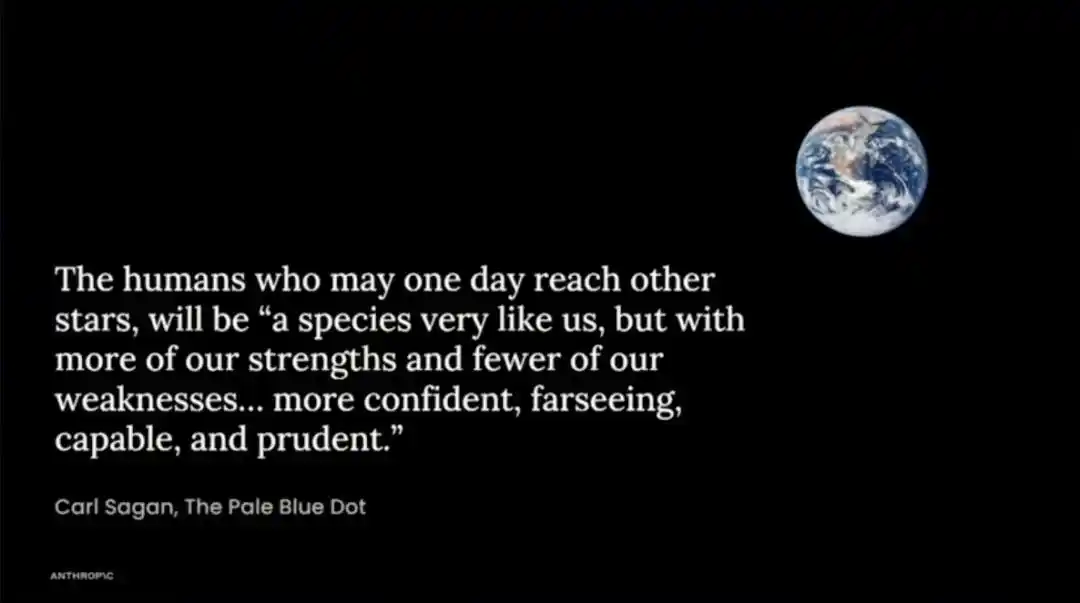
Clark closed with a passage from the late astronomer Carl Sagan’s Pale Blue Dot. Sagan imagined that the beings who eventually reach Alpha Centauri and other nearby stars would not be us as we are today, but a species very much like us, with more of our strengths and fewer of our flaws, more confident, more far-seeing, more capable and more cautious.
Clark said Sagan believed humanity had hundreds of thousands of years to correct its blindness and arrogance. In a world being reshaped by AI at geometric speed, he said, the window left for humanity to complete that mental transformation may be less than 10 years.
The original Chinese article was published by the WeChat account Quantum Positioning (量子位, ID: QbitAI) and written by Cheng Qian.


