
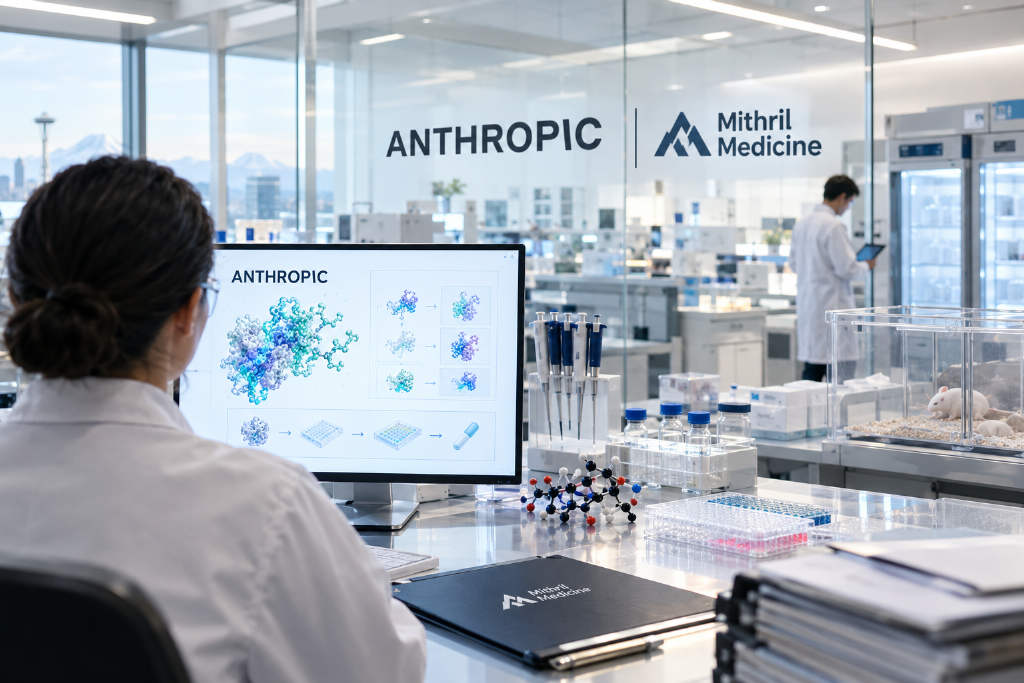
Anthropic has released early results from a set of drug-development projects involving Claude and, for the first time, said it acquired biotech company Mithril Medicine in July. According to the company, Claude is now embedded in workflows at six organizations, covering molecule design, manufacturing record review, regulatory drafting, investment evaluation, and clinical planning. Anthropic also said Mithril is developing two therapies for rare congenital muscular dystrophy, with the earliest human trial targeted for the end of 2028. At this stage, the work remains limited to lab and mouse studies.
Claude is being used across six drug-development organizations
In its research write-up, Anthropic said Claude has moved beyond molecule design and is now part of broader R&D operations. The company described deployments at six organizations, where the model is being used in tasks that include molecular design, review of manufacturing records, preparation of U.S. Food and Drug Administration materials, investment analysis, and clinical planning.
Anthropic also disclosed that it bought Mithril Medicine in July. Before the acquisition, Mithril had one full-time employee, founder Cody Tranbarger. The rest of the work was handled through part-time advisers and 11 outside labs, while contracts, logistics, and experiment coordination were managed with Claude, according to Anthropic.
Molecule design work included CAR-T and food allergy programs
One of the examples came from Generate:Biomedicines, which is trying to improve CAR-T therapy by shortening part of the genetic instructions used in the treatment. The goal was to free up space so the therapy could also be used against solid tumors.
Anthropic said six scientists used Claude Code to build multiple AI agents and redesign the segment that sends the "start attacking" signal. The best design was about 70% shorter. In lab testing, receptor levels on the cell surface, the proteins used to recognize cancer cells, were about 10 times those of the standard version, and tumor-cell killing was higher as well. The company said these were laboratory findings only and had not been validated in patients.
Divergence Labs focused on food allergy, which Anthropic said affects about 33 million people in the U.S. Existing drug Xolair can neutralize free-floating IgE in the blood, but has difficulty removing IgE that is already attached to immune cells. Divergence is trying to build a two-armed antibody, with one arm binding IgE and the other removing it.
Anthropic said Claude completed most of the design work on its own, generating about 35,000 antibody designs in roughly one month and using about 2,750 GPU hours. From concept to experimental results, the removal arm took about three weeks and the binding arm about 4.5 weeks. Anthropic said similar work in the past could take as long as nine months. The reported outcome was that 20 designs could remove IgE, with three appearing to remove more than Xolair. Another three could bind IgE, though the two arms had not yet been combined into a complete drug.
Manufacturing review and IND drafting
Before a drug can enter human testing, each batch needs records showing it was made to standard, and companies must file an Investigational New Drug, or IND, application with the FDA.
Enveda said in a technical report that it built a Claude-based review tool and tested it on four batch records. Across repeated runs, the tool found all 11 issues that human reviewers had identified. In one timed run, it also found seven additional issues that people had missed.
The final human-only review took 25.9 hours, while the tool plus human verification took 2.8 hours, a reduction of 89%. Anthropic said the 2.8-hour figure included the time spent checking the AI's output.
For Module 2 of an IND filing, the summary section, Claude produced a first draft in four hours, compared with about three months for humans. Neither figure included a separate three-week human review period. Anthropic said the draft was rated submission-ready, although the version actually filed was written by humans. In another investigator brochure, only one small unit-conversion error was found, and the corrected document was submitted to the FDA.
Target evaluation and clinical planning
Venture firm The Column Group is forming a new company called Pleiades and plans to make Claude central to its work from day one. The firm used a target-evaluation Claude Skill, a set of prewritten instructions, to test 45 target-disease pairs. Anthropic said that cut literature review time from weeks to days and was intended to make investors more willing to back riskier new targets.
Bristol Myers Squibb, or BMS, used Claude to evaluate early clinical trial plans and estimate the probability of success, with a broader rollout planned for 2027. Michael Pourdehnad, head of early clinical development, said a single prompt could produce a preliminary analysis that would otherwise take several days.
Anthropic disclosed its own drug programs through Mithril
Anthropic said in early July that it planned to develop drugs itself, but it did not identify the disease focus at the time. This update names Mithril Medicine's programs as the answer.
Mithril is targeting LAMA2-related congenital muscular dystrophy, or LAMA2-CMD. Anthropic said there are about 4,000 to 5,000 patients across the U.S. and Europe. Most are born with severe weakness, few live past age 30, and there is no approved therapy. Mithril's bispecific antibody binds two different proteins, acting like a clamp that reconnects muscle fibers to the surrounding support layer.
In Mithril's technical report, the company said it moved from concept to mouse proof of concept in less than 18 months. In the high-dose group, grip strength and muscle strength at six weeks were about twice those of the untreated group. Between weeks two and six, one of eight treated mice died, compared with four of eight untreated mice. The report also said the treated mice were still weaker than healthy mice, so the result was not a cure.
Anthropic described the setup as a "one-person pipeline": the human sets direction and makes decisions, while Claude handles records and coordination with outside labs. Tranbarger estimated that a new program can go from concept to full design in two to three days with Claude, versus one to two months without it.
Human trial timelines are goals, not promises
Anthropic said nearly all of the results are still preclinical, with no human data. Much of the material comes from partner technical reports and preprints that have not gone through peer review. The company provides Claude usage credits and engineering support to partners, and Anthropic also paid for BigHat's lab work, meaning the parties have aligned interests.
For Mithril, Anthropic said the research has already produced more than 100 bispecific antibodies for cell testing. A formal development candidate is expected to be selected in 2027. The LAMA2-CMD program is targeting a human trial by the end of 2028, while the second program, αDG, is targeting 2029. Anthropic added that these are goals, not commitments.



