
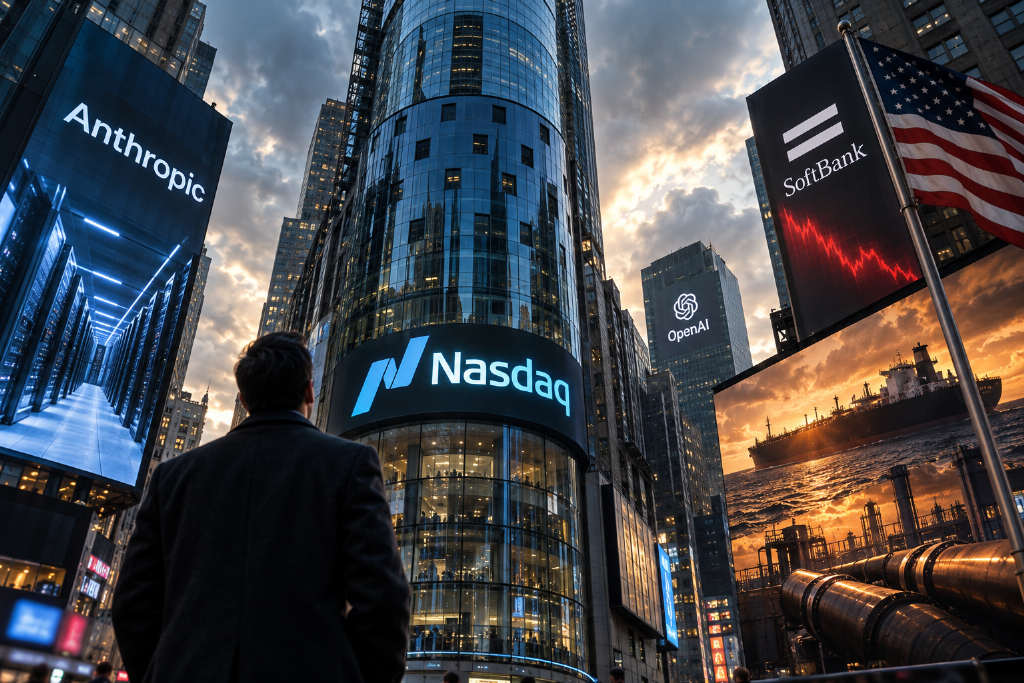
Anthropic has reportedly selected Nasdaq as the venue for its initial public offering and is targeting an October listing, with its valuation potentially reaching $2 trillion. The company is also expected to deliver a second consecutive quarter of adjusted profitability. The deal would mark another important exchange win for Nasdaq after SpaceX.
OpenAI is taking the opposite route. Chief executive Sam Altman said the company will not pursue an IPO this year, citing controversy over whether AI could pose an existential threat to humanity. SoftBank, which holds a large stake in OpenAI, fell 11% after the comment.
AI companies are splitting on the IPO question
The contrast between Anthropic and OpenAI stood out across the day’s headlines. Anthropic is reportedly moving toward a public listing on Nasdaq in October, while OpenAI’s leadership has made clear that an IPO is off the table for now.
At the same time, Visa and Mastercard joined Ant International to launch the Know Your Agent framework, a move designed to let AI shopping agents complete payments on their own. The shift takes AI from answering questions to directly making purchases, creating a new variable for the business models of both card networks.
Google DeepMind also unveiled Gemini’s agentic video understanding capability. The update is meant to let AI do more than simply watch video by enabling it to interpret behavioral logic and cause-and-effect relationships in what it sees.
Crypto flows split between BTC and ETH
Capital moved in different directions across the two largest crypto assets. Bitcoin ETFs recorded $463 million in net outflows for the week, while Ethereum ETFs took in $197 million, pointing to a clear reallocation of exposure.
Bitcoin now faces two major near-term events: a vote on the CLARITY Act and the Federal Reserve’s policy meeting. According to the report, the stablecoin bill’s outcome will directly shape the compliance path for USDT and USDC. An unexpected rate hike from the Fed would also pull more liquidity away from risk assets.
In security news, Symbiosis said it had recovered 15 BTC after its cross-chain bridge was hacked and is offering a 20% bounty for information tied to the remaining funds.
Corporate and political developments added to the mix. Bitcoin Suisse is set to cut up to half of its Swiss workforce and shift its business focus abroad. Separately, Donald Trump’s 2025 federal disclosure showed $1.4 billion in crypto-related income, a figure drawn from a public federal financial filing that sparked heavy discussion on Hacker News.
Chips and hardware stories gained traction
A community effort called CUDA for AMD on Windows climbed the Hacker News rankings after claiming it could run CUDA on AMD GPUs under Windows. The post triggered 92 comments.
Meta, meanwhile, disclosed details of its MTIA 300 training chip. It is the company’s first training chip with a built-in network interface and includes a communications offload engine, with the goal of reducing reliance on NVIDIA’s expensive InfiniBand setup.
Big Tech and equities also came under pressure
Google faced renewed criticism over advertising quality after a technical blog post said spam ads in Google Search results and on YouTube had continued to worsen. The topic received 854 upvotes on Hacker News and drew 376 comments, including remarks from users described as former ad-system employees.
Oracle co-founder Larry Ellison canceled a planned $7.5 billion sale of Oracle stock after reports had said he was preparing a large disposal. The reversal left investors trying to interpret the sudden shift.
Apple is reportedly developing a game controller for the iPhone. The report said several large companies had sent developers to Apple’s headquarters to adapt products for the upcoming iPhone Duo foldable phone.
In U.S. equities, Nike was removed from the S&P 100, with the report saying the company has lost $200 billion in market value over 18 years. Nasdaq 100 futures fell 1.5% as concerns about slower AI development gained traction. Brent rose 3%, and gold slipped below 4300.
Oil jumps as Middle East tensions intensify
Energy was the main macro driver. A critical Saudi pipeline running across the country was shut after an attack, putting roughly 4% of global oil supply at risk. Brent crude in Asian trading briefly touched $108.49.
Iran also said it had shot down an advanced U.S. drone in the Strait of Hormuz. According to the report, the United States has rerouted 101 merchant ships, raising global supply-chain costs.
Pressure inside the U.S. energy market is also rising. Trump called on Ukraine to stop striking Russian refineries, while U.S. diesel prices have hit a record high.
Traditional finance and crypto infrastructure moved closer together as well. Crypto data company Kaiko raised $110 million in a funding round led by S&P Global.
Markets are repricing faith in growth stories
The headlines spanned AI, crypto, chips, consumer brands and oil, but they pointed to the same issue: investors are reassessing how much trust to place in growth narratives.
OpenAI is staying private as debate over AI risk continues. Anthropic is reportedly moving toward a listing. Nike has dropped out of the S&P 100. Bitcoin ETFs are losing money ahead of the Fed meeting. Oil is climbing as supply disruptions and regional tensions build. As energy prices push inflation risk higher again, assets that rely on easy liquidity and long-dated growth expectations are facing a fresh valuation test.