
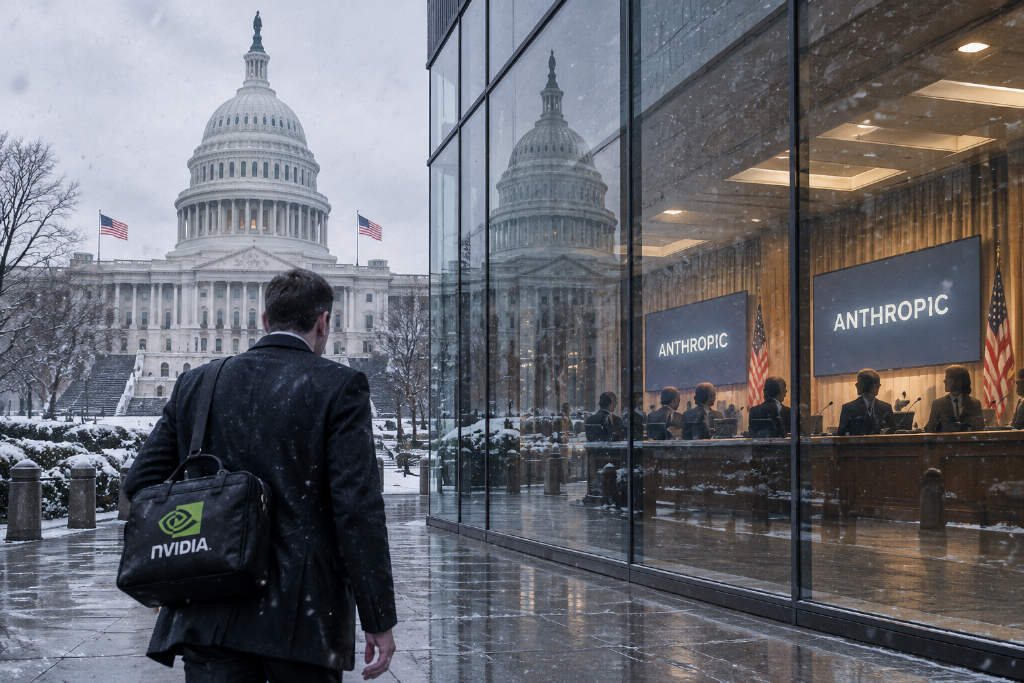
Jensen Huang resigned one day after three House committee chairs asked him to attend a closed-door briefing. The day after his resignation, the Senate Banking Committee asked him to appear at a public hearing. The sequence has drawn attention to Anthropic, the artificial intelligence company behind Claude.
Fortune reported on November 12 that an unnamed venture capitalist said: “If you ask who benefits from this, I think it’s Anthropic.” Public records reviewed in the report show overlapping financial, policy and personal connections. They do not prove that Anthropic orchestrated Huang’s departure.
From a closed briefing to a public hearing
On November 4, House committee chairs Brian Mast, John Moolenaar and Crawford jointly wrote to Huang. They asked him to attend a closed-door briefing on November 18 and address two issues: how Nvidia prevents foreign adversaries from obtaining relevant technology, and his contacts with a woman identified as Alice. The letter requested a response by November 11.
Huang resigned on November 11. The following day, November 12, Senate Banking Committee Chairman Tim Scott sent a letter asking him to attend a public hearing on December 3. The committee oversees areas that include export controls.
A closed briefing and a public hearing carry different political weight in the United States. Bringing the head of a technology company to Capitol Hill for public testimony is a formal political event. Members of Congress sit above the witness, C-SPAN records the proceedings, and a stenographer enters the testimony into the congressional record. The witness must take an oath. Lying after taking that oath is a federal felony punishable by up to five years in prison. Failure to appear can lead first to a subpoena and then to a contempt-of-Congress charge.
There is also a longer media cost. Any answer can be cut into a 15-second clip and replayed for years. Mark Zuckerberg spent two days testifying on Capitol Hill in 2018; the image most people remember is the cushion under his seat, rather than the details of his answers.
Hearings do not write laws by themselves, but they can shape whether legislation moves forward. TikTok CEO Shou Zi Chew spent several hours answering questions in the House in March 2023. Thirteen months later, Congress passed legislation requiring TikTok to sell its US business or face a ban. A hearing can mark the point at which a company’s dispute becomes a matter of national policy.
Nvidia and Anthropic’s dispute over advanced chips
Anthropic develops AI models, and its chatbot Claude is described as one of ChatGPT’s strongest rivals. Nvidia is both a major Anthropic customer and an investor in the company. The two firms have disagreed for years over whether high-end chips should be sold to Country C. Nvidia wants to keep selling them; Anthropic opposes those sales.
Huang first met Anthropic founder Dario in May 2022 at an upscale Chinese restaurant in San Francisco. According to a forthcoming book by New York Times technology reporter Kevin Roose, the meeting got off to a bad start. Before dinner, Anthropic co-founder Tom Brown approached Huang with a spreadsheet and asked for a lower price, arguing that Google’s in-house TPU chips were more economical than Nvidia’s products. Huang reportedly became angry, called Brown a “bean counter,” meaning someone focused only on the numbers, and threatened to cancel the dinner.
During the meal, Huang repeatedly discussed his plan to build the world’s largest data center. Dario later said privately that Huang was “a little like Trump.” Their public disagreements grew from there.
On April 30, 2025, Anthropic published a blog post describing alleged ways Country C obtained chips, including hiding them in fake pregnant bellies and shipping them with live lobsters. An Nvidia spokesperson responded the next day, calling the account fiction and adding: “Country C has half of the AI researchers in the world.”
At Davos in Switzerland on January 20, 2026, Dario told Bloomberg that selling Nvidia’s H200 chips to Country C was “like selling nuclear weapons to North Korea and bragging about it.” On April 15, Huang used the word “absurd” on the technology podcast Dwarkesh. He said giving up the Country C market would damage US national security and technological leadership for the benefit of one company. He did not name Anthropic, but the report connects the remark to the company’s position.
The two executives met again at the White House in the fall of 2026. Trump later confirmed a dinner with Dario on September 27. Two days later, the White House hosted a lunch on “superintelligence.” The Wall Street Journal, citing people familiar with the meeting, reported that several technology executives, including Huang, asked Dario why he described AI risks so alarmingly in public. Dario has repeatedly said that “AI could destroy humanity.”
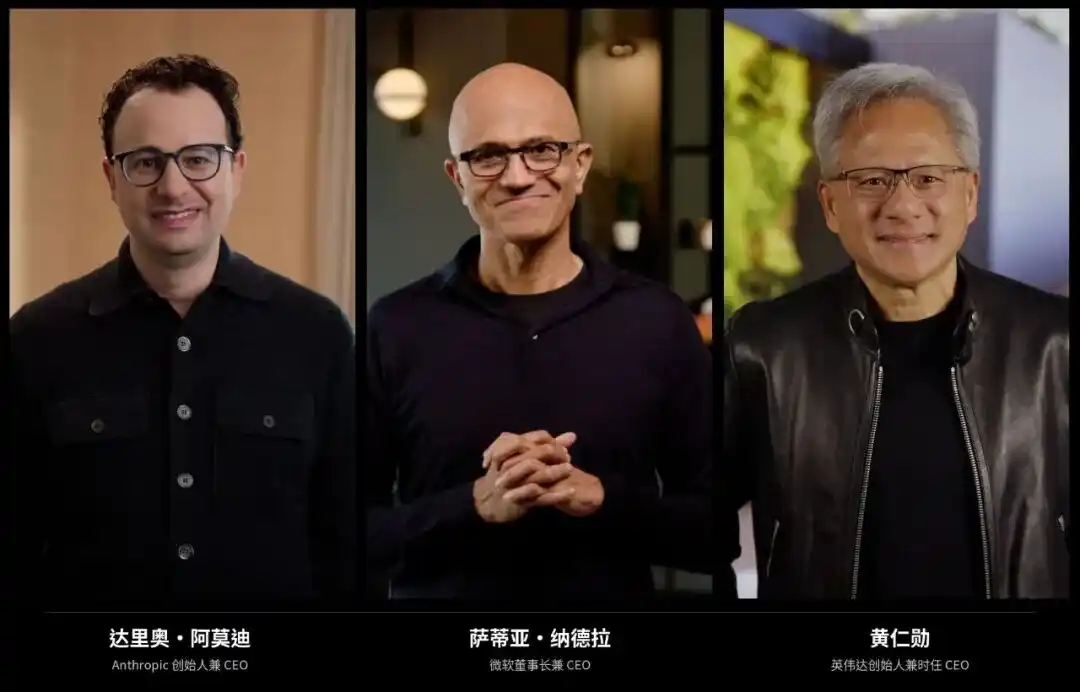
The dispute has not ended their business relationship. On November 18, 2025, Huang, Dario and Microsoft CEO Satya Nadella announced a three-way agreement. Anthropic would purchase $30 billion of Microsoft cloud computing capacity and use up to 1 gigawatt of Nvidia systems, a scale compared in the report with the output of one unit at a large nuclear power plant. Nvidia committed up to $10 billion in investment in Anthropic, while Microsoft committed up to $5 billion.
Nvidia is therefore both an Anthropic shareholder and a supplier. It is also the company’s main obstacle in its effort to limit Country C’s access to AI technology, according to the report.
Where $40 million in political funding went
On February 12, 2026, Anthropic announced a $20 million donation to Public First Action, a Washington organization that promotes AI policy. One of its co-founders is former Republican Representative Chris Stewart. Anthropic’s announcement listed four policy positions. The third concerned chips: support for “smart export controls” on AI chips to keep the United States ahead of authoritarian rivals.
On July 21, Anthropic announced another $20 million donation. This time it stated more directly that it supported tighter export controls on advanced chips and semiconductor manufacturing equipment. The two donations totaled $40 million. Based on Anthropic’s own lobbying spending of roughly $2 million per quarter, that amount would equal about five years of lobbying in Washington.
On the day of the first donation announcement, Public First Action launched its first advertisement since its creation. The ad appeared in Tennessee and thanked Senator Marsha Blackburn for her work on child online safety and AI legislation. That same day, a related political organization ran another ad in Nebraska supporting Senator Pete Ricketts. Its theme was keeping advanced AI chips out of an adversary’s hands.
Public First Action is legally organized as a 501(c)(4) group. It may lobby, conduct public advocacy and spend substantial sums, but it cannot make influencing elections its primary purpose. It also does not have to disclose its donors. A super PAC, by contrast, is built specifically to influence elections. It can run ads for or against candidates, has no spending cap, and must disclose every contribution.
In its July announcement, Anthropic said the two donations were restricted to public education and policy work and could not be used to influence any federal, state or local election. Twelve days after the first donation arrived, on February 24, Public First Action transferred $1 million to a super PAC called Public First. Summaries of Federal Election Commission filings show that it later transferred roughly $7.9 million to another super PAC, Defending Our Values PAC.
No evidence proves that the $1 million sent out came directly from Anthropic’s $20 million donation. By November, Public First Action had raised about $80 million, with Anthropic accounting for roughly half. Put another way, about 50 cents of every dollar Public First Action sent toward election-related accounts came from Anthropic.
Donations from Anthropic’s executives and employees
On May 4, 2026, Dario personally donated $1 million to the Public First super PAC. The filing listed Anthropic as his employer and CEO as his occupation. In June, five more Anthropic employees donated to the same super PAC, contributing more than $2.15 million combined.
Including Dario’s contribution, the super PAC received more than $3.15 million from Anthropic’s executives and employees. That represented more than 60% of its total fundraising of roughly $4.9 million over the full cycle. The company said its own money would not be used in elections, yet its CEO and employees became the largest source of funding for the same political account.
Anthropic also has its own political action committee, AnthroPAC. Most of its money came from $5,000 checks written by employees, with total receipts slightly above $400,000. By November, it had donated more than $195,000 to candidates from both parties, with the list split roughly evenly between Democrats and Republicans. Mast received $2,500 and Crawford received $1,000. Both were among the three House committee chairs who later wrote to Huang.
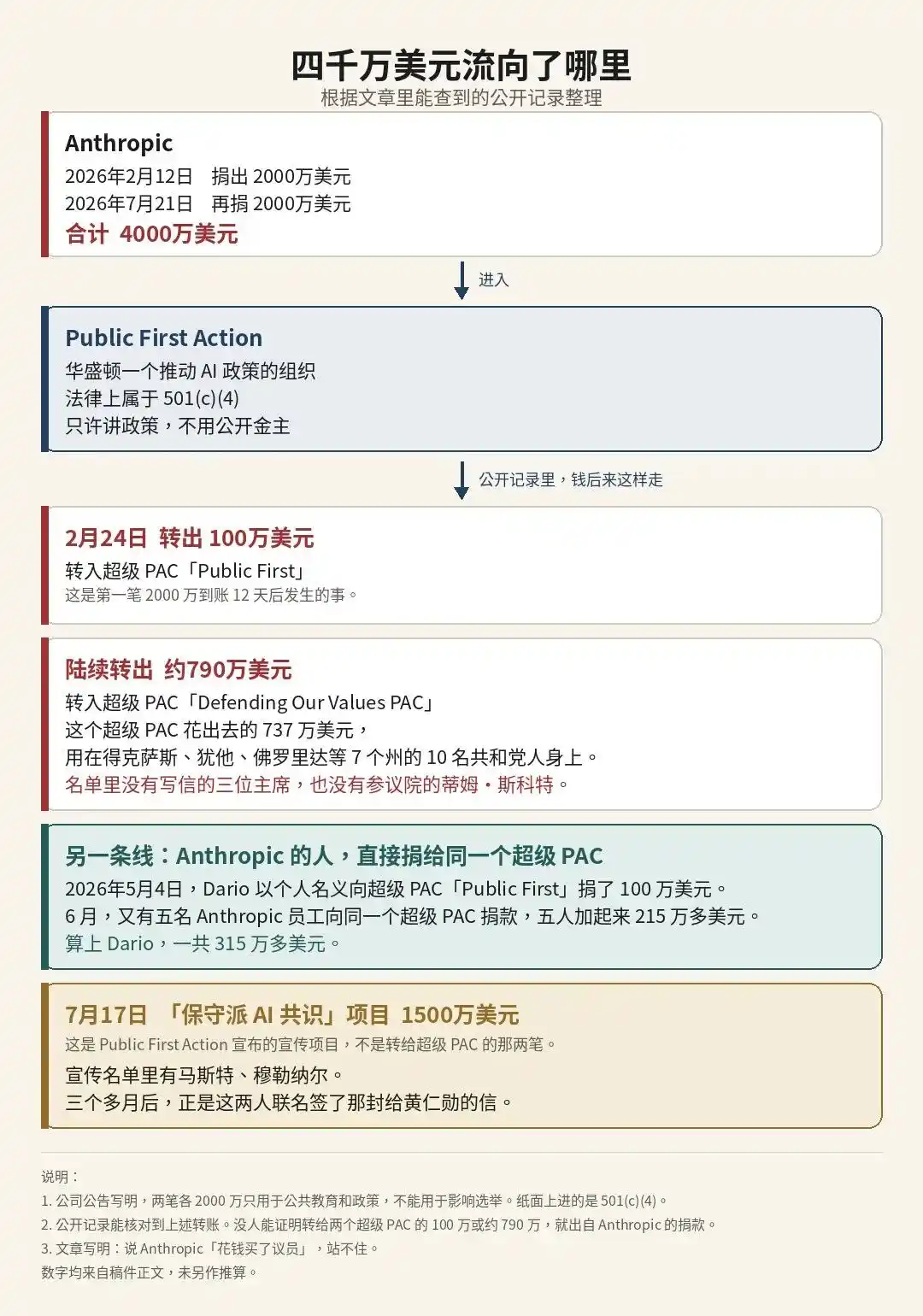
On July 17, Public First Action, which had received the $40 million from Anthropic, announced a $15 million project called “Conservative AI Consensus.” It began by spending more than $7 million on positive advertisements for four Republican lawmakers. Over the following month, it planned to support another 12 Republican lawmakers, including Mast and Moolenaar.
More than three months later, Mast and Moolenaar signed the letter requesting Huang’s closed-door briefing. The project described its purpose plainly: “Conservatives built this country’s technological advantage, and we are not going to hand it over to a few companies that answer to no one.”
The policy pipeline above the political groups
Think tanks are another source of policy ideas in Washington. Members of Congress often draw arguments and data for bills and letters from their reports. The report identifies three think tanks as important to research on how the United States should restrict Country C’s access to technology.
- The Center for Security and Emerging Technology at Georgetown University, known as CSET, was established in 2019. A Georgetown press release described it as the largest AI and policy center in the United States. Its funding came from Open Philanthropy. The first grant was $55 million, followed by two additional grants, for a total of $102 million. The center had 51 people, which works out to roughly $2 million per person under the report’s calculation.
- RAND is one of the oldest US think tanks and has long conducted research for the Pentagon. From 2020 through 2026, it received 17 grants from the same fund totaling $86.956 million.
- The Washington-based Institute for Progress, or IFP, received three grants from that fund totaling $21.457 million.
All three institutions received money from the same source. That source changed its name on November 18, 2025, to Coefficient Giving. Its founding partners are the foundation of Dustin Moskovitz and his wife, Cari Tuna. Moskovitz is a co-founder of Facebook and one of Anthropic’s earliest investors.
Forbes, citing Cari Tuna in February 2026, reported that the couple transferred their Anthropic shares to a nonprofit organization in early 2025. The shares were worth about $500 million at the time. The report places the congressional letter to Huang within a longer research and policy chain funded by an early Anthropic investor.
What the public record can and cannot show
In a long post published on November 12, the X account @Dream1984Tube raised a series of alleged connections under the headline “Who Is Really Behind the Hunt for Jensen Huang?” The post said the New York Times reporter who first reported Huang’s alleged affair had a long-standing Anthropic source; that the Financial Times reporter who first described the alleged romantic relationship had long covered Anthropic favorably; that McGuire, who first changed a social-media repost’s reference to a “romantic relationship” into “sleep,” was coincidentally a former subordinate of an Anthropic executive; that lawmakers among the first to sign a congressional investigation request had received tens of millions of dollars in Anthropic-backed support; and that the first senator to call for Huang’s resignation had previously held a private meeting with Dario.
These connections are investigative leads, not proof of causation. The public records cited in the report confirm overlaps in donations, lobbying filings, think-tank funding, policy positions and congressional action. They do not establish that Anthropic planned Huang’s resignation.
Anthropic is described as having one of the best models currently available and as one of Silicon Valley’s leading AI labs with the strictest restrictions on users from Country C. Social media searches for Claude produce guides on how to use the model domestically, but the report says those methods are generally blocked in the end. Anthropic has also recently updated an account-ban policy aimed specifically at Country C.
There is an opposing argument. If Anthropic genuinely wanted to bring down Huang, some observers say it would have been more advantageous to wait until after its own public listing. Huang’s departure casts a shadow over the broader AI industry, and Anthropic’s valuation could also be exposed to pressure.
Under the three-way agreement, Nvidia committed up to $10 billion to Anthropic. Fortune reported that Nvidia also planned to purchase roughly another $10 billion of Anthropic stock when the company goes public. The report says the parties did not appear to believe that Anthropic, valued at $1.4 trillion, would create a problem for its largest shareholder before an IPO.
The direct relationship, if any, between Huang’s resignation and Anthropic remains unresolved by the public information available.



