
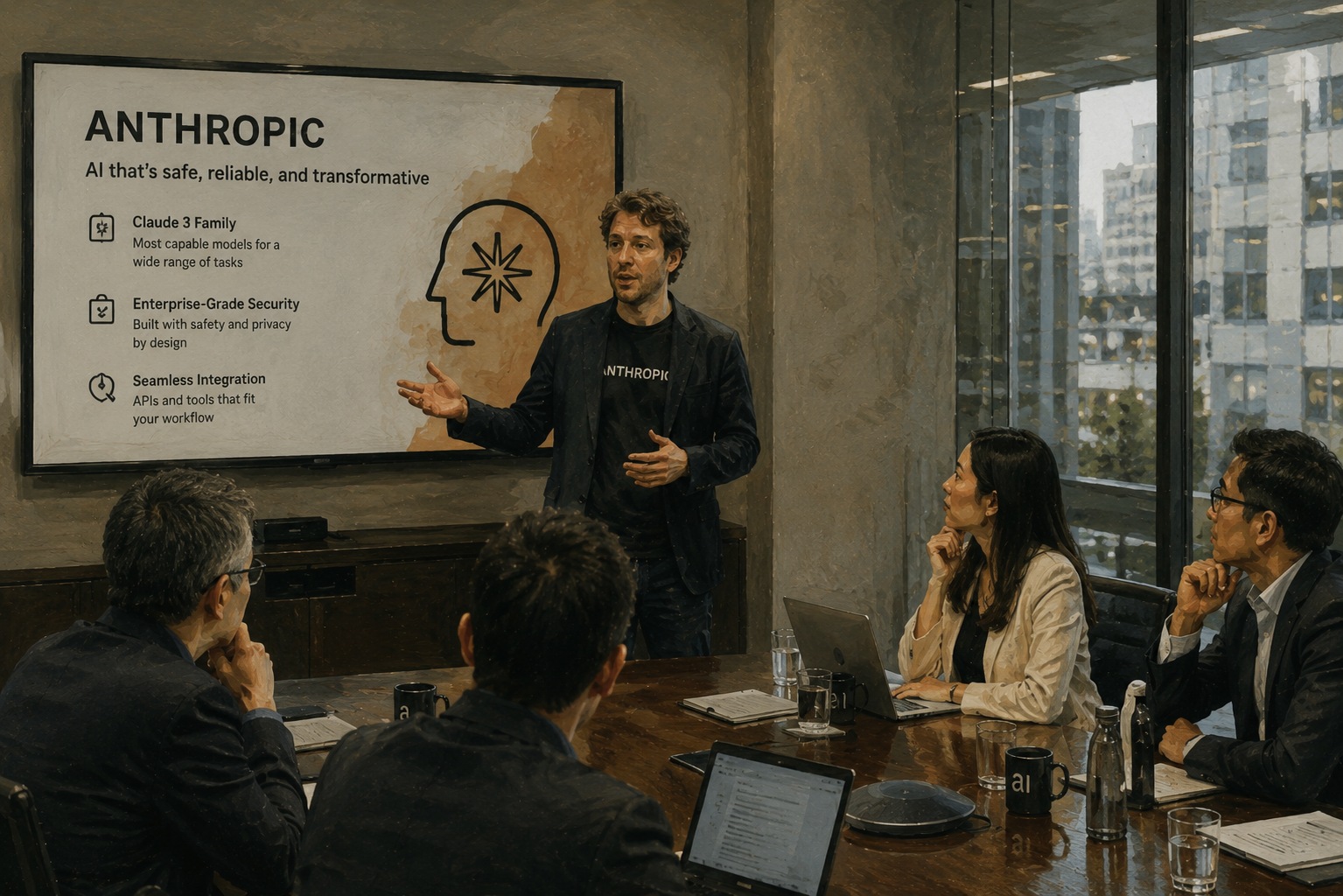
An analysis of enterprise AI usage data reveals that Anthropic achieved a 34.4% enterprise adoption rate in April 2026, edging past OpenAI's 32.3% for the first time. The shift marks not just a change in rankings but a structural redistribution of power in the generative AI market.
How Claude Gained Ground: Focus on Software and Document-Heavy Workflows
The report attributes Anthropic's growth to product strengths in software development and document-intensive enterprise workflows, particularly the network effects of Claude Code among developers. In sectors like finance, legal, and R&D—where accuracy and context comprehension are critical—Claude's penetration is notably higher. The data shows Claude models handle over 25 billion API calls per month, with about 45% coming from enterprise users. That means enterprise clients account for nearly half of Claude's API traffic, a revenue structure that suggests growth is not solely driven by consumer subscriptions. Even more telling: over 70% of Fortune 100 companies have adopted some form of Claude tool. Claude is moving from a "top option" toward a "de facto standard" in the enterprise segment. But the numbers also hint at a mid-term ceiling—once a majority of large enterprises have tried or deployed Claude, the next wave of growth will depend on deeper integration rather than raw adoption expansion.
Lower Switching Costs Accelerate Market Churn
The enterprise AI market is shifting from a "brand-driven phase" to a "multi-vendor competition driven by performance and cost." The key catalyst is the dramatic drop in model-switching costs. Unlike 2023–2024, when locking into one model meant rewriting prompts, tuning API endpoints, or retraining vector databases, companies now increasingly adopt model-router architectures that maintain two or three API keys at the application layer and switch dynamically via A/B testing or real-time cost calculations. This amplifies market share volatility: a lead can reverse in a short cycle. Anthropic's 34.4% edge is symbolic, but with switching costs shrinking, a 2.1-percentage-point gap could be just a quarterly fluctuation.
Taiwan's Angle: Cloud Sovereignty and Data Residency Become New Variables
The news carries special significance for Taiwan's market, where enterprises are accelerating AI adoption in 2025–2026 but face a challenge less felt in the U.S.: cloud sovereignty and data residency. While U.S. firms can freely choose between Claude or GPT-4.5 as their enterprise AI backend, Taiwanese companies must consider whether data will fall under U.S. laws like the Defense Production Act, and whether inference latency (20–25ms round-trip to San Francisco) is acceptable. For Taiwan's financial sector, the Financial Supervisory Commission's "Generative AI White Paper" (2025) lists model supplier diversity as a risk management factor—meaning banks will not bet all their AI chips on a single U.S. vendor. The near tie between Anthropic and OpenAI actually insures Taiwanese enterprises, as two similarly sized products reduce switching costs. Moreover, the AI inference boom in Taiwan's semiconductor industry (especially the TSMC supply chain) opens a "third path" for local models, such as MediaTek's Moto AI or custom models backed by TSMC fabrication. The global AI model race is shifting from "whose model is best" to "whose supply chain is most stable"—a structural trend that could favor Taiwan.