
Nvidia founder Jensen Huang’s departure has prompted questions about the forces surrounding him, including a planned congressional hearing, Anthropic’s political spending and its long-running disagreement with Nvidia over advanced chip sales to China. Odaily reviewed public filings, policy announcements and media reports that show links among people and organizations in the debate. The records do not establish that Anthropic engineered Huang’s departure.
Fortune, in a November 12 report, quoted an unnamed venture capitalist saying: “If there’s anyone who benefits from this, I think it’s Anthropic.” Anthropic develops AI models and makes Claude, one of ChatGPT’s strongest competitors. The company is both a major Nvidia customer and an Nvidia investee. The two have clashed for years over whether advanced chips should be sold to China: Nvidia has wanted to sell them, while Anthropic has opposed the sales.
An X user, @Dream1984Tube, published a long post on November 12 titled “Who Is Really Behind the Hunt for Jensen Huang?” The post pointed to a series of alleged connections. It said the long-term source of the New York Times reporter who first reported Huang’s alleged affair was associated with Anthropic; that the Financial Times reporter who first covered the romantic relationship had a history of favorable Anthropic coverage; and that McGuire, who changed a social media repost about the relationship to “sleep,” had previously worked under an Anthropic executive. It also said lawmakers who signed an early congressional inquiry had received tens of millions of dollars in support from Anthropic, and that the senator who first called for Huang to resign had held a closed-door meeting with Anthropic chief Dario. The post asked whether a series of coincidences should be viewed differently from a single one.
Odaily says it compared these claims with donation records, legislation, lobbying disclosures and public reporting. The account below concerns facts visible in public records; those records do not establish what the people involved intended.
Congressional scrutiny continued after Huang resigned
On November 4, three House committee chairs—Brian Mast, John Moolenaar and Crawford—jointly wrote to Huang. They invited him to a closed-door briefing on November 18 to discuss how Nvidia prevents foreign adversaries from gaining access to technology, as well as his dealings with a woman identified as Alice. The letter asked Huang to respond by November 11. He resigned on November 11.
The congressional process did not stop there. On November 12, Senate Banking Committee Chairman Tim Scott invited Huang to testify at a public hearing on December 3. The Senate Banking Committee has jurisdiction over export controls. A closed-door briefing and a public hearing carry very different levels of exposure.
In the United States, bringing a technology-company chief executive before Congress for a public hearing is a form of public accountability. Lawmakers sit above the witness, cameras and lights focus on the witness stand, C-SPAN records the proceedings, and a clerk transcribes testimony for the congressional record. Witnesses take an oath. Lying under oath is a federal felony that can carry a maximum five-year sentence. Failure to appear can lead first to a subpoena and then to contempt-of-Congress proceedings.
There can also be a lasting media cost: any answer can be cut into a short clip and recirculated for years. Odaily points to Mark Zuckerberg’s two days of testimony on Capitol Hill in 2018. The image most remembered from the hearing was the cushion beneath him; fewer people recall what he said.
A hearing does not itself write legislation, but it can affect whether a bill advances. In March 2023, TikTok CEO Shou Zi Chew testified for several hours before the House. Thirteen months later, Congress passed a law requiring TikTok to sell its business or face a potential ban. Odaily describes hearings as a turning point at which a company’s issue becomes a matter of national politics.
Huang had already resigned, but the planned hearing was still set to proceed, and the questions before Congress were broader than one individual. Odaily writes that bringing a figure close to Donald Trump—described in the article as the only person comparable to Elon Musk in having a seat on Trump’s plane—to a hearing would not be a simple undertaking. Anthropic’s name, the article says, kept resurfacing.
A dinner, a chip-export dispute and a business partnership
Odaily cites an upcoming book by New York Times technology reporter Kevin Roose for an account of Huang’s first meeting with Anthropic co-founder Dario in San Francisco in May 2022. Before dinner at an upscale Chinese restaurant, Anthropic co-founder Tom Brown approached Huang with a spreadsheet to negotiate price, arguing that Google’s in-house AI chips, known as TPUs, offered better value than Nvidia’s. Huang became angry, called Brown a “bean counter” and threatened to cancel the dinner.
At the table, Huang repeatedly talked about building the world’s largest data center. Dario later privately remarked that Huang was “a bit like Trump.” The two men would go on to clash over chips and the risks of AI.
On April 30, 2025, Anthropic published a blog post describing alleged ways China obtained chips, including hiding them in fake pregnancy bellies and shipping them among live lobsters. The next day, an Nvidia spokesperson said the claims were made up and added: “China has half of the world’s AI researchers.”
On January 20, 2026, Dario told Bloomberg at the World Economic Forum in Davos, Switzerland, that selling Nvidia’s H200 chips to China was “like selling nuclear weapons to North Korea and bragging about it.” On April 15, Huang called that argument “absurd” on the Dwarkesh technology podcast. He said giving up the Chinese market would hurt U.S. national security and technological leadership, all for the benefit of one company. Huang did not name that company; Odaily says the criticism was understood to refer to Anthropic.
The two met again around White House events in the fall of 2026. Trump later confirmed that he had dinner with Dario on September 27. Two days later, the White House held a lunch about “superintelligence.” The Wall Street Journal, citing people familiar with the matter, reported that several technology executives, including Huang, asked Dario in person why he spoke so alarmingly in public about AI risks. Dario often says that “AI could destroy humanity.”
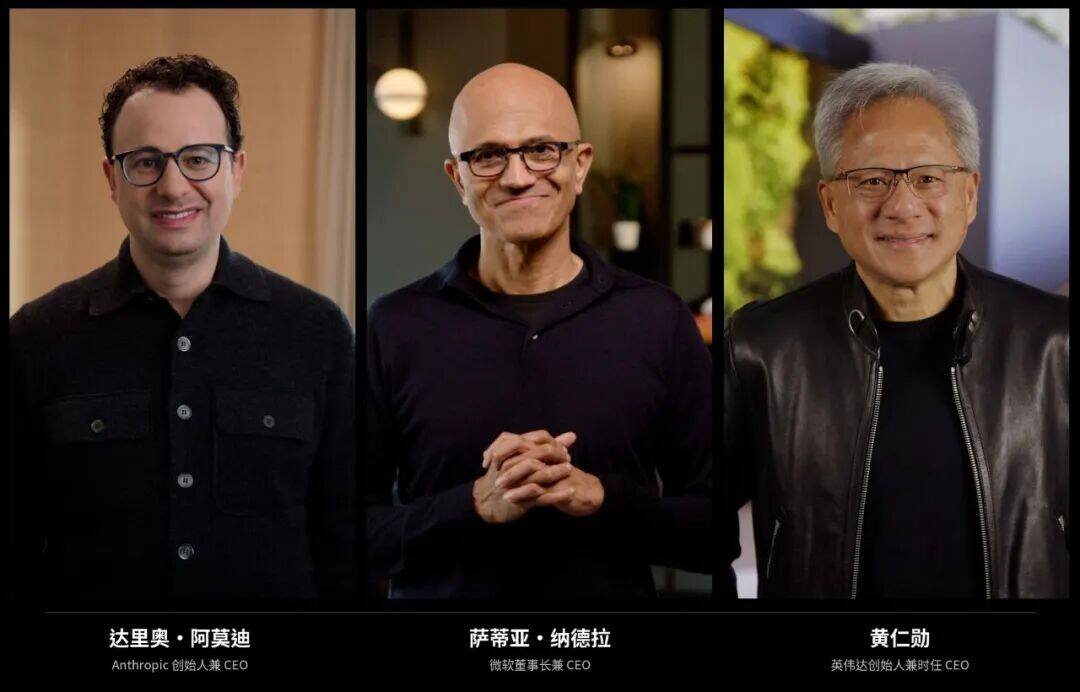
The relationship has not been all conflict. Nvidia has leading chips, and the companies also struck a deal. On November 18, 2025, Huang, Dario and Microsoft CEO Satya Nadella announced a three-way partnership. Anthropic would buy $30 billion of Microsoft cloud computing and use up to 1 gigawatt of Nvidia systems. Nvidia committed to invest up to $10 billion in Anthropic, while Microsoft committed up to $5 billion. The source compared 1 gigawatt to the output of a unit at a large nuclear power station.
Nvidia is therefore an Anthropic shareholder and supplier, while also being a major obstacle to Anthropic’s effort to restrict China’s access to AI technology.
Where the $40 million in donations went
On February 12, 2026, Anthropic announced a $20 million donation to Public First Action, a Washington group that advocates for AI policy. One of its co-founders is Chris Stewart, a former Republican member of the House. Anthropic’s announcement listed four policy positions. The third called for “smart export controls on AI chips” to keep the United States ahead of authoritarian rivals.
More than five months later, on July 21, Anthropic announced another $20 million contribution. This time the company explicitly backed tighter export controls on advanced chips and semiconductor manufacturing equipment. The two donations totaled $40 million. Based on Anthropic’s own lobbying expenditures of roughly $2 million a quarter, Odaily calculated that $40 million would equal about five years of its Washington lobbying spending.
On the day the first donation was announced, Public First Action ran its first advertisement since forming. In Tennessee, it thanked Senator Marsha Blackburn for her work on children’s online safety and AI legislation. That same day, a campaign group affiliated with it ran another ad in Nebraska supporting Senator Pete Ricketts, with the message of keeping advanced AI chips out of adversaries’ hands. The organization began advertising on the day the donation was announced.
Two types of political groups help explain the funding trail. Public First Action is organized as a “501(c)(4),” a category that allows lobbying and public advocacy and can spend heavily, but does not allow influencing elections to be its primary purpose. Such organizations do not have to disclose their donors. A Super PAC, by contrast, is specifically designed to influence elections. It can run ads for or against candidates and has no spending limit, but it must disclose each contribution. One type cannot make elections its primary purpose but is less transparent; the other engages directly in elections and must disclose its funding. Anthropic’s $40 million went to the first type.
In its July announcement, Anthropic said both donations were for public education and policy work and could not be used to influence any federal, state or local election. But 12 days after the first donation arrived, on February 24, Public First Action transferred $1 million to a Super PAC called Public First. A summary of Federal Election Commission filings also shows that it later transferred about $7.9 million to another Super PAC, Defending Our Values PAC.
No one has shown that the $1 million transfer came directly from Anthropic’s $20 million donation. Still, by November Public First Action had raised about $80 million, with Anthropic accounting for roughly half. Odaily’s illustration: for every dollar the group sent toward election activity, about 50 cents came from Anthropic.
Anthropic personnel also gave to the campaign group. On May 4, 2026, Dario personally donated $1 million to the Public First Super PAC. The filing listed Anthropic as his employer and CEO as his occupation. In June, five other Anthropic employees gave more than $2.15 million in total to the same Super PAC. Including Dario’s contribution, the PAC received more than $3.15 million from Anthropic personnel—over 60% of its approximately $4.9 million raised during the cycle.
Anthropic said company donations would not be used for elections, while its CEO and employees became major donors to the same campaign account.
Anthropic also has its own political action committee, AnthroPAC. Almost all of its money came from $5,000 checks written by employees, and it raised just over $400,000. By November, it had donated more than $195,000 to candidates from both parties, with the recipient list split roughly evenly between Democrats and Republicans. Mast received $2,500 and Crawford $1,000; both had signed the letter to Huang.
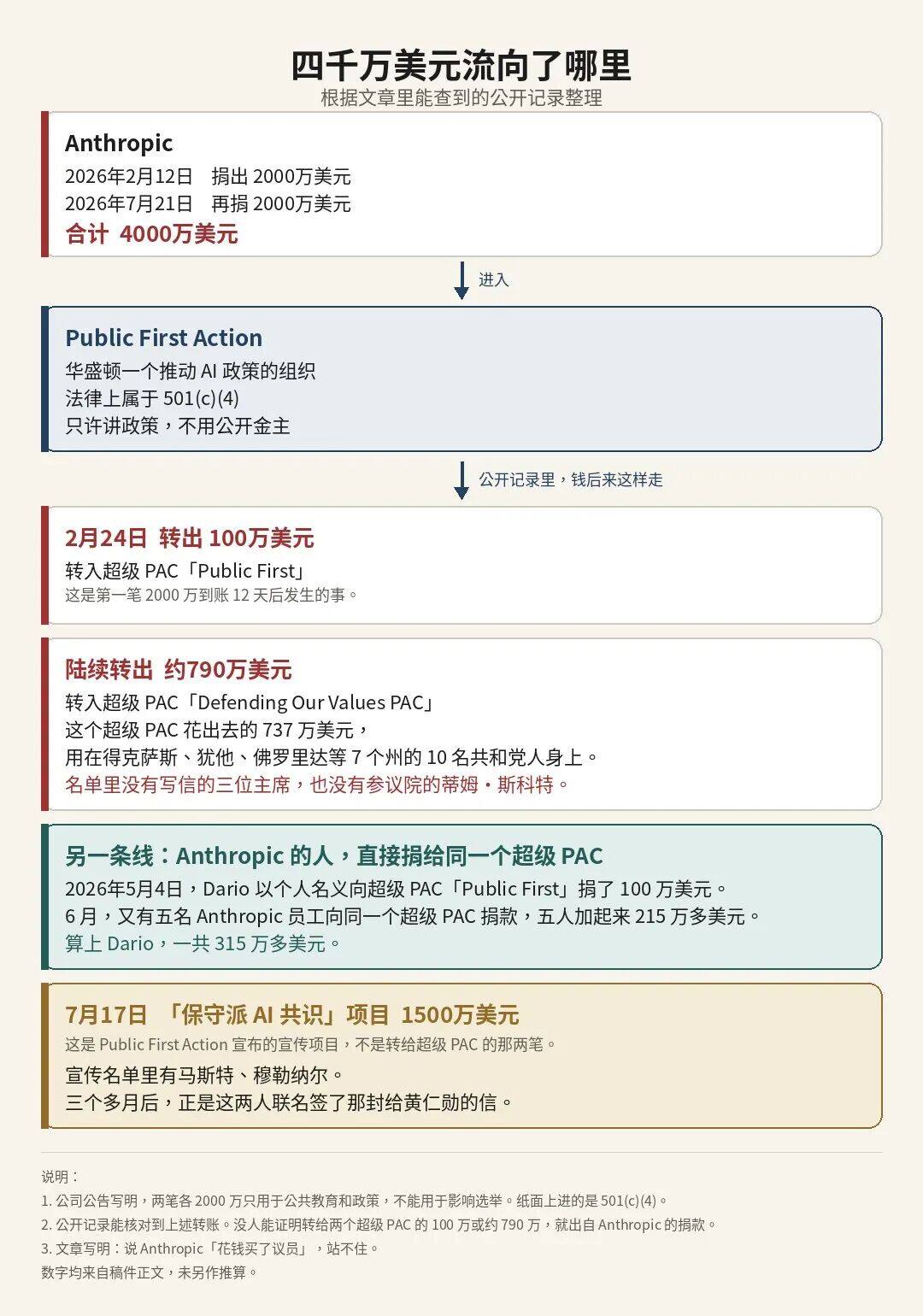
On July 17, Public First Action announced a $15 million initiative called “Conservative AI Consensus.” The group had received Anthropic’s $40 million in donations. It planned to spend more than $7 million at the outset on positive ads for four Republican lawmakers, then promote 12 more during the following month. Mast and Moolenaar were among them. A little over three months later, Mast and Moolenaar jointly signed the letter asking Huang to attend a briefing.
The initiative described its aim this way: “Conservatives built this country’s technological advantage. They won’t hand it over to a few companies that don’t listen to anyone.”
Think-tank grants trace back to an Anthropic investor
Odaily then looked upstream at think tanks, which advise policymakers in Washington. Reports from these organizations often supply arguments and data used by lawmakers drafting bills and letters. The article focuses on three think tanks involved in debates over how the United States should restrict China’s access to technology.
The first is Georgetown University’s Center for Security and Emerging Technology, or CSET. When it launched in 2019, a Georgetown University press release called it “the largest AI and policy center in the United States.” Its funding came from the philanthropic fund Open Philanthropy: an initial $55 million grant followed by two additional grants, bringing the total to $102 million. CSET had 51 staff members. Dividing the total funding by that headcount yields roughly $2 million per person, as the article notes.
The second is RAND, a long-established U.S. think tank that has long conducted research for the Pentagon. From 2020 through 2026, RAND received 17 grants from the same fund, totaling $86.956 million.
The third is Washington’s Institute for Progress, or IFP. It received three grants totaling $21.457 million. All three organizations received money from the same source.
That source changed its name to Coefficient Giving on November 18, 2025. Its founding partners include a foundation established by Dustin Moskovitz and his wife, Cari Tuna. Moskovitz co-founded Facebook and was one of Anthropic’s earliest investors. Forbes reported in February 2026, citing Tuna, that the couple transferred their Anthropic shares to a nonprofit organization in early 2025. The shares were worth about $500 million at the time.
Odaily links the letter to Huang to research produced over the years by this policy pipeline, and notes that an Anthropic investor stood upstream of its funding. The connections described do not prove that the investor directed the letter or congressional inquiry.
Public records do not settle who benefited
Odaily stresses that none of the material establishes that Anthropic alone brought about Huang’s departure. The donations, policy positions and relationships can be checked against public records; the motives behind the activity cannot be determined from those records.
The article describes Anthropic as having one of the best models currently available and as one of the most restrictive major frontier AI labs in Silicon Valley toward China. Searches on social media turn up guides to using Claude in China, but Odaily says these methods generally end in account bans. Anthropic had also recently updated an account-ban policy specifically targeting China.
There is a counterargument. Some people say that if Anthropic truly wanted to move against Huang, it would make more sense to wait until after an initial public offering. Huang’s departure has cast uncertainty over the AI industry, and Anthropic’s own valuation could also face pressure.
The partnership makes the relationship harder to read. Under the three-way agreement, Nvidia committed to invest up to $10 billion in Anthropic. Fortune reported that Nvidia also planned to buy about $10 billion in Anthropic shares when the company goes public. The article asks whether a company valued at $1.4 trillion would put its own major shareholder at risk before an IPO. The cited material does not answer that question, and the truth behind Huang’s departure remains unknown.



