
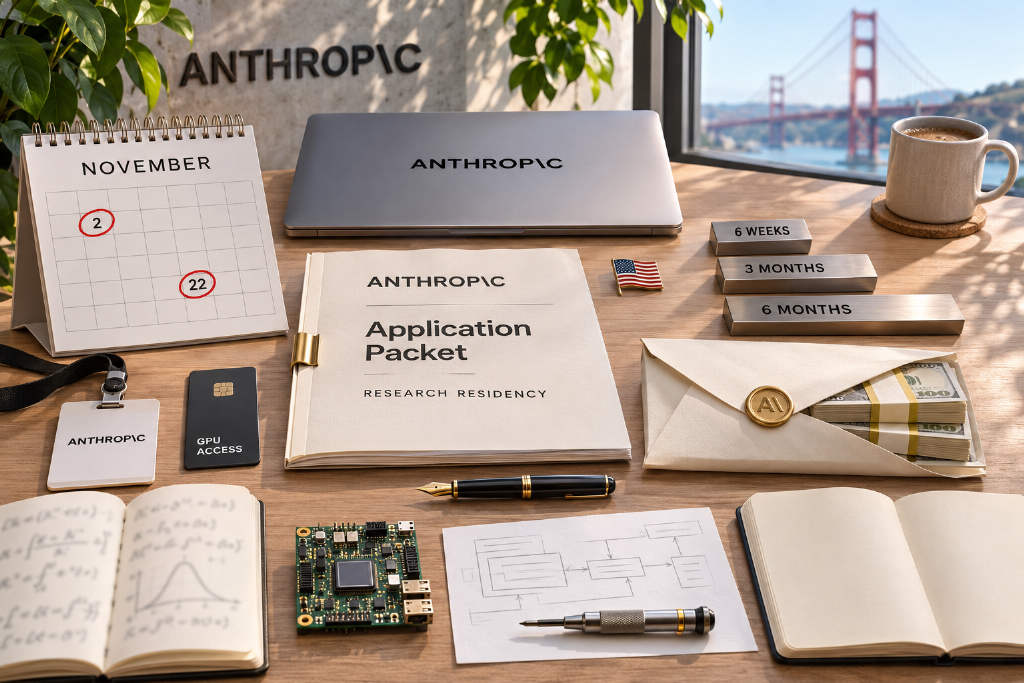
Anthropic said on Nov. 2 on its Alignment Research blog that applications are open for Anthropic Residency, a paid research program with fixed terms. The company listed annualized compensation at $350,000 to $500,000 and set the application deadline for Nov. 22.
Applicants do not need a machine learning background, according to the program description. Anthropic also said the role does not require a PhD, prior machine learning experience, or published research papers.
Program targets experienced technical leaders
Anthropic said the residency is not designed for beginners. It is aimed at people such as professors in quantitative fields, founders with technical backgrounds, and staff-level senior engineers — people who have led important work in their original fields and want to shift into AI safety research.
Three term options: six weeks, three months, or six months
The residency is offered in three lengths: six weeks, three months, and six months. Applicants can choose among them during the application process. According to Anthropic's U.S. job listing, the $350,000 to $500,000 figure is annualized, and actual pay is prorated based on the length of participation. Benefits are included.
Anthropic said it can help with visas for participants staying longer than three months. For the six-week option, the company said short-term participants are advised to join remotely from countries where Anthropic is able to employ them.
The company said it prefers participants to work from its San Francisco office, but remote participation is also accepted, especially for shorter placements. Applications are split across separate job pages for the United States and the United Kingdom.
One-on-one mentorship and access to frontier models
Each participant will be paired with an Anthropic researcher for one-on-one guidance. Research topics will be proposed by Anthropic teams and then matched to each participant's background.
The program also includes self-study time and lectures intended to help participants build foundations in modern machine learning and AI safety research. Anthropic said participants will also receive access to frontier models and dedicated compute.
Potential mentors listed by Anthropic include Ethan Perez, who leads the Alignment Science team; Evan Hubinger, who leads the Alignment Stress Testing team; and Nicholas Carlini, whose work covers adversarial machine learning and AI security and who previously worked at Google Brain and DeepMind.
Research areas include security, cryptography, and red teaming
Anthropic said research areas for the residency include scalable oversight, AI control, model internals and interpretability, safeguards, AI welfare, and red teaming for frontier models.
The company described that red teaming work as testing what models can do in areas such as cybersecurity, robotics, and cryptography.
Extension of the Anthropic Fellows program
Anthropic said this round extends its existing Anthropic Fellows program, but is now tailored specifically to established technical leaders.
One result from the earlier Fellows program, Anthropic said, was a smart contract vulnerability study published in December 2025. In that work, the research team built a benchmark from 405 contracts that had been attacked in the real world between 2020 and 2025. On contracts that were exploited only after the model training cutoff, attack code written by AI agents including Claude and GPT-5 had a combined value of $4.6 million.
Anthropic said machine learning is still a young field and that many of its senior researchers originally came from physics, mathematics, neuroscience, or software engineering. By the end of the residency, the company said it hopes each participant will continue doing AI research full time, whether at Anthropic or elsewhere.



