
Anthropic has publicly filed an S-1 registration statement with the U.S. Securities and Exchange Commission, setting up a proposed Nasdaq Global Select Market listing for its Class A common stock under the ticker ANT. The company said in a same-day announcement on its website that the number of shares to be offered and the price range have not been determined. The filing is dated October 26 in U.S. Eastern Time, and the registration statement is still marked as not yet effective, which means no shares can be sold before it takes effect.
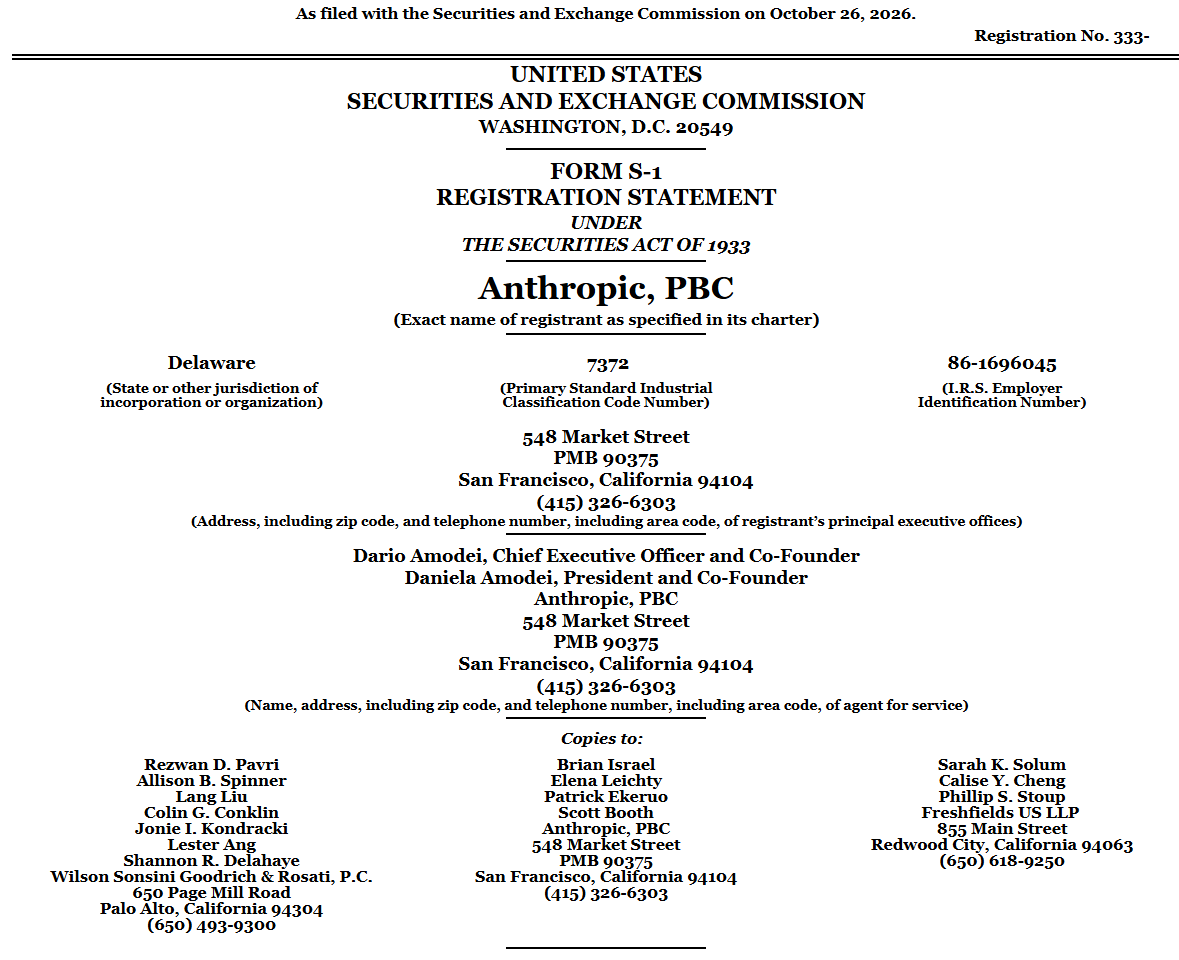
The filing includes an unusual admission for a company heading toward public markets. Anthropic wrote that it had “materially underestimated compute demand in the past.” The S-1 presents two sharply different ledgers at once: surging revenue and a narrowing operating loss on one side, and hundreds of billions of dollars in future compute-related commitments on the other.
Revenue in six months topped all of 2025
For the six months ended June 30, 2026, Anthropic reported revenue of $16.29 billion, up from $1.16 billion in the same period a year earlier, an increase of about 1,304%. The company generated $4.59 billion in revenue for all of 2025, so the first half of 2026 alone was about 3.55 times that figure.
The earlier base was far smaller. Anthropic posted about $41 million in revenue for all of 2023. In roughly three years, the company moved from annual revenue measured in the tens of millions to more than $16 billion in six months.
The growth trend was still extending beyond the reporting period. Reuters had previously reported that Anthropic’s annualized revenue had exceeded $65 billion by the end of July 2026. A separate August report said the company had given investors 2028 revenue guidance of $190 billion to $200 billion. That figure was described to investors as an expectation at the time, not as revenue already achieved.
The customer base also expanded quickly in both count and size. According to the filing, more than 11,900 customers generated at least $100,000 each over the past 12 months, up from more than 950 a year earlier. More than 1,900 customers were paying at least $1 million annually, and about 250 were above $10 million. For the nine months ended September 30, 2026, no single customer accounted for more than 10% of revenue. The top five customers together made up about 25%, while the remaining roughly 75% came from a broader and more distributed customer base.
An $80.75 billion net loss, mostly from valuation changes
The most eye-catching figure in the income statement is net loss. Anthropic reported a net loss of $80.75 billion for the first half of 2026, roughly five times its revenue for the same period.
But the filing says about $72.39 billion of that amount came from fair-value changes tied to convertible notes, derivative liabilities, and future equity agreements. These instruments all involve arrangements under which investors may convert into company stock under certain conditions. As Anthropic’s valuation rose, the accounting value of those future equity-linked obligations rose as well, and the increase was recorded as a loss under accounting rules.
The filing indicates that this was not a cash outflow. The company’s higher valuation pushed up the book value of those liabilities, and that component accounted for about 90% of total net loss.
Operating loss, which gives a cleaner view of the core business, was much smaller. Anthropic posted an operating loss of $693 million in the first half of 2026, compared with $2.14 billion a year earlier, a decline of about two-thirds.
That improvement came from revenue growing faster than compute costs. Compute and infrastructure expense reached $8.95 billion in the first half, up from $2.33 billion a year earlier, an increase of about 3.8 times. Revenue over the same period rose about 14 times. A year ago, Anthropic was spending about $2 on compute and infrastructure for every $1 of revenue. In the first half of 2026, that figure fell to about $0.55.
Minimum future payment obligations of about $417 billion
A narrower operating loss does not mean the funding question has eased. The larger numbers in the filing sit in future contracts.
Anthropic said that after the end of 2025 it signed or amended compute, infrastructure lease, and commercial agreements carrying about $417 billion in minimum future payment obligations. “Minimum payments” are the portions fixed in the contracts and payable whether or not the company fully uses the compute capacity.
There is another layer beyond that. Anthropic said it expects to pay an additional $125 billion to $150 billion under agreements whose terms have not yet been finalized. Taken together, those two buckets amount to about $542 billion to $567 billion.
One contract shows the scale on its own. Anthropic’s service agreement with compute provider NScale provides for total spending of as much as about $44.6 billion through 2033, close to ten times Anthropic’s full-year 2025 revenue.
A larger figure has also circulated in the market. The Wall Street Journal, citing a draft prospectus, reported that Anthropic’s compute spending cap over the coming years could reach $750 billion. That number is a cap, not the same thing as the minimum payments already contracted or the expected payments under pending terms, so the three figures cannot be added together.
Against those obligations, Anthropic reported $112.4 billion in cash and cash equivalents and $19.3 billion in short-term investments as of June 30, for a combined total of about $131.7 billion. Since inception, the company has raised about $141.1 billion. The combined total of signed and expected payments is about 4.1 to 4.3 times the cash and short-term investments on hand.
Zacks analyst Andrew Rocco put it plainly, saying Anthropic “definitely needs that money.” On the use of proceeds, The AI Insider said Anthropic planned to use the funds for working capital, operating expenses, compute and infrastructure, and hiring. The company did not say the IPO proceeds would be dedicated solely to compute.
Read together, the admission that Anthropic had “materially underestimated compute demand in the past” and the $417 billion in contracts point to the company’s trade-off. Rather than risk being constrained by compute again, it appears willing to sign more capacity in advance. The premise behind that choice is the speed of revenue growth.
From seven founders to a $965 billion valuation
Anthropic did not begin as an obvious giant. From late 2020 into 2021, seven people including former OpenAI VP of Research Dario Amodei and former VP of Safety Policy Daniela Amodei left OpenAI to start the company. Anthropic was incorporated in February 2021 and announced a $124 million Series A in May, led by Skype co-founder Jaan Tallinn.
Its product came later. Anthropic launched the Claude model in March 2023. In September that year, Amazon said it would invest up to $4 billion. In October, Google agreed to invest up to $2 billion. Within six months, the two largest cloud companies in Anthropic’s orbit had both stepped in, and over the following years the company’s funding, compute access, and sales channels became closely tied to them.
In March 2024, Anthropic released Claude 3. In August, it faced a class-action lawsuit from authors. In November, Amazon invested another $4 billion.
The steepest move came in valuation after 2025. Anthropic raised $3.5 billion in March 2025 at a post-money valuation of $61.5 billion. In September 2025, it raised $13 billion at $183 billion post-money. In February 2026, it raised $30 billion at $380 billion post-money. In May 2026, it raised $65 billion at a $965 billion post-money valuation. Over 14 months, the valuation increased by about 15 times, while the size of a single financing round climbed from $3.5 billion to $65 billion.
That valuation curve is the other side of the same story as the $72.39 billion non-cash loss. Each step up in valuation triggered another remeasurement of liabilities tied to convertible notes and future equity agreements.
One month later, in June 2026, Anthropic confidentially submitted its IPO paperwork.
The company’s view of its industry appears at the start of the filing: “We believe the diffusion of AI throughout the global economy represents one of the greatest opportunities in human history to improve the way people live and work, and we are still in the earliest days.” The filing also says AI’s impact will exceed that of industrialization, electricity, semiconductors, and the internet.
Amazon and Google are investors, suppliers, channels, and rivals
Amazon and Google appear in several columns of Anthropic’s ledger at once.
First, they are shareholders. Beyond the investments made in 2023 and 2024, Agence France-Presse reported that under agreements reached in April 2026, Google would invest $10 billion upfront and could invest another $30 billion if conditions are met, while Amazon would add $5 billion and could invest another $20 billion under certain conditions. After the IPO, both Amazon and Google are expected to hold more than 5% each. Google also bought 38.6 million G-2 non-voting redeemable shares.
Second, they are suppliers. Anthropic has committed to spend more than $100 billion on Amazon Web Services over the next decade. Money invested by shareholders can then flow back to those same companies through cloud purchases.
Third, they are distribution channels. Many enterprise customers do not contract directly with Anthropic. They buy Claude through cloud marketplaces on AWS or Google Cloud using budgets they already settle with those providers. Reuters, citing a confidential version of the prospectus, reported that revenue transacted through Amazon and Google cloud marketplaces was about $2.16 billion in 2025, or 47% of annual revenue. That share was 11% in 2023 and 32% in 2024. The public S-1 gives a newer figure: about 48% of revenue in the first half of 2026 came through AWS, Google Cloud, and Microsoft cloud marketplaces.
Those channels take a cut. In 2025, Anthropic paid about $351 million in channel fees to platforms including Amazon and Google, or roughly $0.16 for every $1 of related revenue.
Fourth, they are competitors. Both Amazon and Google are building their own large models and competing with Claude for the same enterprise customers. Anthropic does not avoid that point in the filing, saying dependence on a small number of partners “may create conflicts of interest and impact access to compute.”
That leaves Anthropic in a structure where nearly half of revenue passes through rivals’ storefronts and critical compute is purchased from rivals as well. The arrangement has been one of its fastest growth routes, and one of its hardest risks to work around.
The cloud marketplace business has also produced an accounting dispute. Reuters reported in June 2026 that OpenAI had told investors and employees Anthropic was booking cloud marketplace contracts on a gross basis and “inflating revenue by billions of dollars.” The dispute centers on whether Anthropic should record the full amount paid by customers and treat channel fees as a cost, or recognize only the net amount after those fees. Anthropic responded that it is the principal in those transactions and follows established accounting standards. Under those rules, a principal can recognize revenue on a gross basis, which is the position Anthropic cited.
What public investors would actually buy
The shares to be listed on Nasdaq are Class A, but Anthropic’s capital structure includes several other classes, including F, E, T, and N. The power to direct the company is concentrated elsewhere.
The founders, through Founder LLC, hold one Class F share. That single share carries 50.1% of the voting power on general shareholder matters. The Long-Term Benefit Trust, or LTBT, holds Class T shares and generally has the right to appoint and remove a majority of the board. The LTBT is described as an independent trust, separate from shareholders, with a mandate tied to the company’s long-term mission.
So public investors buying Class A shares would get economic exposure, but limited influence over who runs the company or where it goes. A majority of the vote in shareholder matters sits with the founders, while a majority of board seats is determined by the trust.
Anthropic is incorporated as a Delaware public benefit corporation, or PBC. That structure writes a public-benefit mission into the charter and requires the board to consider that mission alongside shareholder returns.
Outside the filing, the company has also made philanthropic commitments. The Wall Street Journal reported that Anthropic’s two founders pledged to direct 80% of their personal holdings to charity and to establish a public-benefit fund equal to 5% of the company. Based on the Financial Times’ reported expected valuation range of $1.5 trillion to $1.75 trillion, that fund would be worth about $75 billion to $87.5 billion, roughly comparable in scale to Anthropic’s final private financing round in May.
Those commitments may channel part of the wealth toward public causes, but they do not alter the voting structure after listing. The Class F share’s 50.1% voting power and the LTBT’s authority over most board appointments remain in place.
A possible pricing window in November
As of now, Anthropic has completed only the first public step in the IPO process. The S-1 still leaves the number of shares and the price range blank. The offering is expected to include both newly issued shares from the company and existing shares sold by current holders, but the split between the two has not been set.
The timetable had once looked earlier. Anthropic had originally planned to list in September, but that did not happen. On October 22, media reports were still saying the company could publicly file as soon as that Friday. The actual filing came the following Monday.
The next stage is tight. University of Florida finance professor Jay Ritter said SEC rules require a company to publicly file its S-1 at least 15 days before the roadshow. Counting from October 26, that would put the earliest roadshow around November 10. Fox Business reporter Liz Claman said Anthropic still planned to price on November 19 or 20. Ritter’s view was that a listing in the second half of November is procedurally possible, but the schedule is tight.
On valuation, market expectations have already moved ahead of the last private round. The Financial Times reported that investors expect the IPO to value Anthropic at $1.5 trillion to $1.75 trillion, about 55% to 81% above the $965 billion post-money valuation from the May private financing. Jared Carmel of Manhattan Venture Partners said a $2 trillion valuation was “not crazy,” though he personally hoped pricing would land in the $1.3 trillion to $1.5 trillion range. Those are outside views, not company guidance.
The significance of the deal extends beyond Anthropic itself. Reuters reported that Anthropic could become the first frontier AI lab to go public. OpenAI confidentially filed in June 2026 but delayed its IPO and is expected to list in early 2027. Jim Lebenthal of Cerity Partners said the market needs a successful Anthropic IPO to show that the AI narrative can continue.
Some revenue details remain unresolved
Several points will remain unclear until later. The S-1 does not break revenue out line by line across APIs, subscriptions, and coding tools, so the filing does not show which product line is driving most of the growth. The reports citing OpenAI’s “billions of dollars” claim do not specify which year or which accounting basis that figure refers to. And the final outcome of the $125 billion to $150 billion in expected payments will depend on how those contracts are completed.
For revenue mix, coding tools are one of the clearest clues available so far. When Anthropic announced its Series G financing in February 2026, it said Claude Code had annualized revenue above $2.5 billion. Weekly active users had doubled since January 1, commercial subscriptions had grown fourfold, and enterprise customers contributed more than half of Claude Code revenue.
WebProNews, citing the S-1, said Claude Enterprise users who do not use Claude Code spend less than $75 per month on average, while the top 5% of users who do use Claude Code spend about 20 times that amount.
Research firm Lightshed has offered one of the most widely repeated lines about Anthropic: “It could become the most valuable company in the world, or it could ultimately go bankrupt.” Between those two outcomes sits the same question raised by the filing: whether future revenue can support the $417 billion in compute-related contracts already on the books.




