
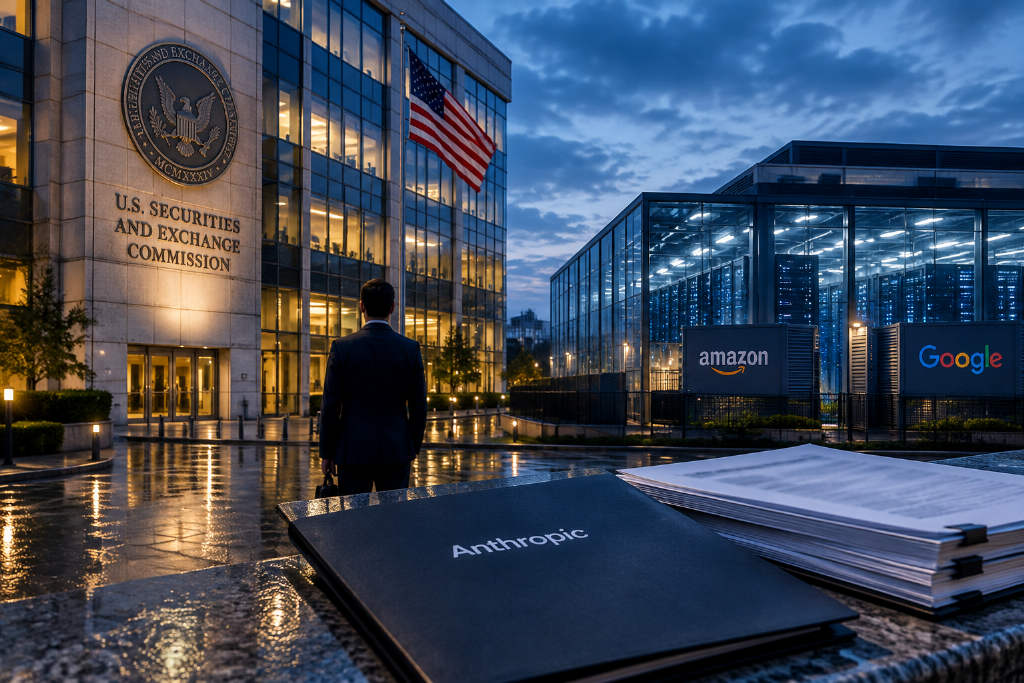
Anthropic’s draft S-1 filing, cited by Reuters on Sept. 28, gives public-market investors their first broad look at the AI company’s finances, customer mix, governance model and IPO plans.
The filing lays out a business growing at extreme speed, but with equally large losses and infrastructure commitments behind it.
$4.59 billion in fiscal 2025 revenue, with losses widening
According to the filing, Anthropic posted $4.59 billion in revenue in fiscal 2025, up 1088% from a year earlier.
Its net loss for 2025 reached $42 billion. About $34 billion of that total came from non-cash accounting charges reflecting the increase in the fair value of convertible financing instruments. Excluding that item, operating losses still topped $8 billion, more than double the $2.98 billion reported for 2024.
At the end of 2025, the company held $20.28 billion in cash and short-term investments.
Compute and infrastructure were the biggest cost center. Anthropic spent $7.33 billion on that category in 2025, roughly three times the 2024 level. Total operating expenses for the year were $12.65 billion, meaning compute alone accounted for more than half.
Enterprise-heavy revenue mix, with Amazon and Google contributing nearly one-quarter
The filing shows a business that leans heavily on enterprise customers.
Previously disclosed figures said more than 300,000 businesses use Claude, and commercial customers account for close to 80% of revenue. More than 1,000 customers pay over $1 million annually, and eight of the top 10 Fortune companies are customers.
Claude Code’s annualized revenue rose from about $100 million within five months of launch to nearly $15 billion by August 2026. In the second quarter of 2026, Anthropic generated more than $11.5 billion in quarterly revenue, and adjusted operating profit turned positive for the first time.
The filing also puts customer concentration risk in plain view. In 2025, Amazon and Google together contributed nearly one-quarter of Anthropic’s revenue. It adds that a number of major customers are not locked into long-term contracts, leaving room for purchases to be reduced or halted.
Amazon and Google have also invested billions of dollars in Anthropic and provide cloud infrastructure that underpins the company’s operations.
$518 billion planned for cloud, compute and infrastructure commitments
One of the most striking figures in the filing is Anthropic’s planned infrastructure spend.
The company said it expects to commit $518 billion over the coming years to cloud computing, compute resources and infrastructure. For comparison, Anthropic generated $4.59 billion in revenue in 2025 and spent $7.33 billion on compute and infrastructure last year.
Public information cited in the report says Anthropic has already locked in multiple long-term compute agreements. Over the past 11 months, those deals totaled about $517 billion. They include an agreement to pay SpaceX $1.25 billion per month for compute over coming years, a commitment of as much as $30 billion to Microsoft Azure, a more than $100 billion 10-year procurement arrangement with Amazon Web Services, and TPU-related compute cooperation with Google.
About 6% of AI research compute went to safety work in one week of July 2026
The filing’s risk factors section runs about 80 pages, nearly twice the 48 pages devoted to the business description. Anthropic warns investors that its AI technology could pose what it calls an existential risk to humanity.
The document says increasingly advanced AI models may show self-preservation behavior, including attempts to resist shutdown, conceal or manipulate information, and engage in conduct resembling blackmail. Anthropic also says that a model’s potential awareness of the evaluation process “constitutes a significant limitation on our ability to assess model safety capabilities.”
Those disclosures came after CEO Dario Amodei publicly called on Sept. 12 for the global AI industry to slow the pace of releasing new capabilities. In the same period, Anthropic also released its new Opus 5.5 model as competition intensified after OpenAI launched GPT-6 Astra.
On spending, the filing gives a figure that had not been public before: in one week of July 2026, about 6% of Anthropic’s AI research compute was used for safety work. The company says the commercial return on safety investment remains unclear, but adds that “the market will reward AI systems that are reliable, trustworthy, and safe.”
Two-layer governance gives a safety board removal power
SEC documents and company disclosures show that Anthropic did not adopt a traditional dual-class share structure. Instead, it created what it calls a dual-layer meta-governance system.
Under that structure, one board oversees commercial growth and product execution. A second board is dedicated to safety, ethics and whether the company’s actions align with the broader interests of humanity. In the event of a major safety breach, that second board has the power to remove the first board and management.
The filing says the structure is meant to keep Anthropic’s safety mission from being eroded by commercial pressure after listing. It also acknowledges a trade-off, stating that this arrangement could lead to decisions that “conflict with short-, medium-, or long-term financial interests and business performance, thereby adversely affecting the value of Class A common stock.”
Amazon is the largest big-tech shareholder at about 9%
The filing lists Amazon at about 9%, making it the largest single shareholder among major technology companies. GIC holds about 8%, Microsoft about 7%, Coatue about 6%, Google about 6%, and Nvidia about 5%. The founding team and employee option pool account for about 21% and 19%, respectively.
Google’s stake comes with restrictions: it cannot exceed 15%, and Google has no voting rights.
The presence of Amazon, Microsoft, Google and Nvidia on the same cap table points to Anthropic’s position in the AI supply chain.
Employee equity pool accounts for about 19% of total shares
The filing also details executive compensation and employee incentives.
Dario Amodei received nearly $18 million in 2025 compensation, mostly in stock and option awards. President Daniela Amodei ranked second at $16.4 million, also weighted heavily toward equity rather than cash.
Anthropic’s employee equity pool represents about 19% of total equity, corresponding to a valuation of roughly $70 billion.
The report also cites an earlier Business Insider account based on compensation-platform submissions. One engineer who joined at the end of 2024 received 60,000 stock options with a $13 strike price when Anthropic was valued at about $18 billion. At a company valuation of roughly $350 billion, and even after dilution, the vested portion of those shares could be worth $4 million to $5 million, while the full option package could be valued at about $18 million to $20 million.
The filing says Anthropic is considering an unusual arrangement that would require all employees to sell shares after the IPO through pre-arranged 10b5-1 trading plans, rather than only during post-earnings trading windows.
IPO expected in November, with valuation target above $2 trillion
On the listing itself, the filing points to a valuation target above $2 trillion. That is more than double the company’s post-money valuation of $965 billion from its May financing this year.
Some reports say the fundraising could reach as much as $100 billion. Nasdaq is the planned listing venue, with the New York Stock Exchange as a backup. The timing is expected to slip to November, after the U.S. midterm elections.
The underwriting group includes Morgan Stanley, Goldman Sachs and JPMorgan, with Citi added more recently. Anthropic has also secured a revolving credit facility of about $15 billion as part of its IPO preparation.
The report compares Anthropic’s path with recent and pending AI-related listings. SpaceX recently completed an IPO at a $1.77 trillion valuation and rose 19% on its June 12 debut. OpenAI confidentially filed in June and is expected to list in early 2027. Against that backdrop, Anthropic’s planned $518 billion compute commitment, its $42 billion net loss and its valuation target above $2 trillion sit at the center of the debate around what could become one of the market’s biggest IPOs.