
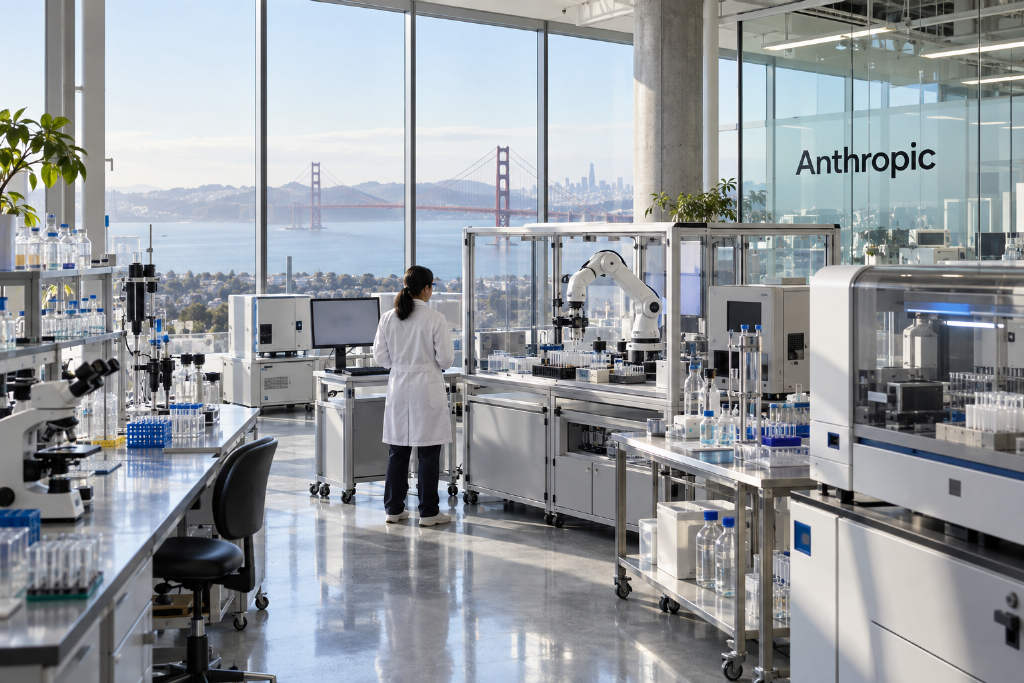
Anthropic has quietly set up a wet lab in the San Francisco Bay Area to carry out hands-on biology work that goes beyond computer simulation, Reuters reported. Two people familiar with the matter said the company is trying to involve AI systems including Claude in experimental execution and has made life sciences a major focus for investment, though Anthropic has not publicly disclosed specific research programs or interim results.
The current lab is not specifically for drug discovery
Eric Kauderer-Abrams, Anthropic’s head of life sciences, confirmed in an interview with Reuters that the company already has a wet lab.
He said the final test in biology still happens in a real laboratory and will continue to do so for some time. Anthropic is using an approach similar to that of many biotech companies, with part of the work done in-house and part handled by external partners.
An Anthropic spokesperson later clarified that the existing lab is not specifically dedicated to drug discovery, and the company did not disclose its exact use. Anthropic said in June that it planned to pursue preclinical research in areas where traditional companies lack economic incentives and to explore treatments for rare diseases.
The effort remains at an early stage. Candidate molecules typically take years to move from the lab to the market, and they must pass clinical safety and efficacy testing. Most drug programs do not succeed, and Anthropic is not conducting clinical trials at this point.
For CEO Dario Amodei, the work also has a personal dimension. He previously wrote that his father died a few years before a treatment became available for a disease. Kauderer-Abrams said using powerful AI to advance life sciences is one of the biggest opportunities in Anthropic’s mission to make technology benefit the world.
Automation plans meet safety debate
Like other biotech companies, Anthropic is exploring physical automation. The people familiar with the matter said the company wants Claude to guide robots through experiments and reduce manual involvement. An Anthropic spokesperson said human oversight and participation remain a safety requirement.
Kauderer-Abrams described the field as 「very early」 and said it could speed up a range of scientific processes.
In August, Anthropic released its Model Hardware Standard to help AI systems connect to and operate laboratory equipment. Earlier, the academic community introduced PyLabRobot for lab automation.
As automation efforts move forward, Anthropic is also dealing with intensifying debate over AI safety. Over the past two weeks, some researchers have warned that AI could lead to human extinction. Anthropic has also said it found ways its systems could potentially be used in biological weapons development, a claim that has drawn skepticism.
Amodei has called for slower development and warned that more capable AI could produce catastrophic outcomes. At the same time, Anthropic is reportedly preparing for a public listing that could value the company at as much as $2 trillion in order to secure more funding for AI research.
Kauderer-Abrams said Anthropic’s life sciences work has to balance faster research with risk control. The company wants to improve how its models support drug development while setting careful limits on deployment.
Life sciences has become one of Anthropic’s biggest investment areas
Anthropic outlined its life sciences strategy at an event in June, then launched Claude Science and added Novartis CEO Vas Narasimhan to its board.
The company also confirmed its acquisition of startup Coefficient Bio. Media reports said the deal was worth about $400 million and was paid in stock. Anthropic did not comment on the specific amount.
Anthropic is now expanding investment in its internal lab operations. Kauderer-Abrams said in-house facilities can speed up some work and help the company build first-hand biology experience, while tasks better suited to outsourcing will still be handled by outside partners.
Job postings show Anthropic is hiring a lead for procurement and related operations, as well as talent in areas including protein and nucleic acid characterization. One job description said the company’s goal is to accelerate progress in life sciences by an order of magnitude.
Kauderer-Abrams said life sciences is already one of Anthropic’s largest areas of investment in both staffing and resources.
Focus on hard-to-drug diseases, but no clinical work yet
Kauderer-Abrams said AI could help advance research into diseases considered hard to drug. The company is looking at technologies including bispecific and trispecific antibodies, molecules that can act on multiple targets at the same time and are harder to design and validate.
Anthropic has not disclosed a list of diseases or detailed project progress. Finding a candidate molecule is only the starting point, to be followed by animal studies, clinical trials, and regulatory review.
Alphabet-owned Isomorphic Labs has spent years on drug discovery, and its timeline for entering the clinic had also been pushed back to the end of 2026.
Anthropic currently provides model standards, AI services, and tools to pharmaceutical companies including Roche unit Genentech, Bristol Myers Squibb, and Novo Nordisk. Those relationships also raise concerns about data handling and competition. Customers may worry that Anthropic could gain information from different drug programs that might be useful competitively, even though the company says customer data is segregated.
Kauderer-Abrams said Anthropic is not moving into clinical trials for now, is focusing on needs the industry has long neglected, and does not intend to compete head-on with pharmaceutical and biotech companies whose core business is bringing drugs to market.
For Anthropic, the wet lab is a new foothold for AI in life sciences. Whether its automation efforts can turn into verifiable, marketable therapies will be answered by future data and clinical outcomes.