
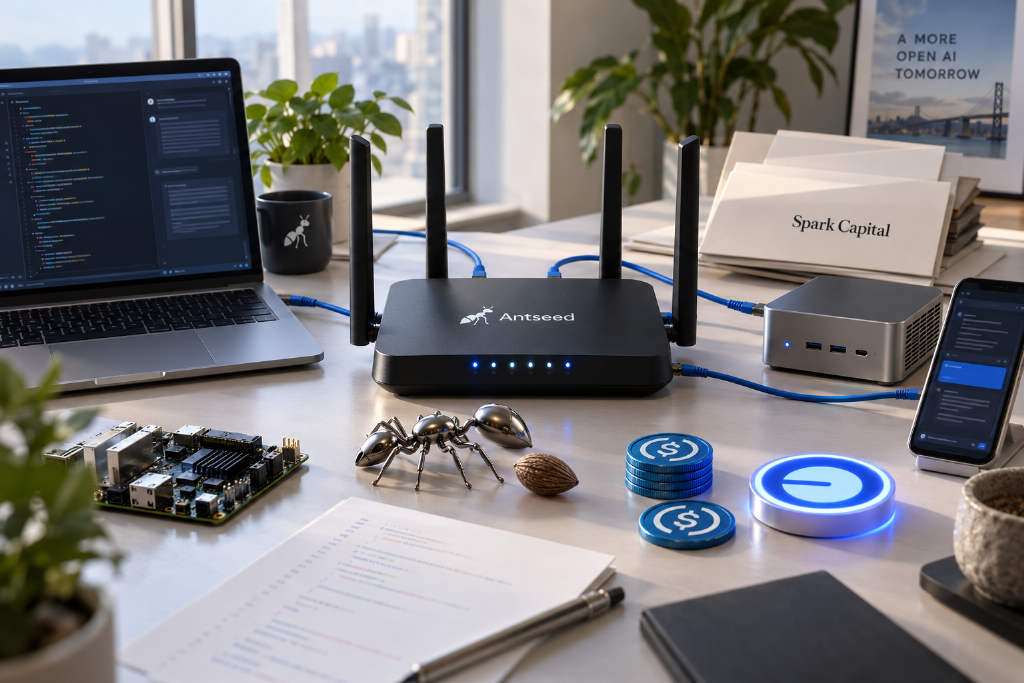
Antseed has officially launched its peer-to-peer AI inference network and disclosed that the nonprofit Antseed Foundation has completed a $2.4 million token financing round.
Spark Capital led the round. Collider, Digital Currency Group (DCG), North Island Ventures, Reciprocal Ventures, Relay Capital, and Venice.ai also participated.
BitTorrent-style architecture for AI inference
Antseed is aiming to bring BitTorrent’s peer-to-peer model into AI inference, so different providers can sell model access and agent services directly.
After running Antseed’s local router on their computers, users can connect tools including Claude Code, Codex, and OpenCode through a single address. For each call, the router chooses a provider based on price, speed, reputation, and privacy conditions. Fees are settled directly in USDC on Base.
Providers run their own models and set pricing
On the supply side, providers can run their own local models, fine-tuned models, or other AI services, and set pricing themselves.
Antseed said its biggest difference from OpenRouter is that there is no centralized platform in the middle forwarding requests. Buyers connect directly to providers, while Antseed handles discovery, routing, reputation, and the payment protocol.
Verification features are still being improved
Standard providers can still see the requests they process. Users can also choose providers verified with a trusted execution environment, or TEE, so requests run inside that environment.
The project is still improving verification mechanisms including model fingerprinting, signed responses, and auditing, with the stated goal of preventing providers from passing off cheaper models as more expensive ones.
The code has already been open-sourced, and the network is already usable in practice. At the same time, GitHub issues involving compatibility with Codex and Claude Desktop are still being addressed.