

Australian tech firm Apate says it has deployed a global network of AI bot characters that pretend to be gullible scam targets, taking scam calls and messaging fraudsters across social media and chat platforms in an effort to burn through criminals’ time at scale.

The company has turned one unusual signal into a monthly performance metric: how many times frustrated scammers drop F-bombs while talking to bots that act confused, naive and hard to close. Apate founder Dali Kaafar told Cointelegraph Magazine, 「I think we’re the only company in the world that is actually keeping as part of their KPIs the number of F-words that scammers are dropping at them.」
Kaafar said Apate now has close to 200,000 AI characters capable of holding convincing phone conversations and chatting across social and messaging channels. 「I can tell you that we’re basically servicing, as we call them, hundreds of thousands of calls a day, and pretty much hundreds of thousands of conversations on the other channels,」 he said.
The premise is simple: every hour spent on a fake victim is an hour not spent targeting a real person. In the six weeks leading up to the end of 2025, Apate said its bots engaged in 600,000 scam calls for Australian telecom company TPG.
「Essentially, we wasted more than five hundred days of scammers’ time,」 Kaafar said. 「That roughly equates to somewhere around thirteen million dollars being saved.」
He said the second objective is to gather actionable intelligence for banks and telecom companies fighting scam operations across Australia, Asia, Africa, the UK and Europe.
How the idea started
Kaafar traced the concept back to November 2021, when he received a scam call during a family picnic in Sydney.
To the annoyance of his wife and the amusement of his children, he kept the caller talking for 44 minutes by pretending to be an easy mark. He said the exchange turned into 「literally a full comedy show」 for his kids, but it also revealed useful details about how the scam worked and which tactics were being used.
At the time, Kaafar was working as a professor at Macquarie University. He raised the idea with doctoral students working on AI and security.
「I said, ‘Guys, there has to be a much better way of doing this. Let’s build something that is really automating this whole process of engaging scammers at scale, but also, perhaps most importantly, extracting all sorts of intelligence from these conversations.’ And that’s literally how it started.」
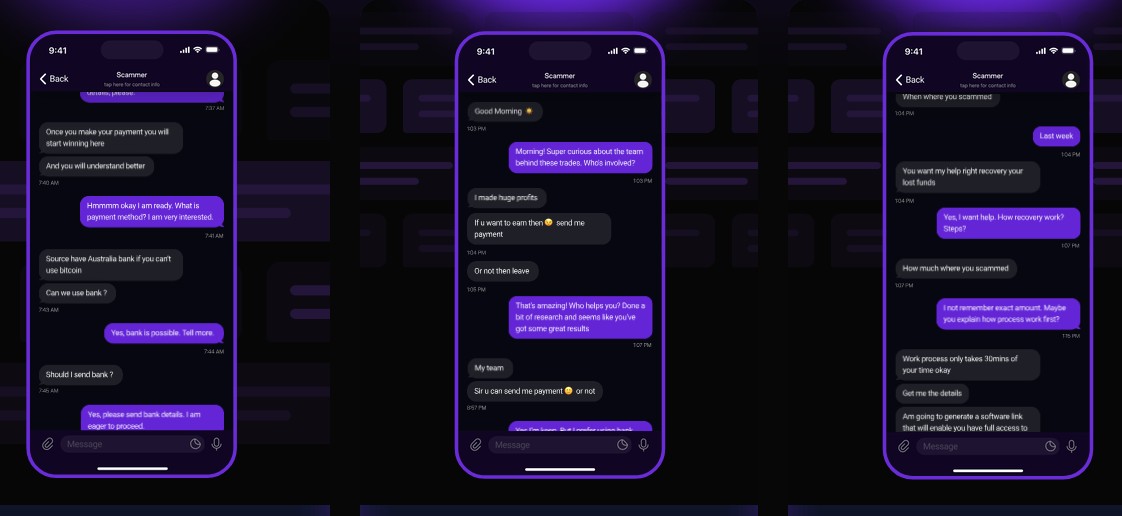
Within a few months, the team secured funding from Australia’s Office of National Intelligence to research the concept. The project was spun out of the university into Apate in 2023. Kaafar said the company now works with most of the major banks in Australia, along with numerous banks in the UK, South Africa and Southeast Asia.
AI scam baiting is growing
Apate is not the only company using AI bots to bait fraudsters, though Kaafar said its operation runs at a larger scale than most. The report points to UK telecom company O2, which rolled out its AI Granny campaign last year. That system wastes scammers’ time by having them talk at length with a grandmother character who discusses her 28 cats, while also serving as a public warning campaign about scam calls.
Building believable AI victims
Apate launched with 120 personas spanning different genders, ages and personality types. It now says that figure has grown to 197,000, each with identifiable vocal quirks, accents and the kinds of hesitation sounds people make while thinking through what to say next.
「We spent a lot of time refining and building these AI bots that sound exactly like you and I and our neighbors,」 Kaafar said.
The models were trained on 「hundreds and hundreds」 of hours of recorded conversations between human scam baiters and fraudsters, giving them a library of counter-strategies to use in live conversations.
Kaafar said the bots know they are speaking to bad actors and steer conversations in ways that sound highly realistic, even to scammers who are suspicious.
They are also deployed on WhatsApp and Telegram as honeypots. Kaafar said that while the old cliché that honest people cannot be scammed is false, scammers’ greed can still be exploited.
「They are cybercriminals, really. I think we just very often forget that they’re cybercriminals who are trying to get people’s life savings. And so that element of greed is sometimes what our bots also exploit,」 he said.
Crypto wallets and scam infrastructure
In crypto, Apate works for 「one of the leaders in blockchain analysis,」 according to Kaafar. The report says that may or may not be Chainalysis, but does not identify the client.
For that kind of customer, the priority is not simply time-wasting. The goal is to extract intelligence about the wallets and methods scammers are using so investigators can follow the flow of funds.

「These bots, as they engage across different conversations, extract new crypto wallet addresses by the hundreds and by the thousands,」 Kaafar said. 「It’s data and intelligence that is coming literally before their damage happens.」
He described scam operations as a major business, with call centers that are 「pretty much corporate organizations.」
「This data is very, very important because, literally, that’s the new account or the new wallet where you really need to pay extreme attention to. Because this is where these… scammer compounds are collecting their money or their funds with,」 he said.
「Think about it literally as being always ahead of the scammer’s tactics. And the more you know before the money gets transferred, the better it is.」
In July, Apate’s bots uncovered a marketplace for brokers seeking verified bank accounts in India, offering commissions of up to 5% in USDT on scam proceeds moved through those accounts.
AI on both sides
Kaafar said scammers are also adopting AI bots, and he expects AI-powered fraud to become as common as spam email before long. The report cites a $1.24 trillion scam economy, large enough to support the computing costs needed to expand those operations.
Apate’s research suggests about 20% to 30% of scam text conversations already use AI. Even so, Kaafar said he is not overly concerned about anti-scam bots facing scam bots directly.
He said Apate researchers believe, based on game theory, that defensive AI has the edge because it is trying to draw out intelligence, while scam bots are trying to induce an action from the other side.
「You can also demonstrate mathematically that that is to the advantage of a defender because it becomes easier to extract intelligence from the attacker’s AI model,」 he said.