

Apple delivered its strongest June-quarter report on record, but the market reaction showed how heavily investors are now weighting AI execution over headline earnings strength.
After the U.S. market closed on July 30, Apple reported results for fiscal third quarter 2026, which correspond to calendar Q2 2026 in the source article’s framing. Revenue came in at $109.417 billion, up 16.4% from a year earlier. Net profit rose 27% to $29.789 billion, and overall gross margin reached 50.1%.
Tim Cook said on the earnings call that it was the best second quarter in Apple’s history, with iPhone, Mac and services revenue all posting double-digit growth, alongside double-digit growth in every geographic segment.
Investors were not convinced that strong hardware momentum answered the bigger question. Apple shares finished the day down 1.41%, then fell more than 8% in after-hours trading after the results were released. Only days earlier, Apple had reclaimed the No. 1 spot in global market capitalization. On July 29, the stock briefly touched a record intraday high of $342.89, lifting the company’s value above $5 trillion for a short period and making it the second listed company after Nvidia to reach that level.
On the same day, AI-linked names moved in the opposite direction. Microsoft rose 15.51%, Micron gained 18.36%, AMD advanced 13%, and Nvidia added 2.65% while continuing to rise after hours. Amazon, which reported around the same time as Apple, climbed more than 9% in after-hours trading.
The source article frames that divergence as a renewed shift of capital toward companies with clearer AI exposure after several weeks of pressure tied to fears of an AI bubble. In that rotation, Apple stood out as the large technology company with the most uneven AI narrative.
This earnings call also carried succession significance. According to the source, Cook was making his last earnings call as Apple chief executive. On Sept. 1, hardware engineering head John Ternus is set to become CEO, with Cook moving to the role of executive chairman.
Strong revenue, profit and margins, with hardware still doing the heavy lifting
On the numbers alone, Apple’s quarter left little room for complaint. Hardware remained the main engine.
Total revenue of $109.417 billion topped the market expectation cited in the article of $108.7 billion. Hardware product sales contributed $78.68 billion at a 40% gross margin. Software and services revenue reached $30.74 billion, with gross margin at 75.6%. Combined gross margin was 50.1%.
The article notes that about 2 percentage points of that margin came from a one-time impact tied to a U.S. government tariff refund. Excluding that item, actual gross margin would have been about 48.1%, still above both market expectations and the midpoint of the company’s prior guidance.
By product line, iPhone remained the anchor. Q2 iPhone revenue reached $54.25 billion, up 21.7% year over year, marking a third straight quarter of growth above 20%.
The comparison base was already elevated. The source says that in the year-earlier period, tariff-related concerns pushed many consumers to buy early and stock up, helping drive 13.5% iPhone sales growth in Q2 2025. Maintaining more than 20% year-over-year growth on top of that base was presented as evidence of strong iPhone 17 demand and of a new super-cycle in the lineup.
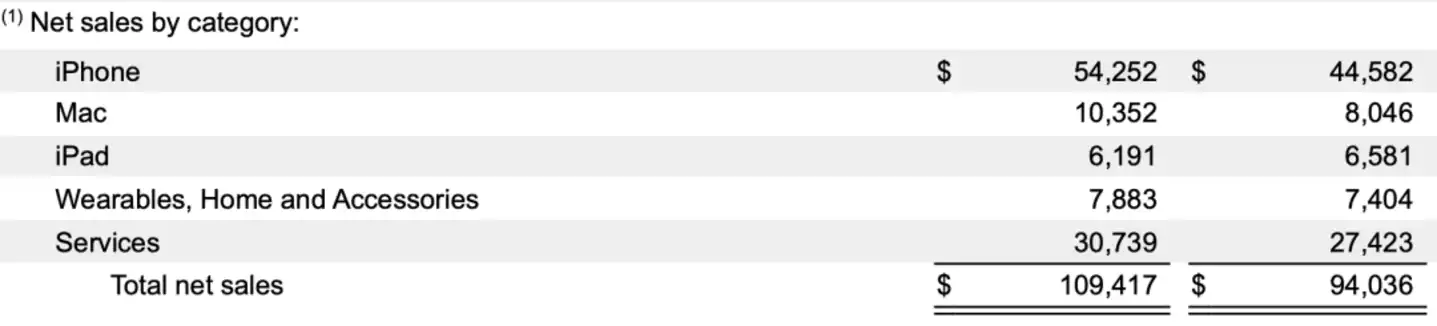
Mac was another bright spot. Quarterly revenue rose to $10.35 billion, up 28.7% from a year earlier. In the context of the broader PC market, that stood out.
IDC data cited in the article showed that global PC shipments fell 4.9% year over year to 68.2 million units in the second quarter, the first decline after nine straight quarters of growth, as higher upstream memory prices weighed on the sector. Lenovo, HP and Dell all posted lower shipments, while Mac grew 10% and expanded market share from 8.5% to 9.9%.
The article attributes part of that gain to the MacBook Neo, launched in Q1 this year with a starting price of $599. It lowered the entry point for Mac buyers to a record low, broadening the addressable user base. Entry-level MacBook Neo models and higher-end MacBook Pro units together lifted Mac sales in the quarter.
iPad remained the weaker product line. Revenue fell 5.9% year over year to $6.19 billion, returning to negative growth after a brief rebound in the previous two quarters.
Greater China led regional growth, but still missed expectations
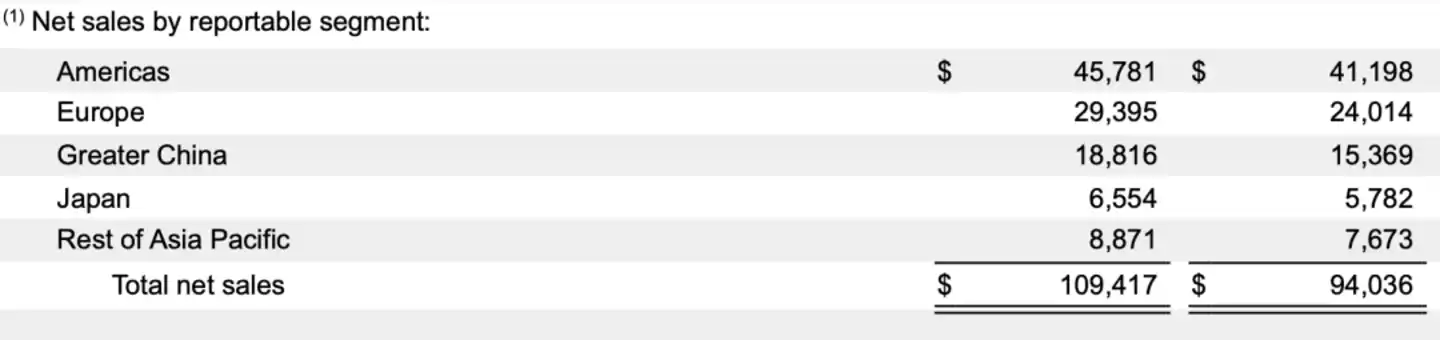
By geography, Apple posted $45.78 billion in revenue in the Americas, up 11.1% year over year. Greater China revenue reached $18.82 billion, up 22.4%, the fastest growth among all regions, though the article says it still came in nearly 4 percentage points below expectations.
IDC figures cited in the report showed global smartphone shipments falling 6.7% in Q2 2026, while China declined 4.3% and marked a fifth straight quarter of year-over-year contraction. Apple, however, recorded 24.4% shipment growth in China, with market share rising from 13.9% to 18.1%.
The article says the rebound in China reflected both the competitiveness of the iPhone 17 lineup and forward buying tied to pricing expectations. As Android vendors broadly adjusted pricing and configurations in response to higher memory costs, Apple kept prices on core models stable through the second quarter, strengthening its relative position in the premium segment.
Management, however, struck a more restrained tone on the next quarter. Apple said total revenue in the coming quarter would be dragged by both foreign exchange and supply constraints. iPhone revenue in Q3 is expected to be held back by supply limits, with growth in the roughly 15% double-digit range. Mac and iPad are also expected to feel supply-chain pressure.
That suggests the high growth of the past three quarters may not continue at the same pace. Even so, the report underscored that in a market focused on AI, Apple’s hardware base still matters. The source says active installed devices reached a new high across all product categories and all regions.
After two delayed years, Apple’s AI is finally moving into products
Hardware alone cannot carry the story forever, and Apple has been trying to pivot toward AI. The article argues that for much of the past two years, that effort was more about setting expectations than delivering a product capable of changing user behavior.
At WWDC 2024, Apple unveiled Apple Intelligence and laid out an approach built around system-level personal intelligence, on-device processing, private cloud compute and cross-app task execution. At the time, investors became more open to valuing Apple not just as a hardware company, but as an AI gateway across billions of devices.
Then the key Siri upgrade kept slipping. Apple acknowledged in 2025 that the planned personalized Siri needed more time, with some functions delayed until 2026.
The article argues that the issue was not simply a one-year delay. In a fast-moving generative AI cycle, delays make it harder for developers to build around stable interfaces, wear down user expectations, and give Google, OpenAI, Amazon and Chinese smartphone makers more time to advance.
By 2026, Apple’s strategy had changed in a more fundamental way. In January, Apple and Google announced a multiyear partnership under which Apple’s next-generation foundation model would be built on Gemini models and Google Cloud technology. For a company known for vertical integration and internal development, that was described in the article as a practical choice and an implicit acknowledgment that Apple was too far behind to catch up from scratch in foundation models.
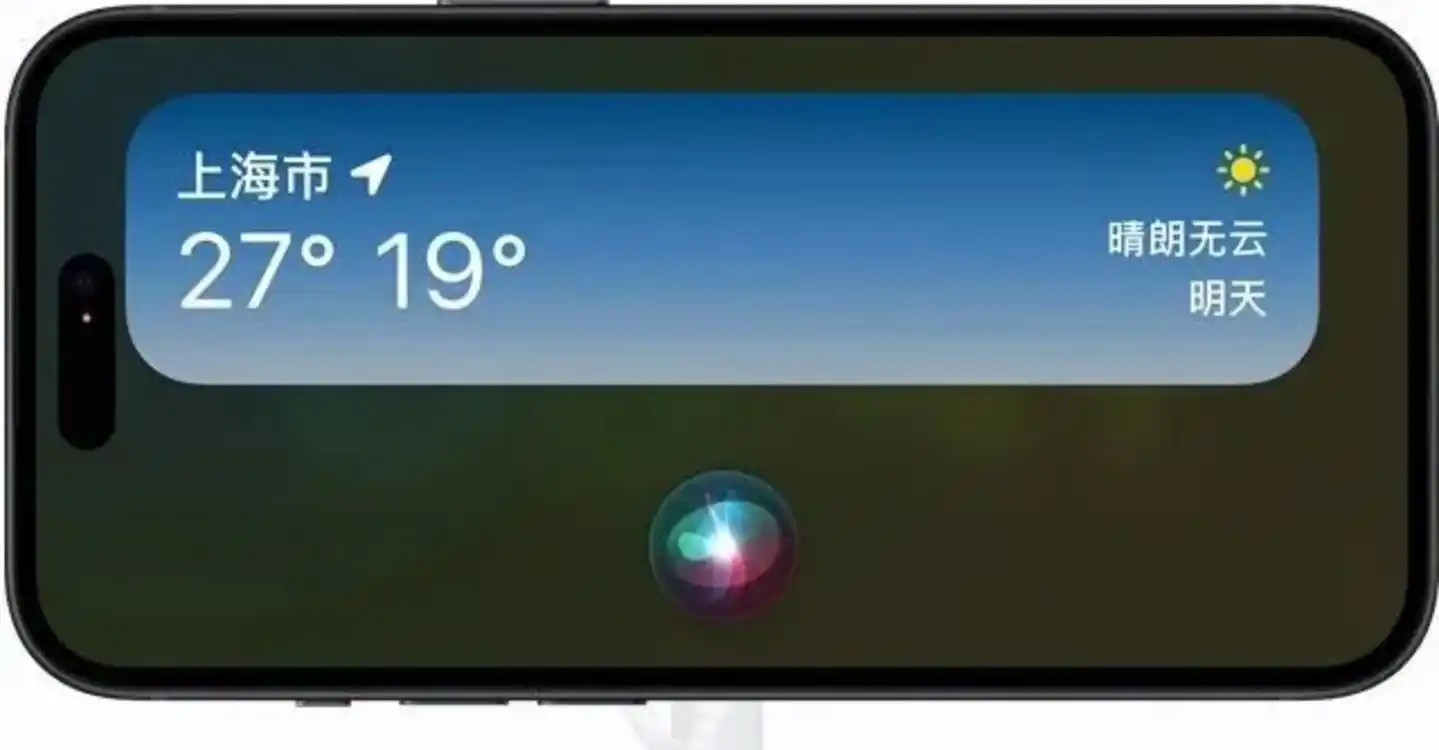
Then, at WWDC in June, Apple formally introduced its new Siri AI, highlighting personal context, on-screen awareness, cross-app actions and a standalone conversational interface.
China’s version of Apple Intelligence will rely on local models and compliance partners
Apple’s AI path in China has been more complicated.
As Apple’s second-largest market, mainland China had long been left out of Apple Intelligence on domestic devices. Regulatory filing requirements for generative AI services remained a clear barrier. The article says the absence of AI features had been an important factor weighing on expectations for Apple’s China sales and on the stock.
In March this year, Apple briefly enabled related features for users of mainland devices by mistake, then quickly rolled them back.
In July, the situation changed. China’s cyberspace regulator published a new batch of filings for on-device generative AI services on mobile phones, and “Apple Intelligence” was included on the list. Alibaba then confirmed that its Qwen model would be integrated into Apple Intelligence for China versions of the iPhone, iPad, Mac and Vision Pro. Baidu also confirmed that it is working with Apple to develop related functions for iPhone users in China.
That means China’s version of Apple Intelligence will not simply mirror the overseas version. Instead, it will use a combination of Apple hardware and software with local models and local compliance.
The article says this closes Apple’s most visible product gap in China’s premium market and could release some pent-up upgrade demand. At the same time, it exposes the limits of Apple’s AI transition. In the United States, Apple is leaning on Google. In China, it depends on Alibaba and Baidu. Apple still controls the device and operating-system entry point, but no longer fully controls the intelligence layer.
Apple’s AI story is still unfinished. The new Siri has moved from a promised future feature to a testable product, but the bigger test will come after a broad rollout in the fall. The source leaves those questions open: whether reliability is good enough for frequent tasks, whether third-party developers will integrate, how cloud inference costs will be managed, and whether AI will trigger another round of hardware upgrades.
After the super-cycle, Apple faces four concrete pressures
The article identifies four near-term pressures in front of Apple.
The first is the high base created by iPhone 17. Apple has seen this pattern before, where one explosive generation pulls demand forward and leaves later models struggling to spark another replacement cycle. The article cites the iPhone 6 as a classic case, noting that analysts at Bank of America Merrill Lynch and KGI Securities at the time said the iPhone 6 super-cycle had pulled forward one to two years of upgrade demand, making it harder for the 6s and 7 series to drive new waves of replacement.
Today, the global smartphone replacement cycle has extended beyond three years, which could make the demand pull-forward effect last even longer. From the formal launch of iPhone 17 in Q4 2025 through Q2 2026, iPhone revenue has grown more than 20% for three consecutive quarters, a pattern the article says is close to the hallmarks of a super-cycle. Apple’s next challenge is not just to sell the iPhone 18 well, but to keep growing on top of that elevated base.
The second pressure comes from costs. Expansion in AI data centers is consuming advanced process capacity as well as DRAM and NAND supply, forcing consumer-electronics makers to compete with cloud giants for upstream resources. TrendForce data cited in the article showed DRAM contract prices in Q1 2026 rising by more than 90% from the previous quarter. The cost of 12GB smartphone memory increased from 200 yuan to 600 yuan, while the unit price of 1TB flash storage tripled.
That pressure first hit the low end of the handset market and is now moving up the pricing ladder. IDC had previously argued, according to the article, that the storage crunch is splitting the smartphone industry in two: vendors with scale, long-term procurement power and premium product mixes can secure supply and pass on costs, while brands that depend on low-price volume face a heavier blow. Apple belongs to the first group, but that does not make it immune.
The piece also points to comments from Micron Chief Business Officer Sumit Sadana, who said in prior media remarks that the root cause of memory shortages was aggressive price pressure from large downstream buyers, which weakened suppliers’ willingness to invest and forced many capacity expansion projects to be halted in 2023. That was interpreted by outside observers as pushing some of the blame toward Apple. More recently, Apple has raised prices on some Mac and iPad products, and management warned that supply constraints will worsen materially next quarter.
The third pressure is competition in AI devices. Apple has often succeeded by entering after technology matures, relying on stronger integration and a large user base. The article argues that AI smartphones may not follow the old hardware rhythm. Google, Samsung and Chinese vendors are turning model capabilities into system-level functions, while AI agents are starting to handle search, shopping, content creation and app operations. At the recently concluded WAIC, the article notes, AI phones from Nubia, StepFun and Honor were all showcased.
If users stop opening apps as frequently and instead complete tasks through AI assistants, the company that controls the assistant could reshape traffic distribution across the mobile internet. Apple still has the gateway advantage, but it also faces a real risk. If Siri is not good enough, the iPhone could become little more than premium hardware for someone else’s model, or be replaced by other AI phones.
The fourth pressure is the management transition. On Sept. 1, Cook will step down as CEO and become executive chairman. The article says he could theoretically continue to guide the company through another quarter, but this is clearly his last earnings call as chief executive.
Ternus, who is set to take over, is 50 years old and joined Apple’s product design team in 2001. He has worked on AirPods, iPad, and multiple generations of the Mac and iPhone. Cook described him as having “an engineer’s mind and an innovator’s soul.” The source argues that placing a product-focused executive at the top could shift Apple’s cultural center of gravity back toward product innovation from operating efficiency.
Fifteen years ago, Steve Jobs handed Cook a company valued at about $350 billion. Now Cook is handing Ternus a company worth $5 trillion. The question has also changed. It is no longer whether Apple can survive without Jobs, but whether it can keep hold of the gateway when AI is redefining what the gateway is.
In the source’s framing, Apple’s best-ever June-quarter report is both Cook’s final report card and the first test paper handed to his successor.