


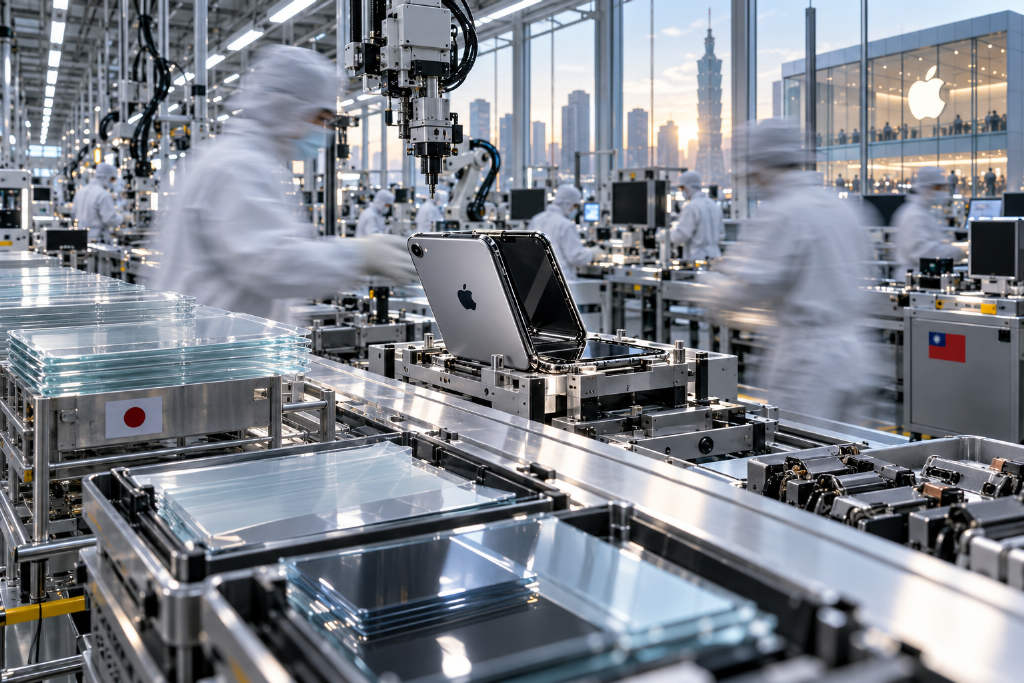
Apple’s first foldable phone, the iPhone Duo, began pre-orders on Oct. 16 and is set for an official release on Oct. 23. A report from ZDNet Korea said Apple has recently asked several suppliers to expand component production, but limited access to Nittobo’s high-end fiberglass material T-glass and low final assembly yields at Foxconn have emerged as the two main variables affecting whether the new model can scale smoothly.
Apple raises component orders with a year-end shipment target of about 6 million units
Citing multiple industry sources, the report said Apple has recently increased component orders for the iPhone Duo and asked several partners to expand production. The market has two readings of that move. One is that demand for the iPhone Duo is running ahead of expectations. The other is that Foxconn’s yields are low enough that Apple needs to secure extra parts to reach a shipment target of about 6 million units by the end of the year.
The report said there is not enough evidence at this stage to determine which explanation is closer to the truth. If Apple meets its plan, the market expects Apple’s foldable phone shipments to expand next year, which would also support growth in the broader foldable handset segment.
On yields, the report said Apple’s earlier headache centered on low yields from hinge supplier Shin Zu Shing. More recently, the issue has shifted to weak final assembly yields at Foxconn. Shin Zu Shing’s hinge yields have improved to some extent, suggesting the production bottleneck is moving away from a single component and toward both material procurement and final assembly.
Nittobo’s T-glass remains tight, with AI chip customers taking priority
T-glass is a high-end fiberglass yarn produced by Nittobo and a key material in copper clad laminate, or CCL, which is used to make printed circuit boards. The report said Nvidia, Apple and semiconductor substrate makers are among Nittobo’s customers. It added that some AI chip makers, including Nvidia, use only Nittobo products for the PCB fiberglass materials required in AI chips, leaving T-glass supply structurally behind demand.
One industry source said Nittobo also tends to allocate capacity first to higher-margin AI chip applications. If Apple cannot secure T-glass in line with its target, production of finished devices would inevitably be affected.
iPhone 18 sales may also shape material allocation
The report also said sales of the already launched iPhone 18 lineup, including the Pro and Pro Max models, could affect how much T-glass Apple is able to obtain. While Nittobo is focusing on AI chips, Apple remains an important long-term customer.
Another industry source said that if iPhone 18 sales are weak, Apple may have more room to secure enough T-glass for the iPhone Duo. The source also said Apple ran into T-glass supply issues for iPhones late last year. At the same time, both T-glass availability and Foxconn’s yields could affect the iPhone Duo sales schedule.
Samsung is also positioning for a foldable phone battle
On the competitive side, Samsung Electronics is estimated to ship somewhere in the upper half of 7 million foldable phones this year, slightly above the level of just over 7 million units last year. The new Galaxy Z Fold8 has seen a solid market response, though demand is expected to cool gradually from November. With the iPhone Duo about to hit the market, competition between the two brands in foldables is drawing closer attention.