
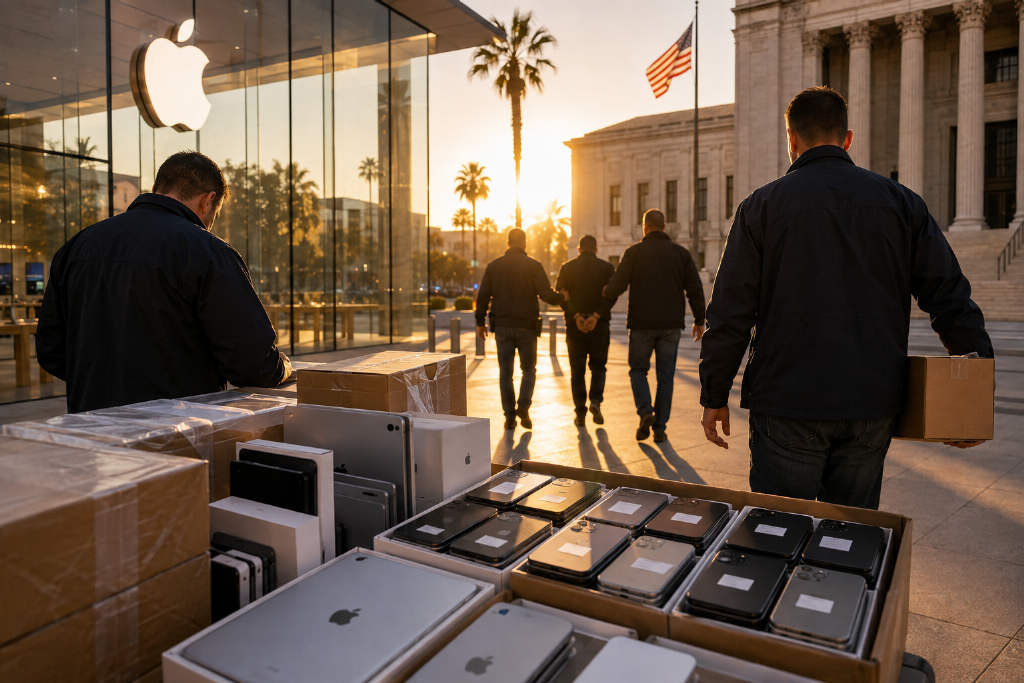
A federal judge in California has sentenced Huang Wenhui, identified by prosecutors as the leader of a cross-border Apple warranty fraud ring, to 78 months in prison in a case that cost Apple at least $16.2 million over eight years.
According to the U.S. Attorney’s Office for the Central District of California, the six-person group ran the scheme from December 2015 to March 2024. Prosecutors said the defendants used counterfeit iPhones and iPads carrying real serial numbers and identifiers to trick Apple Stores in Southern California into issuing genuine replacement devices. In total, more than 27,645 devices were fraudulently obtained.
Huang, 41, pleaded guilty in May 2025. Prosecutors said he had no lawful status in the United States. Federal Judge André Birotte Jr. ordered a 78-month prison term and restitution of $16,239,254.
Song Yang, 39, described by prosecutors as another central figure in the case, pleaded guilty in June 2025 to 21 counts of wire and mail fraud, trafficking in counterfeit goods, and conspiracy to commit money laundering. He was sentenced to 57 months in prison and ordered to pay $16,997,415 in restitution.
Counterfeit devices were paired with real customer identities
Prosecutors said the counterfeit iPhones and iPads were smuggled into the United States from China. The devices were then loaded with serial numbers and identifiers tied to real North American consumers whose products were still covered by warranty or AppleCare+.
With those identifiers in place, the fake devices appeared eligible for official service. The defendants then brought them to Apple retail stores, claimed the products were defective, and sought replacements under Apple’s warranty process. In many cases, stores provided immediate replacements or sent genuine replacement units after repair processing.
Mailboxes in Southern California helped move the devices
According to prosecutors, the group rented dozens of UPS Store mailboxes across Southern California. Those mailboxes were used both to receive counterfeit devices shipped from China and to collect genuine Apple replacements. The authentic devices were then forwarded to accomplices overseas.
Prosecutors said many of the devices were eventually resold in China at higher prices. The fraudulent returns were carried out at Apple Stores in multiple Southern California cities and shopping centers.
Prosecutors pointed to Apple’s serial-number-based warranty process
The case turned on a basic feature of Apple’s warranty system described in the report: AppleCare+ and standard warranty coverage are tied to a device serial number rather than the identity of the person presenting the device. That made it difficult for store staff to determine whether a defective product came from the real owner or from a counterfeit unit using a valid identifier.
The report said Apple’s customer-service approach, including same-day replacements in some situations, was exploited by the group. It also noted that the legitimate owners whose serial numbers were used were victims as well and may never have known their device identities had been used to obtain real replacements.
All six defendants have pleaded guilty or were convicted
Besides Huang and Song, the other four defendants received sentences of 18 months of home detention, 38 months, 24 months, and 36 months. Prosecutors said all six defendants have now either pleaded guilty or been convicted.
The investigation was led by Homeland Security Investigations, or HSI, and IRS Criminal Investigation, or IRS-CI.