
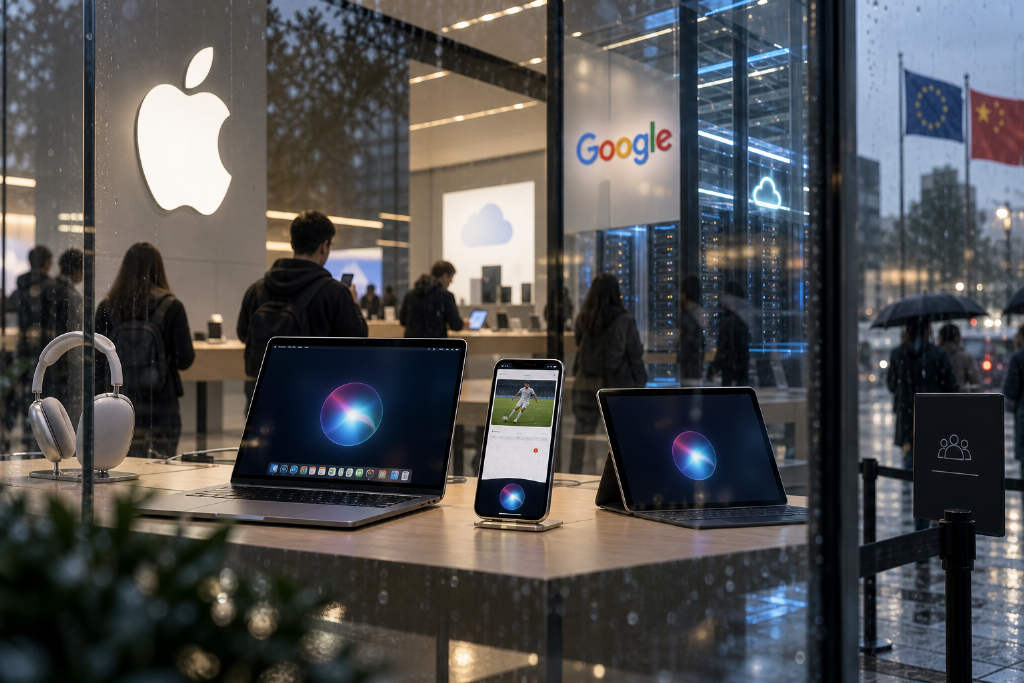
Apple started rolling out Siri AI on Sept. 14 with iOS 27, bringing out a version of Siri the company says is more powerful and more personal. In Apple’s description, the assistant can understand context across a user’s messages, email and photos, and it can also recognize what is displayed on the screen.
That means Siri can look at on-screen content and take action from it directly. One example in the company’s materials is pulling a team’s home schedule from its website and adding it to the calendar.
The first release is limited. Siri AI is available only as a beta in English for now, while French, Japanese, Korean, Portuguese and Spanish are scheduled to arrive in October.
Apple has also turned Siri into a standalone app. Conversation history can sync privately through iCloud, allowing the same exchange to continue across iPhone, iPad and Mac. System-level actions have been expanded as well, including drafting emails from scratch and editing and sharing photos.
Third-party integration currently includes WhatsApp and Audible. Microsoft Outlook, Notability and Tripsy are listed as coming next. Apple also says its writing tools can generate drafts based on user prompts.
Supported devices include iPhone 15 Pro and later models, iPads and Macs with M1 chips or newer, and wearables from Apple Watch Series 9 onward.
A rollout that arrived 27 months after Apple’s original pitch
Apple first laid out its vision for a personalized, screen-aware Siri at WWDC in June 2024. The company promoted the idea heavily at the time and released an ad featuring Bella Ramsey from The Last of Us.
In March 2025, Apple said the personalized Siri launch would be delayed. The ad was then taken down, and the company later faced a consumer class action lawsuit alleging false advertising.
In May 2026, Apple agreed to pay $250 million to settle the case. Eligible iPhone users could receive as much as $95, and a judge granted preliminary approval in July.
Siri AI was formally unveiled at WWDC in June 2026, then reached users on Sept. 14. From promise to delivery, the process took 27 months.
Apple is paying Google about $1 billion a year for the model behind Siri AI
The core model behind Siri AI is not something Apple built entirely on its own. Apple and Google announced a partnership on Jan. 12, 2026. According to Bloomberg, Apple is paying Google about $1 billion each year for a custom Gemini model with 1.2 trillion parameters built for Siri.
That model runs on Apple’s own Private Cloud Compute infrastructure, not on Google’s servers. Apple’s position is that the company is bringing Google’s model into its own privacy framework and extending iPhone-level privacy standards into the cloud.
Simpler tasks such as setting timers, playing music and controlling smart home devices still run on-device and do not require the larger model.
Waitlist access, language limits and regional restrictions remain in place
Siri AI is not turned on by default. Users have to enable it manually in settings. In Taiwan, for example, users need to switch both iPhone and Siri language settings to English (U.S.) and then join a waitlist from the Siri settings page. The process mirrors the rollout method Apple used for Apple Intelligence in iOS 18.1 in 2024.
Regional restrictions are also part of the initial release. Apple is not making the feature available at first on iOS, iPadOS and watchOS in the European Union. In China, the product is not being offered yet because of regulatory review.
Craig Federighi said some features rely on server-side models and come with usage caps. Most iCloud+ subscription tiers can raise those limits, meaning access to higher usage thresholds may require users to upgrade their cloud plan.
Apple Intelligence itself supports 16 languages this month, including Simplified Chinese and Traditional Chinese. Siri AI, however, still does not support Chinese at this stage.
More app integrations are on the way
Apple’s list of app connections shows that Siri is expanding into a broader conversational interface for software actions. WhatsApp and Audible are already connected, while Microsoft Outlook, Notability and Tripsy are set to join later.
Alongside that, Siri can call on writing tools to generate text drafts from a user’s instructions. Apple is extending those capabilities across email, photo editing and sharing tools at the system level.
The product is live, but the first version is still constrained
The launch closes a long cycle that included delays, the withdrawal of an ad campaign, litigation and a settlement. Siri AI now ships with screen awareness, cross-device conversation continuity and broader action-taking ability, but the first release is still an English-only beta with device limits, regional blocks and subscription-based usage tiers.