
Aptos took four months to go from a network that was effectively costing token holders money to one where holders, in aggregate, earn more than the network pays operators, according to a report by Blockworks authors Sam and Schubert, cited in a translated version carried by TechFlowPost.

The report centers on Token Holder Net Income, or THNI, a metric defined as total network revenue minus payments made to validators. Under that framework, staking rewards are treated as transfers within the holder base rather than an external cost.
The same report also included a market snapshot. Crypto equities led performance, helped by Circle, while BTC and most token sectors traded under pressure ahead of the July CPI release.
Crypto equities led the tape while most token sectors lagged
Market action was relatively quiet on the day. Crypto equities rose 2.9%, the standout move across the board, while BTC slipped 0.4% and the S&P 500 fell 0.2%.

Sector performance was uneven. Oracles gained 5.8%, meme coins rose 3.0%, exchange tokens added 2.5%, and RWA tokens were up 2.4%. On the downside, DEX tokens fell 4.1%, privacy names dropped 3.7%, and the Solana ecosystem lost 3.1%.
On a weekly basis, the gap was clearer. Crypto equities climbed 12.0%, ahead of oracles at 7.6% and gold at 7.1%. BTC was down 0.7% for the week and the S&P 500 fell 0.4%. Most token sectors ended lower, with the Solana ecosystem down 10.0% and crypto miners off 11.2%.
The report linked gold’s move higher to macro data. July nonfarm payrolls showed an actual decline of 23,000 jobs, far below expectations for an increase of 80,000, reducing the implied odds of a Federal Reserve rate hike in September.

Circle remained the main driver inside crypto stocks
According to the report, the move in crypto equities was largely a Circle story. CRCL rose 16.0% this week, while BLSH gained 4.4% and GLXY added 2.3%. FIGR fell 4.0% and GEMI lost 3.2%. A broader crypto equities index edged up just 0.1%.
Circle reported second-quarter 2026 results on Aug. 5. Revenue plus reserve income totaled $701 million, up 7% year over year. Adjusted EBITDA came in at $143 million. USDC circulation reached $73.3 billion, up 19% from a year earlier, and total onchain transfer volume hit $14.8 trillion, a 151% year-over-year increase.
The stock reaction did not happen all at once. CRCL rose 3.2% on the day of the earnings release, then extended gains to 8.7% by last Friday. It closed at about $71 yesterday, up 16.0% from before the earnings report.

- Arc mainnet is scheduled to go live on Sept. 16, with BlackRock, Visa, and DTCC participating as founding validators.
- Circle National Trust has been approved by federal regulators, making Circle one of the first stablecoin issuers to secure a federal bank charter.
The report said those two future catalysts have continued to shape investor attention.
Aptos flipped from laggard to leader on the value-capture metric
By the report’s THNI measure, Aptos turned positive in May 2026 and has remained positive since then. Ethereum, Solana, and Sui were still in negative territory over the same period.
The turning point came after protocol changes rolled out between February and March 2026. Measured by annualized contribution per $10,000 of FDV, Aptos went from the bottom of the ranking in January 2025 to the top in July 2026, a reversal of more than $110.
The comparison was limited to general-purpose platform chains. The report excluded Hyperliquid on the grounds that it functions more like an app chain, BNB because of its deep connection with Binance, TRON because it behaves more like a stablecoin-focused chain, and Avalanche because of its subnet-based architecture rather than a single execution environment.

Four protocol changes landed within one month
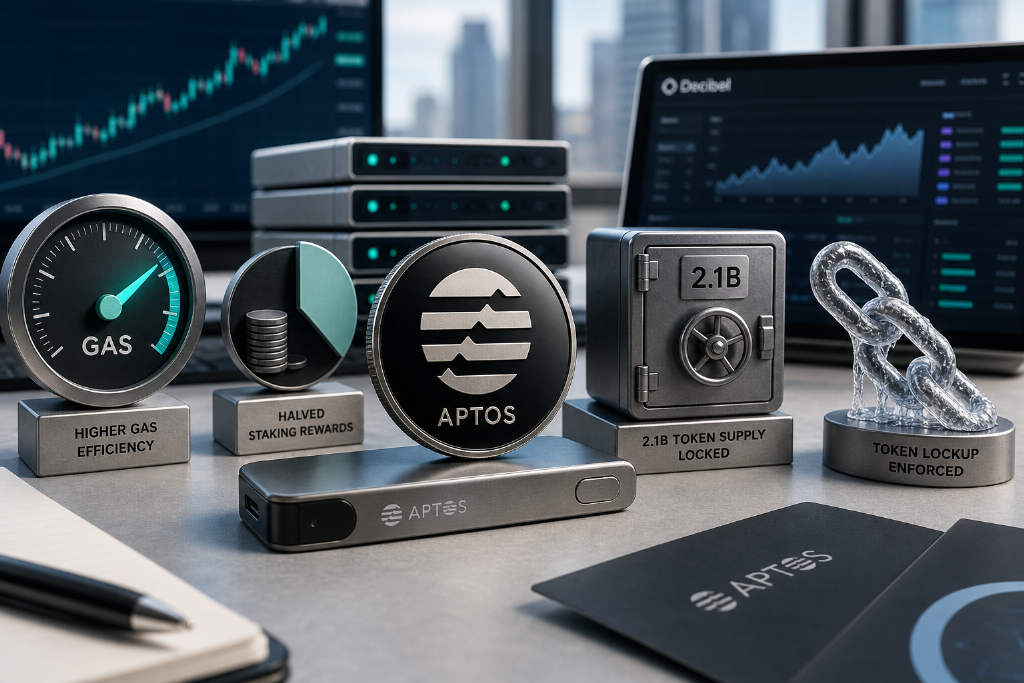
Between Feb. 19 and March 19, Aptos rolled out four core changes:
- Gas prices were raised 10x
- Staking rewards were cut in half and fixed at 2.6%
- Total supply was capped at 2.1 billion tokens
- 210 million tokens were permanently locked
The effects were immediate. Network revenue jumped by about 16x, while operator commissions were cut in half, improving both the revenue side and the cost side at the same time.
Demand, according to the report, did not weaken after fees rose. Daily transaction count increased from about 4.5 million to more than 12 million, even with transaction fees running at 10 times their previous level.

Decibel accounted for most of the chain’s transaction count
The report identified Decibel, a fully onchain perpetual futures order book, as the main engine behind Aptos activity. It accounted for the vast majority of onchain transactions on the network.
Its structure matters. For every $1 executed through a fully onchain order book, the amount of APT burned is roughly 50 times higher than what a standard liquidity-pool swap burns for the same $1 of value. The reason is mechanical: every quote, cancellation, and fill is a separate transaction that consumes gas.
As a result, Decibel contributed just over half of Aptos trading volume but represented 97% of total transaction count. The report argued that a fully onchain central limit order book, or CLOB, is economically viable only under Aptos’ current mix of fees and throughput.

Another metric to watch is burn-to-issuance
Beyond THNI turning positive, the report highlighted the ratio of token burn to token issuance as the next metric worth tracking over time.
That ratio stood at 0.2% in January and has now moved to nearly 10%. The report said the measure matters because token issuance creates persistent sell pressure on its own: validators may sell rewards to cover operating costs, and a foundation may also sell rewards to realize income.
It added that the reward rate is now fixed, large unlock pressure is set to decline materially after October, and Decibel’s product roadmap is still expanding. If onchain activity keeps growing, Aptos’ value capture could strengthen as well.