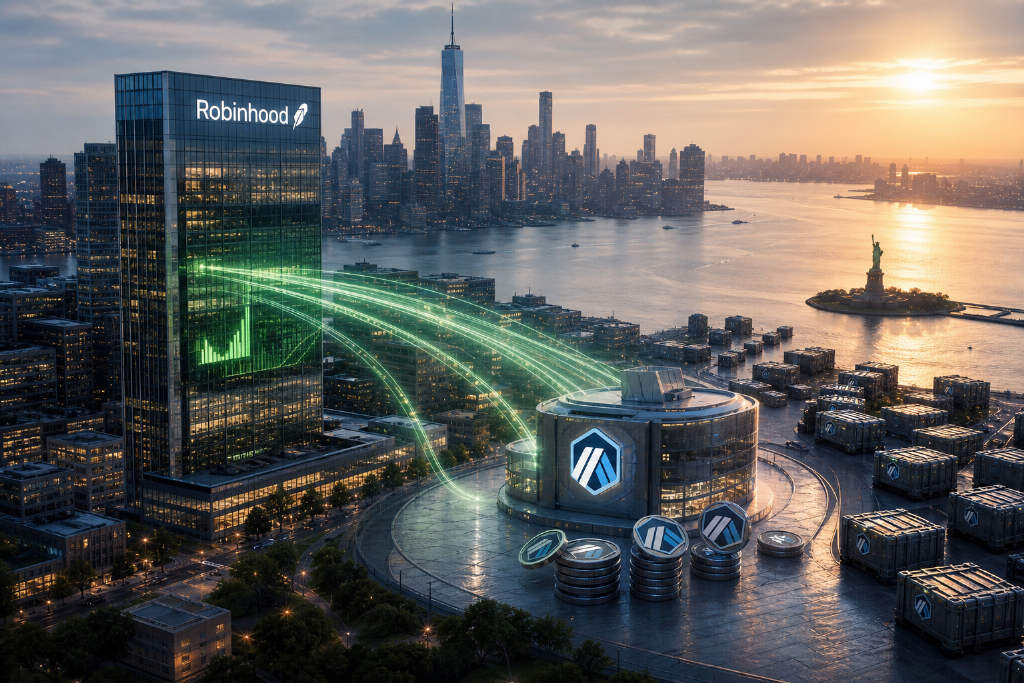
Arbitrum’s ARB token has posted a sharp rebound as activity on Robinhood Chain keeps climbing, with the token gaining as much as 43% over the past two days. Bitget market data cited in the source showed ARB recovering from a record low near $0.07 to around $0.113.
On Sept. 1, Adam data showed that 24-hour DEX volume on Robinhood Chain topped $900 million for the first time. Meme token launchpad trading volume reached a record $438 million in a single day, while RWA turnover moved above $200 million for the first time. Taken together, those figures pushed market attention back toward Arbitrum, because Robinhood Chain is built on Arbitrum Orbit.
Why Robinhood Chain is lifting ARB
Robinhood Chain is not positioned in the article as a rival to Arbitrum. It is a customer of Arbitrum’s stack. The Layer 2 network, launched by stock brokerage Robinhood, was built on Arbitrum Orbit and went live on mainnet on July 1 this year, with tokenized stocks and other real-world assets as a core focus.
Under Arbitrum’s scaling plan, chains built with its technology are required to route 10% of net protocol revenue back to the Arbitrum ecosystem, with 8% going to the ArbitrumDAO treasury. That means a fixed portion of Robinhood Chain revenue flows to Arbitrum. Whether any of that revenue is ultimately used to buy back ARB has not been established here, but the market has still tied the two together on the revenue side.
Crypto blogger Chen Jian quantified that relationship in an analysis dated Sept. 1. He said Robinhood had been generating about $100,000 in daily revenue on average since its July 8 launch, implying roughly $10,000 for Arbitrum. On the previous day, that revenue figure jumped to $1.92 million, putting Arbitrum’s share at about $190,000. Measured against ARB’s current $742 million market capitalization, that is still small, but the pace of revenue growth itself has become part of the case for re-rating the token.
From one of Ethereum’s leading Layer 2s to a token under pressure
Arbitrum was once one of the leading Layer 2 networks in the Ethereum ecosystem by total value locked and real usage. Its March 2023 ARB airdrop was also one of the largest token distributions the industry had seen. The total airdrop came to about 1.162 billion ARB across 625,000 addresses, with an average of about 1,859 tokens per address. At prices at the time, the article said the average airdrop was worth roughly $2,000 to $2,800 per address. Claim traffic briefly crashed the website on launch day, and on-chain activity hit a record.
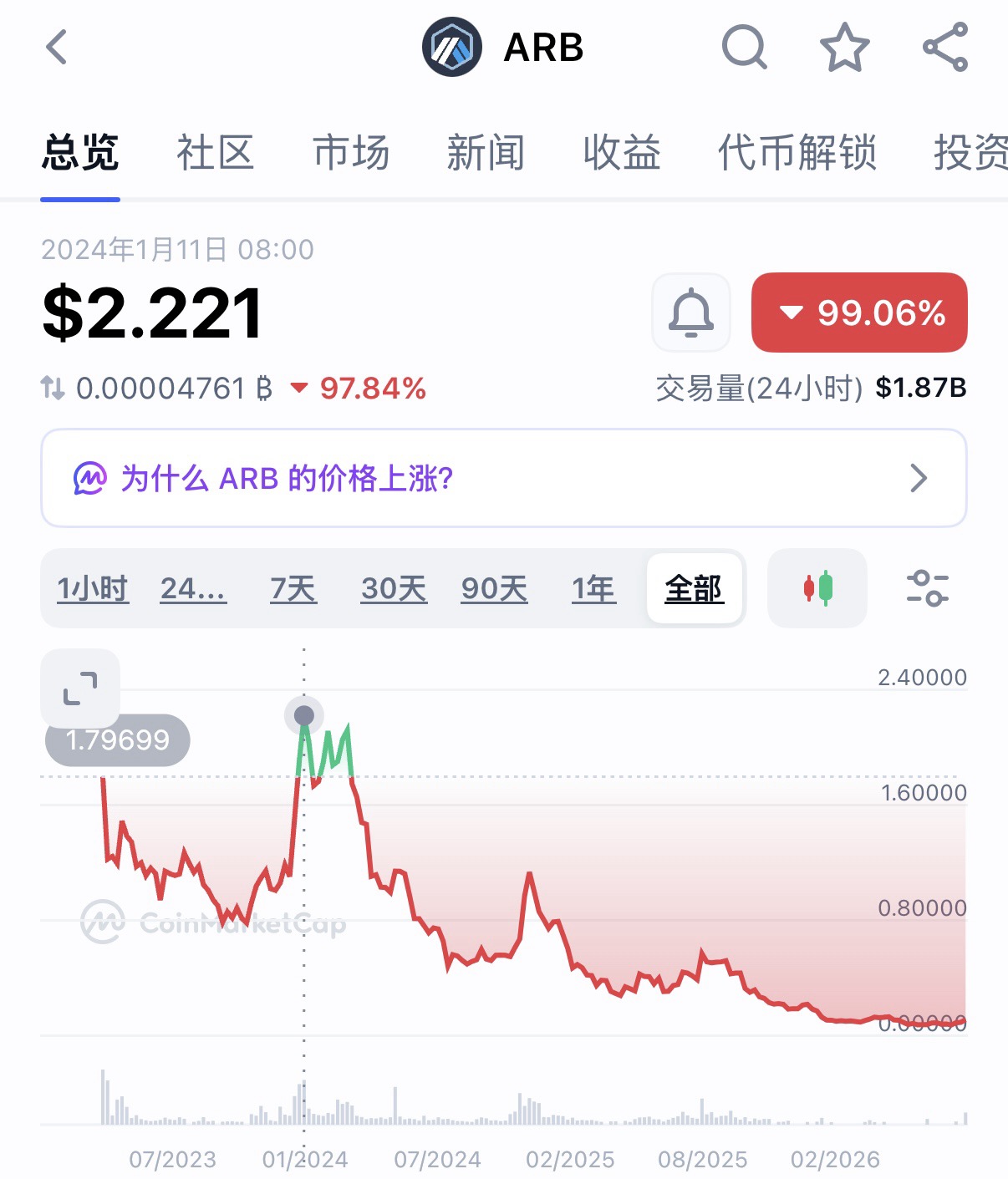
That period has long passed. After reaching an all-time high of $2.4 in January 2024, ARB moved steadily lower and hit a record low of $0.07 in June 2026, down more than 97% from the peak. CoinMarketCap data cited in the article put ARB’s market capitalization at about $742 million, with a fully diluted valuation near $1.11 billion, ranking it 69th by market value. Current circulating supply stands at roughly 6.67 billion tokens against a maximum supply of 10 billion, leaving about $376 million worth of tokens still to be unlocked.
Usage remains, but the application mix has shifted
DefiLlama data in the report showed Arbitrum with about $1.408 billion in TVL. The top five applications were Aave V3 at about $490 million, Spiko at about $441 million, USD AI at about $228 million, Spark at about $226 million, and GMX at about $197 million.
GMX has long been one of Arbitrum’s most representative perpetuals platforms, but the article said it generated only $26,800 in fees over the past 24 hours. Its market share is being chipped away by newer platforms including Hyperliquid and Aster.
Governance-only token economics and steady unlocks remain a drag
The article argued that ARB’s collapse was not only about declining ecosystem share. It also reflected a broader weakness in the token design used by Ethereum Layer 2 governance tokens. ARB and OP, the tokens of Arbitrum and Optimism, were designed primarily for governance, while network fees are paid in ETH. As a result, token holders do not directly benefit from rising network usage.
At the same time, team and investor allocations continue to unlock on schedule, adding fresh supply to the market month after month. Tokenomist data cited in the report showed that ARB unlocked 92.65 million tokens on Aug. 16 this year, equal to 1.61% of circulating supply. Another roughly 10.45 million tokens are due to unlock on Sept. 16. Without a direct value-capture mechanism, that steady release has added to selling pressure.
Some traders are looking at PONS instead
That has led to the market view summarized in the article as “buying ARB is not as good as buying PONS.” On Sept. 1, crypto blogger Dayu said buying PONS, the token of the Pons launch platform on Robinhood Chain, was far more efficient than buying ARB because PONS accounts for 50% of the chain’s revenue and 80% is used for buybacks and burns, while ARB “is still air, and there are still large unlocks every month.”
MemeFees data showed that Pons ranked first among all launch platforms by fee revenue over the past 24 hours, at about $4.73 million, with about $82.68 million in 24-hour trading volume.
The Base example is keeping the market cautious
Optimism’s experience has become a harsher reference point for Arbitrum’s current situation. On Feb. 18, 2026, Coinbase said in an official blog post that Base would leave the OP Stack and Superchain system and shift to a self-developed unified technology stack. Bitget data cited in the article showed OP falling from $0.1869 to $0.1247 in the three days after the announcement, a drop of 33%.
According to the report, Base had previously contributed most of Superchain’s revenue. Its departure did not just remove revenue sharing. It also weakened the narrative around OP Stack as one-click chain-launch infrastructure.
Chen Jian said on Sept. 1 that Base had only needed to pay 2.5% of profit sharing to Optimism and had also received a subsidy of 120 million OP tokens, yet it still chose to leave. Robinhood, by contrast, has to pay 10% of net protocol revenue to Arbitrum and received no subsidy. As a U.S.-listed company, Robinhood could eventually face shareholder scrutiny over that continuing expense, which may become the starting point for renegotiation. Based on that comparison, Chen Jian said, “the ending of this marriage can probably be guessed.”
This looks more like an expectations trade than a fundamentals reversal
With revenue, users, and trading volume moving toward Robinhood Chain while ARB remains constrained by monthly unlocks and a governance-token structure, the article said the latest rally looks more like an improvement in expectations than a turn in fundamentals.
The open question now is whether the Robinhood Chain-Arbitrum relationship becomes a durable long-term arrangement or turns into another version of the Base departure story.