
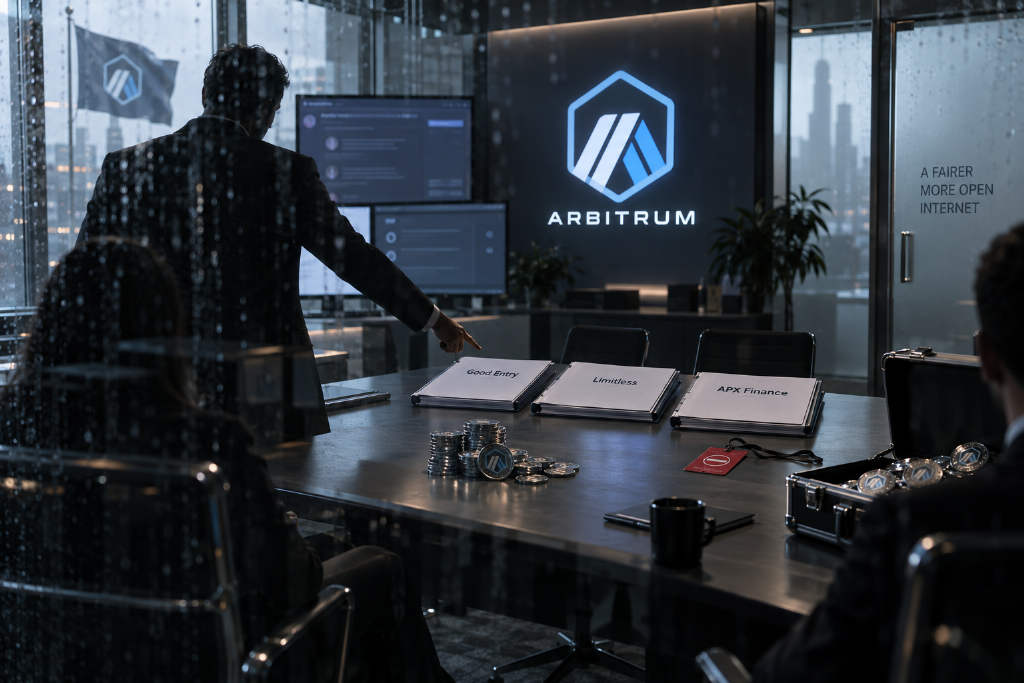
Arbitrum’s Watchdog Committee is asking ARB holders to permanently block three DeFi projects and their founders from all future ArbitrumDAO programs after finding that they misused grants from the DAO’s legacy incentive rounds.
The proposal was posted to the Arbitrum governance forum on Sept. 3 by OpCo on the committee’s behalf. It pushes the DAO’s grant-misuse process past clawbacks and into exclusion. The reach is broader than the projects themselves: two of the three have already stopped operating in 2024, while the third later merged into Aster, a perpetuals exchange whose value now sits mostly on BNB Chain.
Under the filing, Good Entry, Limitless, and APX Finance, formerly ApolloX, are the three named cases. The committee flagged 142,839 ARB for Good Entry, 75,000 ARB for Limitless, and 239,714 ARB for APX Finance. The proposal does not provide a combined total, but the three figures add up to 457,553 ARB, worth roughly $76,000 at ARB’s current price of $0.166.
The committee, identified in the proposal as Entropy Advisors, MinistroDolar, the Arbitrum Foundation, and OpCo, classified all three matters as “high-severity.” In the original program framework, that category covers large-scale and deliberate misuse, including fabricated deliverables and theft.
As of Sept. 2, the Watchdog Program had received 90 reports, recovered about 532,000 ARB for the DAO, and distributed roughly 268,000 ARB in reporter bounties, according to the proposal.
Good Entry: ineligible users and self-farming concerns
Good Entry received 200,000 ARB in the first round of the Short-Term Incentive Program, an up-to-50-million-ARB effort approved by the DAO in late 2023 to drive DeFi activity on Arbitrum.
On-chain analysis found that 142,839 ARB from Good Entry’s grant went to 1,032 ineligible users during and after the STIP period. The committee also said it found evidence of self-farming by wallets linked to the team’s own addresses. When asked for clarification, the team “refused to cooperate,” according to the proposal.
Good Entry sold protected perpetuals built around pricing gamma in Uniswap LP tokens. It sunset that product on June 28, 2024 after reporting “more than $245m volume,” announced a memecoin launcher on Arbitrum the same day, and then halted development completely on July 22 in a post-mortem titled “The Dream Ends.”
In that write-up, the team blamed liquidity, saying “Required swaps led to slippage during open/close txs” and that “whales prefer principal protected products.” The account has not posted since. DefiLlama still shows about $39,000 remaining in the protocol.
Limitless: 75,000 ARB swapped to USDC and bridged to Base
In the Limitless case, the committee said the team swapped its full 75,000 ARB LTIPP allocation into USDC and bridged the proceeds to Base, “removing grant funds from the Arbitrum ecosystem entirely.” The committee categorized that conduct as suspected theft.
This protocol was a liquidation-free, oracle-free margin trading venue, not the Base prediction market that shares the same name. It launched on Arbitrum on Aug. 6, 2024, and its latest post is dated Aug. 22 that year. DefiLlama marks it as deprecated, with about $2,300 left across Arbitrum and Base. The committee said it could not reach anyone on the team.
APX Finance: unspent funds, late distributions, and a sybil cluster
The largest case involves APX Finance, which was approved for 525,000 ARB in LTIPP, the follow-on program to STIP, to grow its perpetuals DEX on Arbitrum. The committee found 239,714 ARB tied to three overlapping issues: funds left unspent in team treasury addresses rather than transferred to distributor contracts, delayed distributions into those contracts, and a sybil cluster traced on-chain to team addresses.
Here again, the committee said it could not reach the team. APX’s operating business, though, still exists in another form. The project announced a merger with Astherus on Dec. 5, 2024, three months after LTIPP incentive streams were required to end, and Astherus rebranded to Aster in March 2025.
In an AMA recap published in April 2025, Aster chief executive Leonard said, “Aster (formerly Astherus) is the marriage of two of the strongest products and teams in the BNB Chain ecosystem.” The @APX_Finance account, which has 176,000 followers, now tells users to convert APX to ASTER and follow Aster for product updates.
DefiLlama shows Aster with $814 million in TVL and $1.9 billion in perpetuals volume over the past 24 hours. Nearly 70% of that value sits on BNB Chain, while about $51 million remains on Arbitrum. Aster also launched a privacy-focused Layer 1 in March 2026.
What happens next
ArbitrumDAO approved the Watchdog Program in an on-chain vote that ran from May 11 to May 26, 2025 and executed on May 27. The tally was 189.97 million ARB in favor, 116,140 against, and 21.13 million abstaining.
Entropy Advisors had proposed the program the previous December with a 400,000 ARB budget. Reporter rewards included a base bounty based on severity — 1,000, 10,000, or 30,000 ARB — plus 5% of recovered funds. That extra amount is deducted from the recovery and capped by severity at up to $100,000 per report. Every case the committee validated in its April retrospective traced back to STIP, STIP Bridge, or LTIPP.
Each project has until Sept. 10 to make its case in a reply on the forum thread. Six days after publication, the thread carried no replies.
If the committee is not satisfied with the explanations and the funds are not returned within the same week, three separate Snapshot votes will be posted, one for each project. Each vote will ask whether the project, “including all founders, current team members, and affiliated contributors,” should be permanently banned from all future ArbitrumDAO programs. For projects that are no longer operational, the ban would apply only to founders.
There is no on-chain component to the final step. The proposal says each Snapshot vote “will serve as the final decision” because enforcing a ban does not require on-chain action. The dates remain tentative.
Part of a wider DAO spending debate
The filing places the proposed bans inside a broader argument over ArbitrumDAO spending in 2026. That debate has included a $45 million funding request from the Arbitrum Foundation that delegates challenged as exceeding DAO revenue. Against that backdrop, three possible ban votes over 457,553 ARB represent only a small part of the dispute, but they are the only cases in this discussion that explicitly name people.