


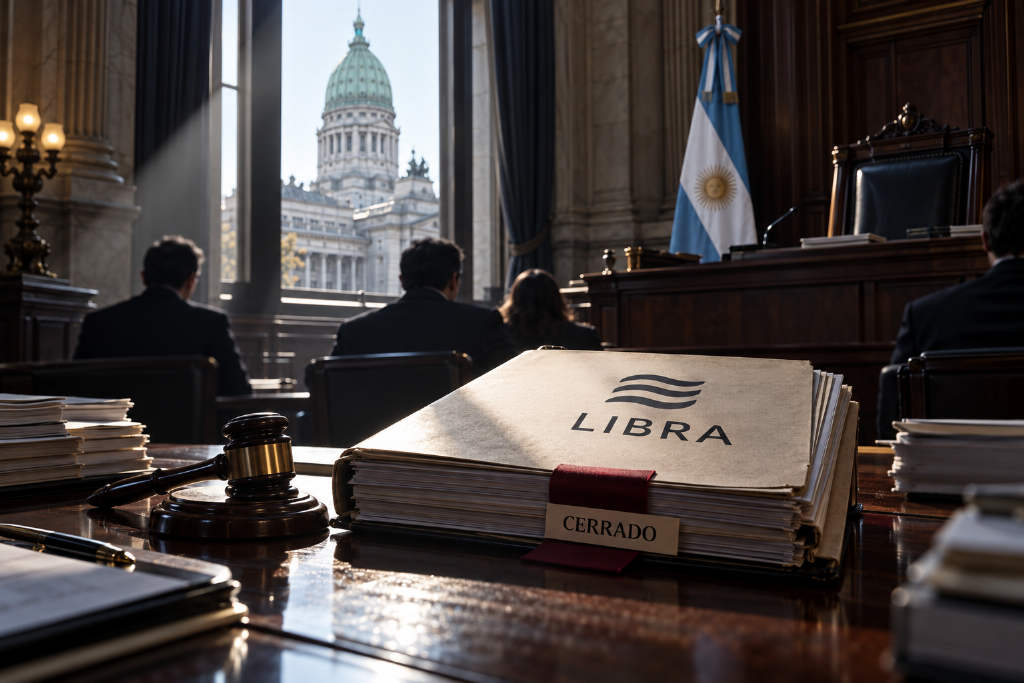
An Argentine federal judge has closed the $LIBRA criminal case against President Javier Milei, his sister Karina Milei, Hayden Davis and eight others, ruling that the alleged conduct did not fit any criminal offense. Judge Marcelo Martínez de Giorgi signed the 60-page decision on Oct. 23 under Article 336, paragraph 3 of the criminal procedure code.
The ruling also stated that the proceedings do not affect the defendants’ prior reputation.
From the opening of the case in February 2025 to its dismissal, none of the 11 people named in the matter was summoned to appear in court as a defendant. The case was closed after prosecutor Eduardo Taiano formally requested dismissal, and the judge adopted the prosecution’s reasoning. At the center of the ruling is a simple conclusion: the reach that comes with the presidency is not, by itself, fraud.
The ruling recounts the rise and collapse of $LIBRA
According to the decision, Milei promoted $LIBRA on X on the night of Feb. 14, 2025. The token’s market capitalization briefly climbed above $4.5 billion, then fell about 95% within hours. On-chain analysis cited in the report said eight wallets linked to the team cashed out about $107 million.
The ruling says the token price moved from a few cents to nearly $5, that a small number of wallets withdrew about $100 million, and that more than 40,000 buyers suffered losses. Milei later deleted the post and said he had acted in good faith.
Judge says losses alone do not establish fraud
On the fraud question, the judge wrote that prosecutors needed to prove a “criminally relevant deception.” Reconstructing a timeline of promotion, a price spike, a crash and investor losses was not enough on its own. The court said the case required a showing that some aspect of the project had been presented in a misleading way, or that key information had been concealed.
The ruling repeated and endorsed the prosecutor’s view that the project existed, the token was issued, the participating companies were real, and the transactions took place on a public, traceable blockchain. It also noted that the defendants never guaranteed future returns, price stability or any compensation mechanism, and that the events took place in the highly volatile, heavily speculative memecoin market.
The judge did not avoid the issue of Milei’s office. He wrote that the institutional status of the person promoting a project “may bring special reach and visibility” and may affect the trust of some buyers. But recognizing that influence is one thing; concluding that it necessarily amounts to a false representation is another. Fame and trust, the court said, are not the same as a fraudulent device.
Key evidence did not bridge the gap
One of the most closely watched pieces of evidence was a note found on Mauricio Novelli’s phone. In March 2026, Argentine outlet El Destape reported on the note’s contents, which described three payments totaling $5 million.
The forensic conclusion cited in the ruling was much narrower. The image found on the phone was identified as an automatically generated preview created by iOS Intents. That, the court said, only proved that the note had existed in Apple Notes and that the user had opened or edited it. Investigators did not find the note itself in the main database, and they found no transmission record in the databases of iMessage, WhatsApp or Messenger. On that basis, the court said it could not be proven that the note had ever been sent to Davis or anyone else.
As for Karina Milei, the ruling said the only written record linking her to Davis came from documents provided by the presidential office. Those records showed that on July 16, 2024, she authorized Davis and his partner Bartosz Lipinski to enter Casa Rosada. The judge agreed with prosecutors that this authorization, viewed on its own, was not enough to prove an illegal agreement.
The court also said investigators could not confirm the contents of two deleted conversations on Novelli’s phone under the contact name “Karina Milei RRPP,” or the contents of call records between Novelli and Milei.
Breaks in the chain of custody and overseas developments
The ruling acknowledged weaknesses in the prosecution’s evidence trail. An internal disciplinary review within the prosecution service found that an employee at DATIP, the forensic unit, improperly accessed confidential $LIBRA case files, and some of that material later appeared in the media. The judge wrote that the lack of strict controls affected the chain of custody and reduced the evidentiary value of the forensic work.
The court also cited a finding by the Anti-Corruption Office, which concluded that Milei’s post came from a personal account, did not amount to an institutional act and did not involve public resources. On that basis, it found no breach of public ethics law.
Developments abroad also leaned in favor of the defendants. The ruling cited a response from the U.S. Department of Justice saying that Argentina’s mutual legal assistance request had been closed and returned because the link between the people involved, the alleged offenses and the requested material was insufficient.
It also referred to a Sept. 29, 2026 decision by the U.S. District Court for the Southern District of New York dismissing a civil suit against Kelsier Labs and other defendants. According to Argentine outlet Perfil, the claims against Davis were dismissed for lack of jurisdiction and did not reach the merits.
Milei celebrates, opposition calls it a cover-up
On the night the ruling was issued, Milei posted on X: 「¿Y AHORA QUIÉN ME COMPENSA POR UN AÑO, OCHO MESES Y NUEVE DÍAS DE MENTIRAS, CALUMNIAS E INJURIAS BUSCANDO MANCHAR MI BUEN NOMBRE Y HONOR?」 He said the judiciary had put things back in their place and exposed a “TREMENDA operación política y mediática” whose only purpose was to damage the presidency and pursue a political objective with coup intent.
In the latter part of the post, he named the La Nación group and journalists Hugo Alconada Mon and Carlos Pagni, then ended with his usual slogan.
The opposition read the decision very differently. Maximiliano Ferraro, the opposition lawmaker who chairs the congressional $LIBRA investigative committee and was also one of the original complainants, posted a video on X and wrote: 「Estamos ante una clara operación judicial planificada de encubrimiento e impunidad para Milei y todos los organizadores de la estafa.」
In the video, Ferraro said authorities had never explained, and had never been required to explain, the dozens of meetings that $LIBRA promoters held at Casa Rosada and Quinta de Olivos, the cryptocurrency trades around those meetings with the president, and Milei’s phone calls on the day of the events.
A gap between the court ruling and the congressional probe
Perfil also highlighted another discrepancy. A committee led by Ferraro issued a 205-page report in November 2025 concluding that Milei had provided key assistance to the project. The report counted 114,410 wallets that lost money and 36 wallets that each made more than $1 million.
That report was not mentioned in the ruling.
Changes on the plaintiffs’ side also drew attention. On July 3, 2026, the judge granted a request from lawyers for defendant Novelli and removed five investors who had joined the case as private plaintiffs. Infobae reported the move in detail. On Sept. 4, appellate judges Mariano Llorens and Pablo Bertuzzi upheld that decision, saying $LIBRA buyers had “voluntarily assumed the inherent risks” of this kind of purchase.
Dismissal could become final within days
The next procedural step is relatively straightforward. Because prosecutor Taiano himself asked for the case to be closed, Perfil said he is not expected to appeal. There are also no private plaintiffs left in the case, which means the dismissal could become final within days.
The only remaining variable is at a higher level. The investors who were removed from the case have asked the Federal Criminal Court of Cassation to restore their standing as plaintiffs. Only if that request succeeds would there be a path to appeal the dismissal.
But the lower appellate court has already said buyers assumed the inherent risks of the trade, leaving that route narrow.