
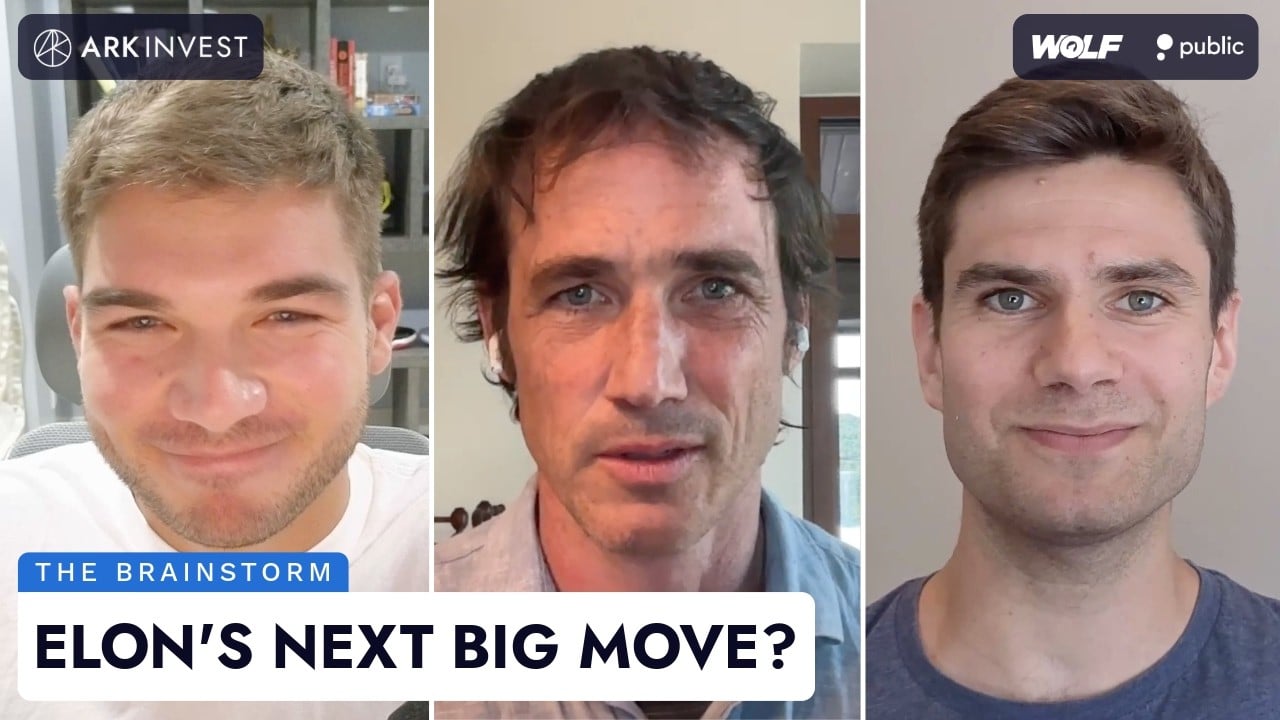
ARK Invest devoted the latest episode of its podcast The Brainstorm to two questions that sit at the center of its current technology thesis: whether China could derail a potential merger between Tesla and SpaceX, and how fast AI inference costs are falling.

The Aug. 7 program was hosted by Sam Korus, ARK Invest’s director of autonomous technology and robotics research. The guests were Brett Winton, the firm’s chief futurist, and Nick Grous, who leads consumer internet and fintech research. The episode also carried a disclosure that ARK Invest’s ARKK ETF holds Tesla and SpaceX as its two largest positions, at about 9.2% and 5.9% respectively, while the ARK Venture Fund also owns shares in OpenAI.
China was framed as a complication, not the deal-breaker
Korus opened the discussion by asking Winton whether Tesla’s business in China could become the landmine in any combination with SpaceX, especially after Elon Musk had said China was “not a problem.”
Winton said he understood why investors would see Tesla China as an uncomfortable piece in a SpaceX-Tesla merger. SpaceX has extensive business tied to national security, and dual-use technology faces clear restrictions when China is involved. Still, he said he does not think China is the factor that stops the deal because there is likely a way to isolate Chinese assets.
He added that Tesla’s ownership of a factory in Shanghai is itself unusual in the global auto industry and, in his view, says something about Musk’s ability to move through politically sensitive situations.
Winton’s larger point was that the Shanghai plant matters less to Tesla’s long-term value than it once did. He argued that Robotaxi, not the China factory, is the core of Tesla’s future economic value. ARK does not expect China to become a major Robotaxi revenue market, he said, citing regulatory pressure, local competition and the fact that China is already a very low-cost ride-hailing market on a per-mile basis.
That does not make the Shanghai factory irrelevant. Winton noted that it still serves as an export base for countries outside Europe and the United States. But in his framing, it is no longer the main driver of Tesla’s future value, which is why he believes the merger issue can be managed.
Grous broadly agreed. He said owning a car factory in China may have been harder than solving the legal and operational challenge of carving out part of the business. He described the Shanghai plant as foundational to “Tesla 2.5,” when the company’s story was centered on scaling auto output and lowering battery costs. Now, he said, Tesla is in a transition phase and “Tesla 3.5” clearly points to Robotaxi, with those systems being built in the U.S.
Winton also said Optimus robots would “most likely” not be allowed to be sold in China. In his view, Beijing could use that point as leverage because it would not want SpaceX to gain access to Tesla Robotaxi cash flow. Even so, he described the China issue as a small wrinkle in a much larger negotiation rather than an insurmountable obstacle.
On Starlink, Grous said neither Washington nor Beijing would necessarily welcome such a merger, but a car integrated with Starlink would likely be very attractive to Chinese consumers.
When Korus asked whether China could stop Starlink satellites from passing overhead, Winton said it could not because “it’s in space.” He said authorities could block antenna sales in China or restrict how service lands in the country, but they could not prevent the satellites themselves from crossing the sky. Referring to an earlier public remark from Musk, Winton described the practical question as: “What can you do, shake your fist at the sky?”
At the same time, he said SpaceX could not afford to completely alienate the Chinese government and should not actively seek that business. But if someone brought a Starlink terminal into China from elsewhere, he guessed SpaceX would still be willing to take the payment.
Winton said a formal announcement could come before year-end
Korus then pressed the timing question: if the deal is real, could it be announced before the end of the year?
Winton answered directly. If the question is only whether it gets announced, he said, then the odds are fairly high that it happens before year-end. He floated two possible windows: after the main IPO lock-up period ends, or after the current quarter.
He also said the more sensitive part is not timing but structure. A key issue is whether SpaceX would need to pay a premium for Tesla stock, and if so how much, in order to secure the shareholder approval needed to complete the merger.
From his perspective, shareholders on both sides would be better off if the merger is completed. The real challenge is to create a mechanism that combines the two companies while delivering fair value to both sets of shareholders.
Grous agreed and joked that, as long as “announcement” does not mean a lawyer who has never appeared on an earnings call fielding questions, then he also thinks the market could hear something before year-end.
ARK put numbers on the speed of AI cost compression
The other major thread in the episode was AI economics.
Korus asked Winton what matters most in a market increasingly focused on falling AI costs and the idea that the model layer is becoming commoditized.
Winton pointed to data from ARK’s annual Big Ideas report. At a fixed level of benchmark performance, he said, AI costs had been falling 99% per year, roughly a 100-fold decline. On a harder agentic benchmark, though, the pace accelerated sharply. From February through July 31 of this year, he said, the annualized cost decline reached 99.99%, two orders of magnitude faster than the earlier figure.
He said ARK expects that rate to stay near 99.97% over the next year. In plain terms, AI is getting dramatically cheaper, and it is doing so very quickly.
Winton stressed that the shift is not only about lower cost at the same capability. The ceiling on performance is also moving higher. Earlier this year, he said, no amount of money could get an AI model above 50% on the benchmark in question. Now the same task can be done for 15 cents per task.
That difference matters because rising performance ceilings pull entirely new tasks into the market. Lower costs do the same, but they are more likely to make repetitive workloads viable, such as classifying 17,000 books or annotating literature tied to a set of gene derivatives.
His practical takeaway was blunt: whatever a company is doing with AI today, if it keeps doing the same thing next year, it may cost one-thousandth as much.
Winton said what interests him even more is that capability gains themselves appear to be accelerating. In his interpretation, the move from 99% to 99.99% suggests that frontier model companies, including Grok, may have found the code for recursive self-improvement. Model release cycles are compressing while capability keeps climbing.
Who wins is still unsettled, Grous said
Grous took a more reserved position on market structure.
He said he does not dispute the data Winton presented. His question is what those numbers actually mean for the market, who ends up with the largest share, and why.
In his view, that answer is still far from clear. The market remains fixated on frontier model companies because they have made coding dramatically easier, and he believes most AI spending is still concentrated there, especially among developers at technology companies.
What he keeps asking is where the next major market opens up, and whether that opportunity truly requires frontier models or whether open-source models paired with a routing layer are enough.
He pointed to several public company examples. Spotify, he said, was unusually candid on its earnings call about building its own development environment, Honk, and a routing system called Chirp that chooses the cheapest and most effective option across open and closed models. Robinhood is doing something similar, according to Grous. Block has its own development environment called Goose. Palantir, after posting what he described as a strong quarter, had CEO Alex Karp saying directly that closed models are bad for the company.
For that reason, he does not think strong progress by frontier labs automatically means they will dominate five years from now. He said they will likely take a large share of the market, but there is still plenty of room for others.
Winton agreed with the “more than one winner” view, but pushed the scale much further. Returning to ARK’s GDP outlook, he said many people still do not grasp how different the world could look in five to seven years.
His answer to the winner question was not one or two companies. He said there could be 50 winners larger than anything the market has seen before. In that future, people might look back and ask whether it was possible that Apple and Nvidia were once only single-digit trillion-dollar companies.
He said one scenario includes a frontier model company becoming a quadrillion-dollar company, potentially SpaceX, OpenAI or both. But he also said another future is possible, one that is more distributed across many firms.
Even now, he said, the companies speaking most openly are talking about model routing and open-source deployment. But the bulk of the market’s revenue is still in coding. The next expansion wave, in his view, comes from enterprises that do not have elite engineering teams but do have large numbers of knowledge workers.
Those customers are less likely to move to open-weight models because if something breaks, there is no one to call. Falling costs may actually reinforce their loyalty to incumbent providers. If the best vendor keeps getting cheaper, there is less incentive to switch.
Winton also noted that OpenAI had cut the price of Luna, its lightest model, by 80% from a month earlier. He said some of that reflected competitive pressure, but he also pointed to OpenAI’s own comments on efficiency gains. The message, in his reading, is that OpenAI wants to pull in enterprise customers no matter where they want to sit on the efficiency curve.
He then turned to the consumer side. For individual users, he said, using a weaker model that makes mistakes is simply painful. That is why consumers will keep pulling demand toward smarter models.
On revenue growth, Winton said the annual recurring revenue trajectories at Grok, Gemini, OpenAI and Anthropic show rising second derivatives. He described year-over-year growth at roughly 5x, with growth still accelerating. He also cited recently leaked revenue information about OpenAI as another sign of an inflection point.
He added that if ARK’s forecast of $2 trillion in revenue for frontier model companies by 2030 is going to be met, growth would actually need to slow sharply from here, with annual growth rates declining by more than 50%. Based on what he sees now, however, the deceleration that would normally show up in a classic diffusion curve is not visible yet. Growth is still speeding up, which he said means the market remains in a major expansion phase.
AI hardware may run into social resistance before technical limits
The conversation later shifted to voice interfaces and AI hardware.
Grous said voice has improved dramatically since the first generation of these systems. If a leading model company ships a hardware device, he said, that could be one of the best ways to lock in large numbers of consumers.
Korus pushed back. In his view, it is much harder than simply launching a device and locking everyone in. Wearables in particular still need a smartphone ecosystem to have a real chance.
He said the more serious issue is that neither consumers nor enterprises appear ready to accept devices that continuously capture all the context those companies would want. If people knew they were being recorded or listened to all the time, he said, social structure and culture would change immediately, and there would be major backlash.
His expectation is that such a product might see an initial burst of adoption and then hit a wall. To change social acceptance, he said, it could take something like five years of gradual normalization by a company such as Apple.
Grous replied that he personally would like the feature and would want his life context preserved, but he still thinks it fails at the social level. If it were attempted, he said, society would split in a barbell pattern: restaurants would ask people to put the devices away or turn them off, and the culture would divide into two camps.
As digital abundance grows, physical experiences may gain pricing power
Winton then offered a view that he framed as counterintuitive: movies are working again, while games are struggling somewhat.
He said this may be an early sign of a broader pattern. As digital experiences get compressed toward extremely low cost, being with other people starts to feel better. Sports events, films and the World Cup could all become what he called “anti-AI lanes.”
The logic is simple. If anything in the digital world can be manufactured, then everything in the physical world becomes relatively scarcer. Society may begin to value that scarcity more, while online experiences turn into commodities.
Grous said the renewed strength in movies is particularly interesting for younger consumers, a group often seen as unable to sustain attention for two hours. It may be the concentration itself, he suggested, that makes the experience feel novel.
He also said that when Sora first came out, he did not think pure AI-generated video would be an attractive medium on its own. It could fit inside Instagram or TikTok, where AI clips appear every few posts within an existing stream of synthetic content. But a standalone app filled entirely with what he described as “AI slot machines” did not make sense to him.
Entertainment, he said, is about storytelling. If storytelling becomes something controlled by AI, humans lose interest.
Winton said OpenAI’s first hardware product was for enterprise developers
Near the end of the episode, Winton pointed to what he described as OpenAI’s first hardware product: a small dongle for enterprise software developers that lets users talk to Codex Agent and switch tasks quickly.
He argued that this fits the normal path of many technologies, which first find traction in enterprise settings and then move toward consumers. Part of the reason, he said, is that the cost of capturing and processing context is still high. Consumer-side applications already exist for paying Pro users, but they are not yet compelling enough to support indirect monetization.
Korus then cut in with a line that captured the tone of the entire discussion: wait one year, and costs may fall another thousandfold.
Winton’s answer was short. “Yes.”
Episode details and disclosure
The podcast episode was published by ARK Invest under the title Could China Block A Rumored Tesla-SpaceX Merger? | The Brainstorm 143 and aired on Aug. 7, 2026.
The program disclosed that ARK Invest’s ARKK ETF holds Tesla (TSLA) and SpaceX (SPCX) as its two largest positions, at about 9.2% and 5.9%, and that the ARK Venture Fund also owns OpenAI shares. That makes the discussion of a Tesla-SpaceX combination and frontier model company revenue forecasts closely aligned with ARK’s existing portfolio exposure.