
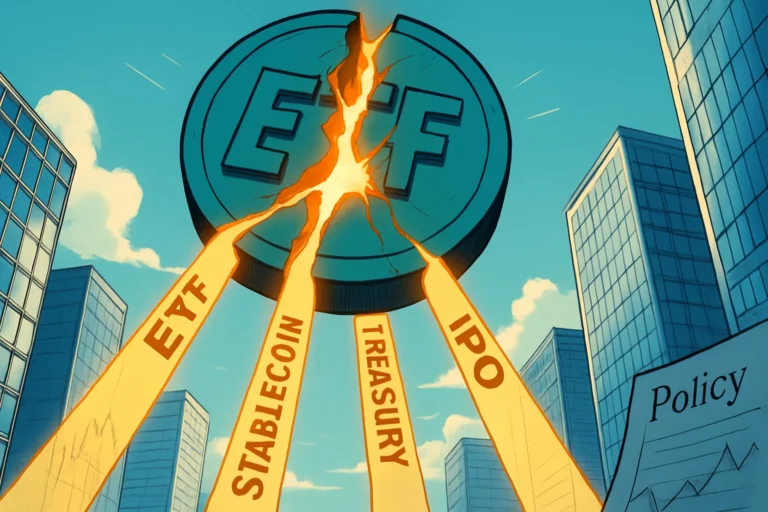
Arkstream Capital argues that the defining shift in the 2025 crypto market was the externalization of the pricing framework. Prices were no longer driven mainly by a single public-chain cycle or by self-reinforcing on-chain narratives. Policy and compliance conditions, macro liquidity, risk appetite, leverage, and platform risk controls moved to the center. In that setup, price elasticity depended less on narrative intensity and more on where capital entered, what instruments it bought, and how positions could exit under stress.
Capital inflows broadened beyond on-chain leverage
The report says capital entry points changed from a largely on-chain leverage model to several parallel channels. ETFs served as standardized allocation tools. Stablecoins functioned as the on-chain dollar settlement base. Corporate treasury strategies turned listed companies’ financing capacity into spot demand. IPOs created a public-market route for crypto infrastructure businesses by turning custody, clearing, trading, and institutional service capabilities into tradable equity.
According to the figures cited in the article, total stablecoin supply rose from about $205 billion to more than $300 billion in 2025. Near year-end, USDT stood at about $186.7 billion and USDC at about $77 billion. IBIT recorded about $25.4 billion in net inflows for the year. Companies adopting digital asset treasury strategies had reached the hundreds, with combined holdings in the hundreds of billions of dollars.
IPO activity became a structural market variable
Arkstream Capital treats the IPO market as one of crypto’s key external variables in 2025. The article says nine crypto or crypto-related companies completed IPOs during the year, raising roughly $7.74 billion in total. Valuations ranged from about $1.8 billion to $23 billion, while initial free-float ratios were roughly between 7.6% and 26.5%. That gave public investors a wider set of regulated, comparable crypto-related equity assets to buy.
The report links that reopening to changes in regulation and accounting treatment. It highlights the SEC’s release of SAB 122 in January 2025 and the withdrawal of SAB 121 as a major signal for custody-related business models. It also notes the creation of an SEC crypto asset task force and legislative progress on stablecoins during the middle of the year. In the firm’s view, those developments made disclosure, underwriting, valuation, and institutional participation easier to standardize.
The article also names about 10 potential IPO candidates for 2026: Anchorage Digital, Upbit, OKX, Securitize, Kraken, Ledger, BitGo, Tether, Polymarket, and Consensus.
Industry growth shifted from narrative to product lines
Inside the industry, Arkstream Capital says the more important evolution was the move from narrative-led growth to product-line-led growth. Stablecoins, on-chain derivatives, and prediction markets were presented as the clearest examples. The traditional four-year cycle did not disappear, but its explanatory power weakened as the market became more sensitive to macro liquidity and risk-budget changes seen in broader financial markets.
In stablecoins, the report describes a split between a “cash layer” and yield-oriented efficiency tools. Mainstream fiat-backed stablecoins remained the core settlement and liquidity network. Yield-bearing or synthetic dollar products were more cyclical and more exposed to basis, hedging costs, and shifts in risk appetite. For USDe, supply moved from around $15 billion at its high to about $8.5 billion, then to roughly $6 billion to $7 billion near year-end.
For on-chain derivatives, the article says 30-day on-chain perpetual volume reached about $1.081 trillion, with open interest around $15.4 billion. Hyperliquid, Aster, and Lighter were cited as platforms competing for share, with market competition moving away from listing speed and incentives toward depth, sticky open interest, and liquidation stability under stress.
Prediction markets also expanded beyond crypto-native usage into a broader event-contract market. By the article’s measure, full-year 2025 prediction market volume was about $44 billion, with sports and politics as major categories. Those products turned macro and public events into tradable probability curves and tied crypto trading activity more closely to political and macro variables.
Arkstream Capital frames 2025 as a year of accelerating institutionalization, tighter macro constraints, and a restart in securitization. In that structure, ETFs answered whether institutions could allocate to crypto, while IPOs addressed what they could buy, how they could benchmark it, and how they could exit. At the same time, product-driven development inside the sector kept changing how capital was organized and how prices were discovered.