
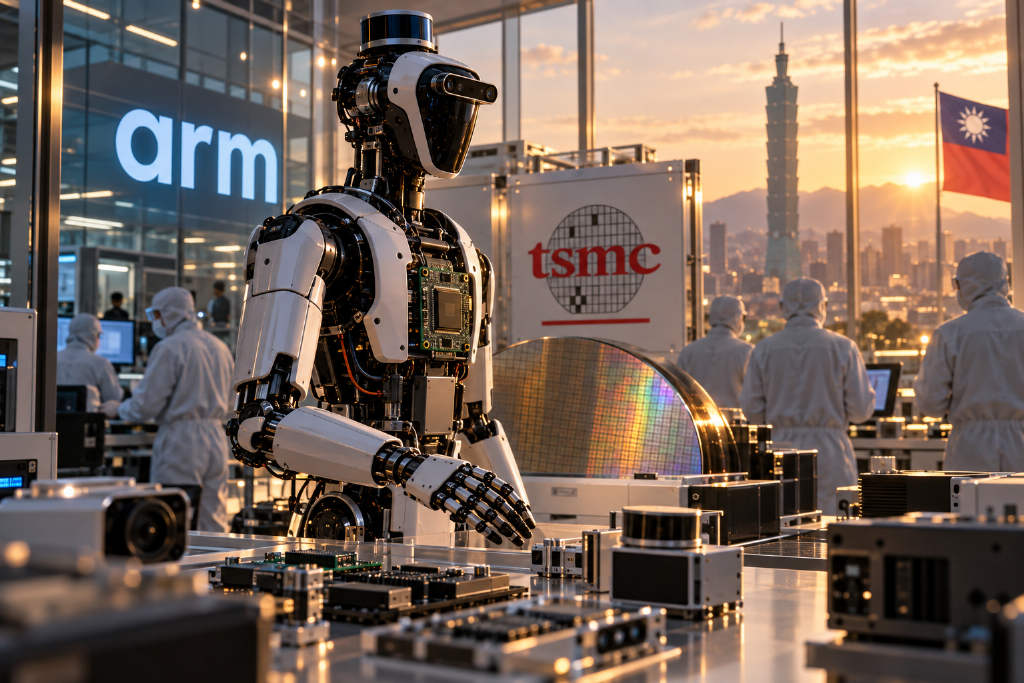
Arm on Sept. 8 announced Arm Total Design for Physical AI, a program that brings together more than 80 companies across the Physical AI technology stack to pursue opportunities in robotics and autonomous systems.
According to the source article, citing Commercial Times, several Taiwanese companies are part of the first group.
Program spans software, AI models, sensors, and compute hardware
Arm said the design program covers software stacks, AI models, sensors, compute hardware, virtual platforms, and digital twins. The stated goal is to move solutions into development and validation earlier, cut integration risk, and speed the path from proof of concept to large-scale deployment for autonomous systems.
The source article said robotics requires more than raw compute. It added that Taiwanese suppliers may have room to enter the silicon ecosystem. Industry participants cited in the report said TSMC, Realtek, and ATL were categorized within the Silicon Ecosystem because robots rely on large numbers of microcontrollers, or MCUs, for motor control, joint actuation, sensor data capture, and real-time control. That raises both volume and performance requirements for low-level control chips.
Realtek was highlighted in the article for its long-standing presence in networking, Ethernet, Wi-Fi, Bluetooth, audio, and connected chips. That profile matches Physical AI use cases that require extensive real-time connectivity and data transfer. As robots move from standalone machines to group collaboration, edge computing, and cloud management, the role of connectivity chips may also become more important.
Media reports pointed to nine Taiwan-linked companies
Arm estimates that Physical AI could create around $200 billion a year in compute opportunities in the 2030s.
According to multiple media reports referenced in the source article, the companies from Taiwan on the list include TSMC (2330), Realtek (2379), ATL-KY (6907), Insyde (6231), AAEON (6579), Huiyou (5484), Silicon Motion (Nasdaq: SIMO, headquartered in Taiwan), Guangcheng Yanchuang, and NEXCOBOT, a unit of NEXCOM (8234), for a total of nine.
The article also noted that Arm’s official partner list did not identify every company one by one, so the final roster should be based on disclosures from Arm and the companies themselves.
Arm publicly named international partners including Amazon Web Services (AWS), ECARX, Hugging Face, Liquid AI, NXP Semiconductors, PlusAI, PSYONIC, QNX, Qwen, Siemens, and Unitree.
Arm said Agentic AI is expanding the capabilities of intelligent systems, while Physical AI is bringing those capabilities into mining, agriculture, manufacturing, transportation, and logistics. The company said the related economic activity runs into the trillions of dollars globally.
RL0 to RL5 framework aims to give robotics a common language
As one of the first collaboration efforts in the ecosystem, Arm also introduced the Robotics Capability Framework. The initial structure has six levels, from RL0 to RL5, moving from reactive machines to systems with situational awareness, cognitive ability, and eventually self-improving capabilities.
Each level maps robot behavior to system requirements such as latency, compute allocation, memory and power limits, determinism, and safety.
Arm chief architect Richard Grisenthwaite said robotics technology is advancing quickly, but the industry still lacks a common way to describe, compare, and communicate machine capability. He compared the framework to SAE levels for autonomous driving and said it is a starting point rather than a finished standard, while inviting broader industry participation.
Rene Haas sees wider humanoid adoption within five years
Arm CEO Rene Haas said in an interview that AI is expected to drive broader adoption of humanoid robots within the next five years. He also said chips designed by Arm will significantly support the development of AI robots with autonomous learning capabilities over the next decade.
He listed manufacturing, cleaning, security, and bridge construction and repair among the use cases. Haas also said he believes AI will help cure cancer within the lifetime of this generation.
At the same time, he pointed to near-term constraints. He said the broad value of robotics will show up in labor-intensive tasks, but robot costs still need to come down and business models still need market validation.
Haas also said shortages across several chip categories are slowing deployment in AI and data centers.
Arm has also introduced its own AGI CPU this year
Beyond robotics, Arm has continued to push into the cloud data center market. The source article said Arm has already launched its own Arm AGI CPU this year and said customers can use the new Neoverse Compute Subsystems, or CSS, N4 to build chips optimized for maximum throughput efficiency.
Arm added that its Arm AGI CPU is production-ready and built for agentic AI workloads that require real-time response.