
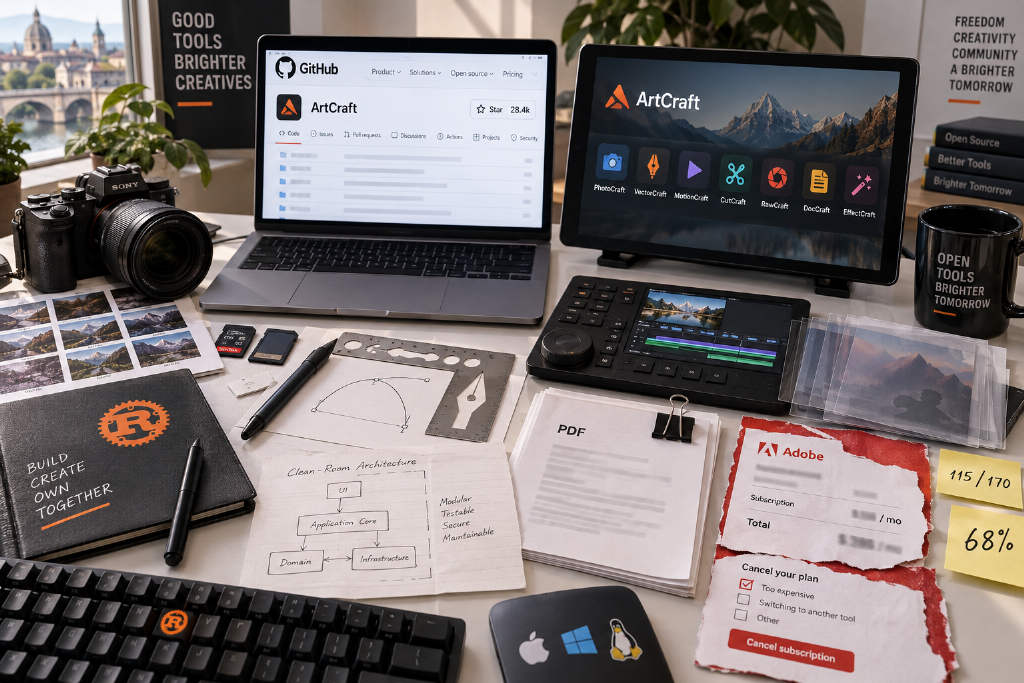
ArtCraft has published seven Rust-built applications designed to mirror major Adobe products, and the project’s PhotoCraft repository picked up nearly 10,000 GitHub stars in seven days. The attention comes against a familiar complaint around Adobe: subscription plans that can carry steep cancellation penalties and a difficult offboarding process. The source article says those penalties are typically 50% of the remaining contract value.
Seven apps mapped to Adobe’s main software lineup
On ArtCraft’s official website, the suite appears under 「Crafting Apps」 and includes seven products targeting Photoshop, Illustrator, Premiere Pro, Lightroom, Acrobat, After Effects, and InDesign.
According to the project description, all seven apps are written in Rust, do not rely on Electron-style web wrappers, and are available for free. The site says installers are prepared for macOS, Windows, and Linux. PhotoCraft’s README lists its license as MIT or Apache-2.0.
The README also describes the software as a clean-room rewrite, meaning the implementation is based on public specifications and observed behavior rather than proprietary source code.
Installers exist, but replacement claims remain limited
That does not mean the suite can fully replace Adobe software today. ArtCraft’s own status labels show PhotoCraft and PrintCraft as Early alpha, while the other five apps are still marked In development.
The article frames that as the central question for users. AI may have made it cheaper to reproduce the visible surface of a software product, but questions around feel, behavioral accuracy, and support for real-world files remain unresolved.
Built with AI-agent operation in mind from day one
The seven apps share another design choice: the same command set can be driven through the interface, the command line, a JSON control channel, or an MCP server. The article describes MCP as a protocol that lets AI agents call external tools. In PhotoCraft’s case, the project registers more than 500 commands.
As the source puts it, the suite was designed from the start around the assumption that the operator may not be human.
Community reaction splits over usability and fidelity
Feedback in the community has been mixed. A user identified as luckydata said after testing that this Photoshop equivalent still has a long way to go. Another user, basch, argued that the model appears to contain a compressed approximation of Photoshop that can function with some adjustment.
User dofm said Photoshop’s edge lies in its feel and responsiveness, and that no pixel-level compliance test suite can fully capture those qualities. Others argued that copying the interface and visual language so closely may be hard to justify and said they expect Adobe to push back on that front.
Project discloses PSD test results
The source article says AI has lowered the cost of copying software at the surface level, but getting behavior right, preserving the right feel, and handling real files remain the expensive part. ArtCraft says all menu wiring has been completed. Even so, only 115 out of 170 PSD test files currently render in a way that matches Photoshop, or about 68%.
In the source article’s framing, that is where Adobe’s moat still sits: behavioral detail, the plug-in ecosystem, and the weight of real-world files.