
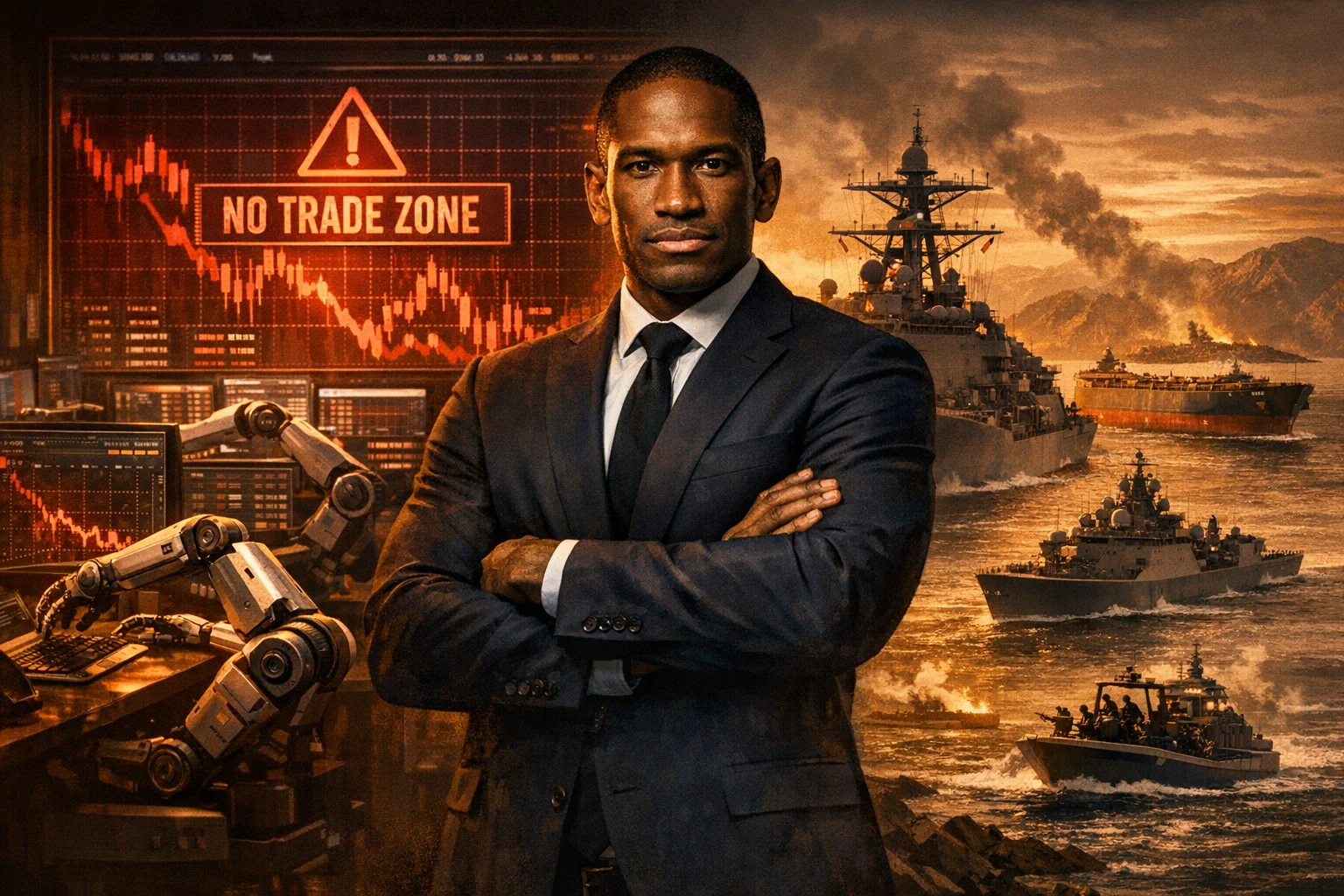
BitMEX co-founder and Maelstrom CIO Arthur Hayes said he made almost no trades in the first quarter, describing the period as a “No Trade Zone.” In his latest Substack post, he argued that two forces have pushed market visibility close to zero: the impact of AI on knowledge-worker employment and the risk that developments around the Strait of Hormuz could disrupt the global energy and financial order. Until the Federal Reserve clearly returns to money printing, he said the only crypto asset Maelstrom is still adding is Hyperliquid (HYPE).
Hayes framed the issue as one of pricing risk rather than a lack of market movement. In his view, any directional bet could be wrong while both variables remain unresolved, which is why he chose to stay largely inactive.
Hayes says AI pressure on jobs could feed a deflationary shock
Hayes linked his deflation thesis to labor displacement rather than CPI data. He cited a conversation with the founder of a crypto gaming company, who said an AI Agent team built with Anthropic’s Claude model reduced a development roadmap from six months of work to four days with a single person, then led to a decision to cut staff by 50%.
From there, Hayes argued that the risk could spread through the broader US economy. He wrote that roughly 70% of US GDP comes from consumer spending, while that spending capacity depends heavily on bank credit. If knowledge workers lose jobs on a larger scale, defaults could rise and hit the banking system, eventually forcing the Fed to respond. He also pointed to a gap between unemployment insurance and white-collar pay: median annual unemployment benefits of about $28,000 versus median knowledge-worker salaries of roughly $85,000 to $90,000, leaving a shortfall of more than $60,000.
Three Strait of Hormuz scenarios, each pointing to a different market path
Hayes treated the Strait of Hormuz as the second major source of uncertainty and laid out three scenarios. In the first, the conflict ends and shipping returns to normal. Under that outcome, he said AI deflation would still matter and Bitcoin could rebound toward $80,000 to $90,000, but he does not expect a full-scale bull move without a clear shift by the Fed toward money printing.
His second scenario is the most disruptive in the piece: Iran controls the strait and charges passing ships a 2 million yuan transit fee. Hayes argued that this would matter not only as a military development but as a financial one, because countries needing to pay could be pushed to sell US assets, buy gold, and then convert through Shanghai or Hong Kong markets into yuan for settlement. He backed the point with several data references: foreign-held securities at the Fed fell by $63 billion after the war began; non-monetary gold has been the largest US export for four to five months with annual growth of 342%; and transaction volume in China’s cross-border payment system, CIPS, has also risen.
He also inserted a “scenario 2.5” into the framework. On April 12, Trump announced that the US Navy would blockade the Strait of Hormuz. Hayes said he is watching that possibility closely because it would reshape the probability of every other scenario.
The third scenario assumes the US military destroys Iran’s interception capability and removes the threat to the strait. Even there, Hayes flagged an extreme tail risk: Iran could choose to destroy energy infrastructure across the Persian Gulf before defeat. If that happened, he wrote, global energy supply would be hit at once and central banks could be forced into synchronized monetary expansion on a scale not seen before.
Why Hayes separates Bitcoin from tech stocks
Hayes spent part of the article explaining why he sees Bitcoin as structurally different from technology equities in this setup. His core point is simple: Bitcoin has no cash flow, so traditional discounted cash flow valuation does not apply. In his framework, rising rates pressure tech stocks by reducing the present value of future earnings, while Bitcoin’s fiat price under fixed supply conditions depends more directly on the total amount of fiat money in circulation.
He wrote that central banks may eventually do two things at once: raise rates to fight inflation while also printing money to finance military spending and commodity stockpiles. That mix would hurt DCF-based assets but support fixed-supply assets such as Bitcoin and gold. The signal he is watching is the MOVE Index. If the US Treasury volatility gauge rises above 130, Hayes sees that as a sign the Fed may be forced to act.
Bitcoin at $60,000 is the trigger level, while HYPE remains the exception
For current positioning, Hayes said $60,000 is the key support level for Bitcoin. If price retests that area and holds, he would add more. Until the Fed clearly expands its balance sheet, though, he does not plan to go all in.
Gold is another asset he said he is still accumulating. Inside crypto, Hyperliquid stands out as Maelstrom’s most aggressive bet. According to the article, the fund has accumulated more than 247,344 HYPE, worth about $10.44 million at the time cited. Hayes has previously given a $150 target before August 2026. He tied that view to Hyperliquid’s annualized revenue of about $1 billion and the upcoming HIP-4 upgrade, which he expects could take prediction-market share from Polymarket and Kalshi.
Hayes wrote that trading has little meaning until the two “bombs” produce a clearer answer. For now, waiting remains the main strategy, with HYPE left as one of the few positions he has not stepped away from.