
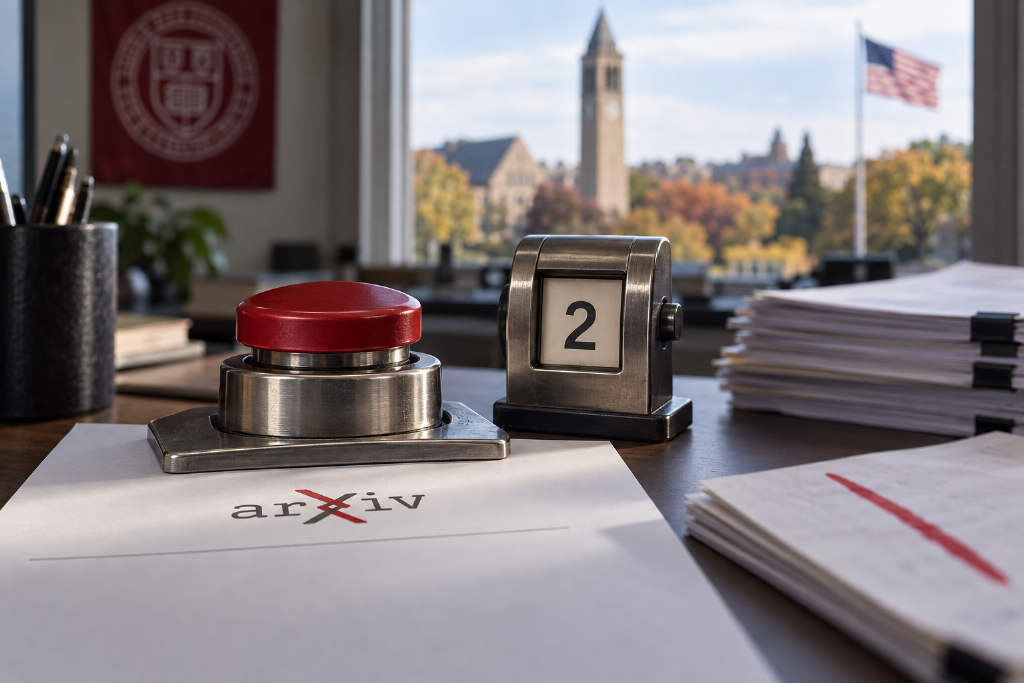
arXiv has put a new submission rate limit in place. Starting Oct. 1, each submitting account can post no more than two papers per month, and no more than three manuscripts from the same account can be under review at the same time. A submission rejected by moderators still uses up part of that monthly quota.
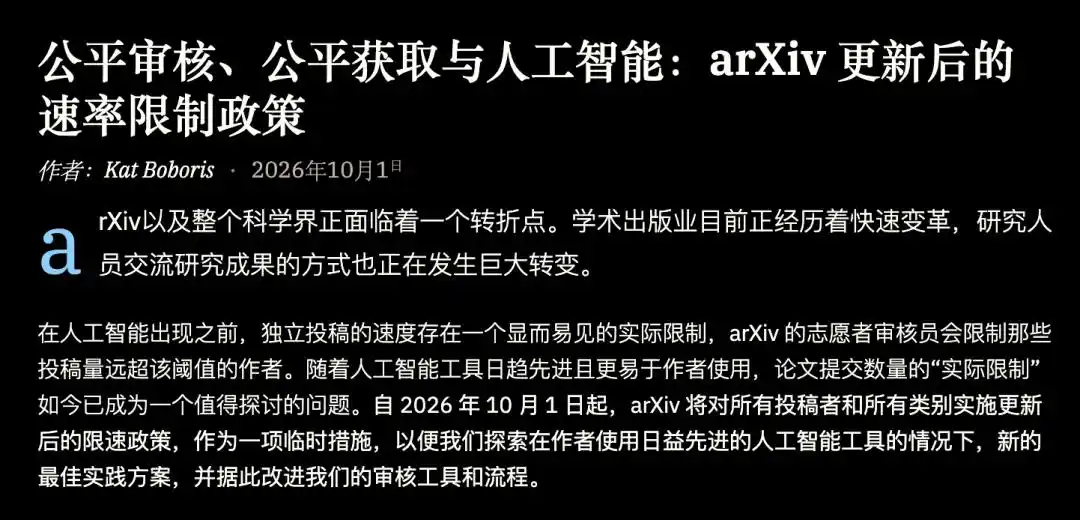
The cap applies only to the account that clicks submit. Other authors listed on the paper are not charged against the limit. arXiv described the move as a temporary measure introduced after submission volume climbed to a level that its moderation system is struggling to absorb.
Record submission volume pushed the platform to act
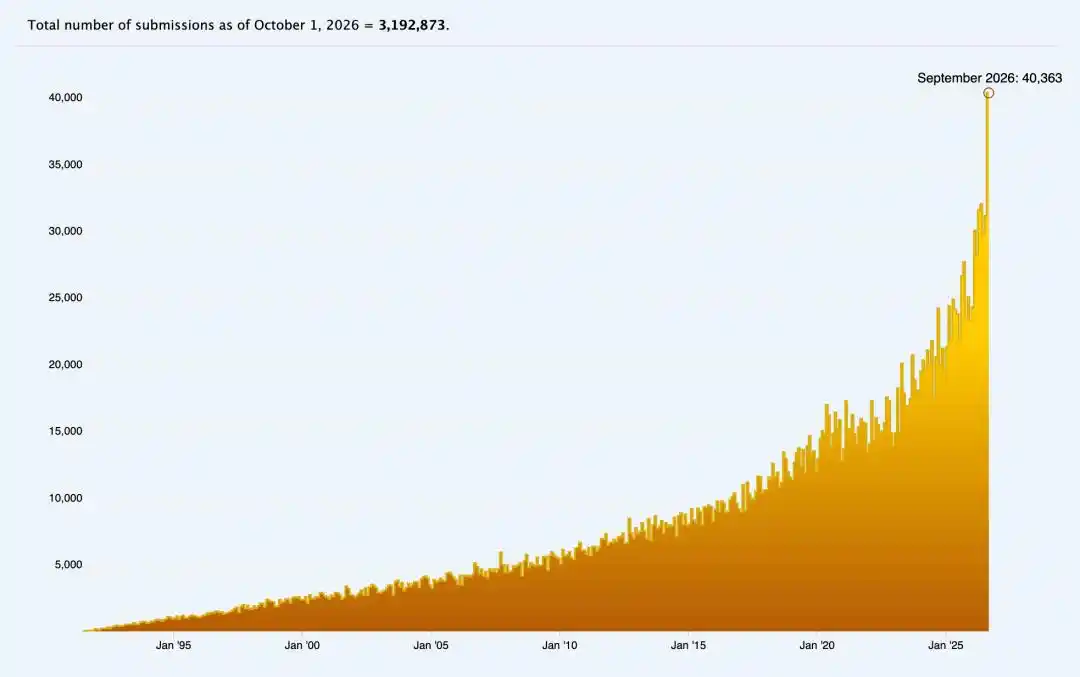
In September this year, arXiv received 40,363 submissions, the highest monthly total on record. Staff and moderators also handled nearly 9,000 support tickets during the same period.
The growth has been steep. In September 2016, monthly submissions were still below 10,000. It took eight years for arXiv to move from under 10,000 to 20,000 papers a month. The jump from 20,000 to 40,000 took only two years.
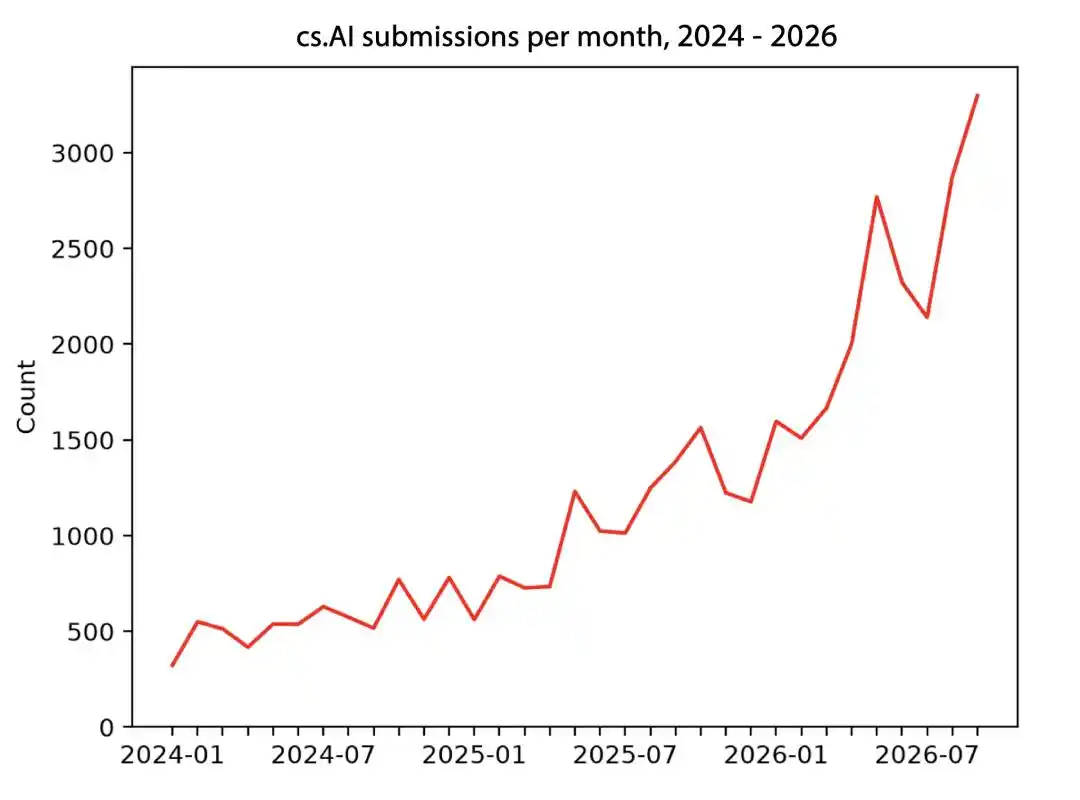
The fastest-growing category was artificial intelligence, listed as cs.AI, where volume expanded to more than six times its earlier level over two years.
In its announcement, arXiv said there used to be a rough upper bound on how quickly one person could produce a respectable paper. After AI tools became widely available, that upper bound became much harder to define. The people screening submissions, however, are still the same volunteer group.
arXiv does not conduct peer review, but every manuscript is screened before it goes live to check whether it meets academic norms and whether it has been placed in the right category. That work is handled by about 300 volunteers, all researchers in their own fields.
Moderators say a small number of authors are consuming outsized time
According to arXiv, moderators have recently seen more narrowly scoped papers, thin manuscripts, "salami-sliced" submissions that split one piece of work into several papers, and large blocks of AI-generated text.
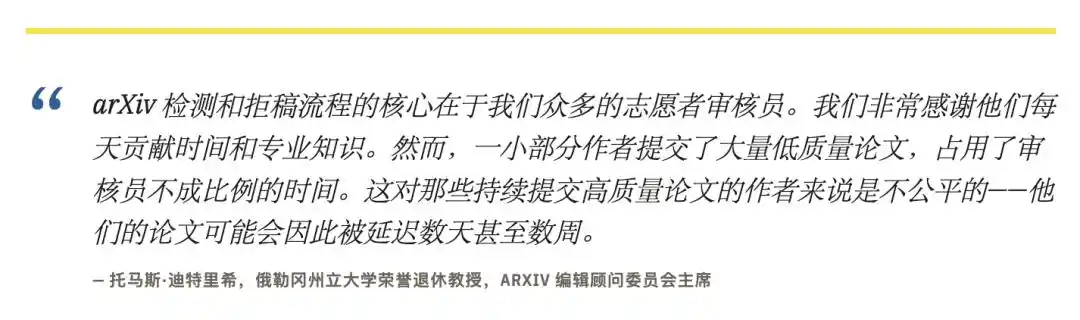
Thomas Dietterich, chair of the arXiv Scientific Advisory Board and professor emeritus at Oregon State University, said in the announcement that the main problem comes from a small number of authors who submit large volumes of low-quality papers. He said those submissions take a disproportionate amount of moderator time, leaving serious researchers waiting days or even weeks longer.
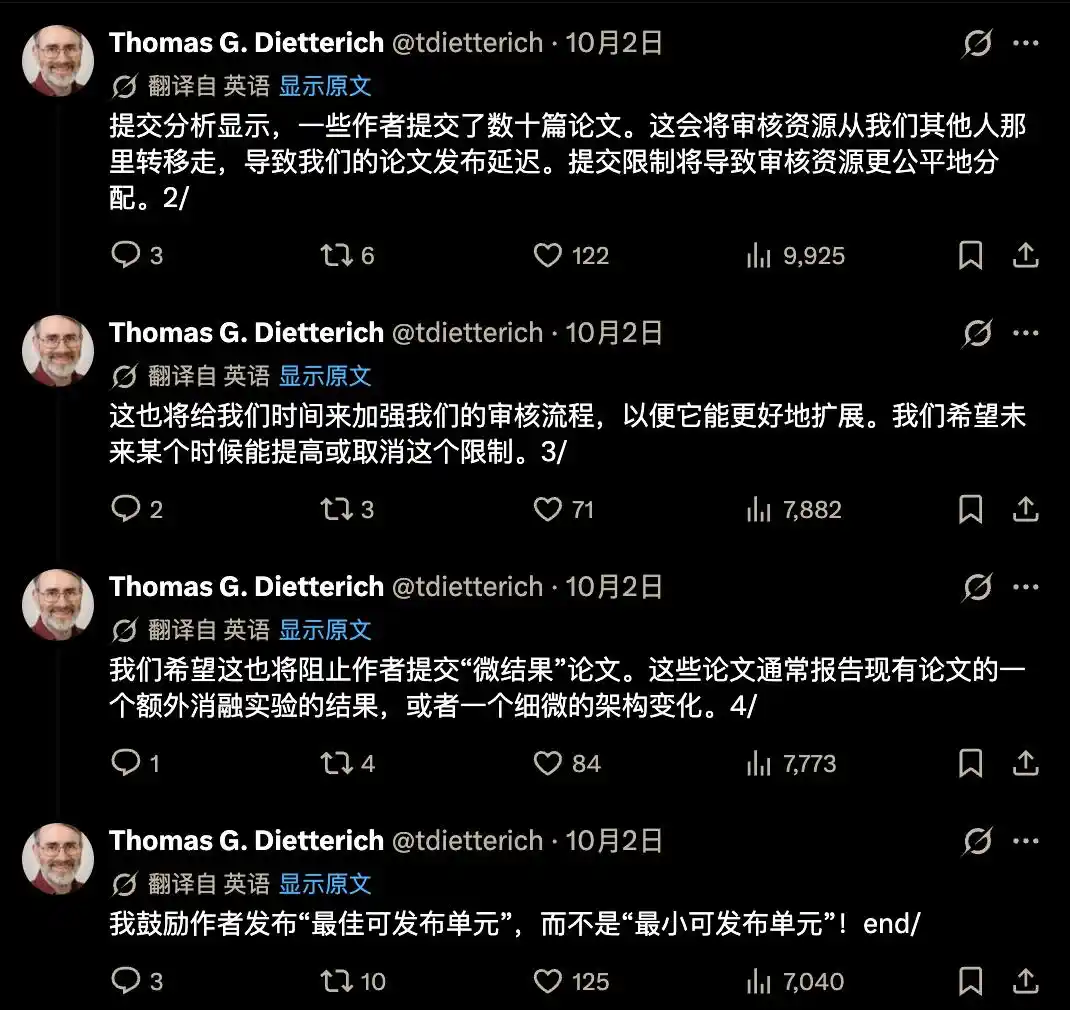
Dietterich later added on X that the data show some authors have submitted dozens of papers.
X post: https://x.com/tdietterich/status/2105751408855450078
Fresh funding did not remove the immediate bottleneck
Money is not the most immediate constraint. On Sept. 23, arXiv announced a $17.2 million donation, roughly RMB 115 million, to be delivered over three to five years. Part of that funding will go toward tools designed to manage AI-generated content.
But those systems will take time to build and deploy, and the number of volunteer moderators will not automatically rise with the new funding. Dietterich said he hopes the restriction can eventually be loosened or removed.
This is also not the first tightening step arXiv has taken over the past year. It had already required review and position papers in computer science to pass peer review before upload, raised the bar for new authors seeking endorsement, and imposed one-year bans on authors whose papers contained AI hallucination content.
Why the quota is tied to the submitter, not every author
The submitter-only rule reflects a technical limitation in arXiv's workflow.
Author lists on arXiv are entered manually at submission. Co-authors are linked to a paper only after they receive the paper password and later claim the manuscript. At the moment of submission, the platform can reliably verify only the identity of the submitter.
Conference systems work differently. ICLR 2027, for example, says each author can appear on no more than 20 submissions. If none of the authors on a paper is qualified to review, each such author can submit no more than one paper. Conferences can count by individual author because each author is tied to an OpenReview account in the submission system.
The weakness in arXiv's approach is easy to see. A user identified as Pitt wrote in replies to Dietterich's post that co-authors could simply take turns uploading papers and bypass the cap.
Under that logic, the people hit hardest may be legitimate researchers who happen to finish several papers at once. At the same time, one person could still submit 24 single-author low-quality papers in a year, and three people rotating submissions could raise that number to 72.
Still, counting only the submitter avoids an older problem seen in author-based conference limits. If a supervisor exceeds the quota in a conference system, a student's paper may be rejected along with the supervisor's other submissions. On arXiv, a paper submitted by the student is not affected by the supervisor's quota.
arXiv also left room for case-by-case intervention, saying it may require certain authors to reduce their submission frequency even further when necessary.
Research groups may need to change how they handle uploads
For most researchers, two papers a month is more than enough. The bigger impact falls on labs that are used to having one person upload everything.
The article gives one example: a group has six ICLR 2027 submissions that have not yet been posted to arXiv and wants to make them public soon after decisions are released on Dec. 16. Under the old routine, a supervisor or senior student could upload them over a few days. Under the new rule, one account can submit only two papers in a month, and no more than three can be pending review before the first batch is posted.
To get all six papers online in December, at least three people would need to submit them separately. The most practical option is to have each paper's first author submit it, assuming those students are eligible to do so.
Since January this year, a new user seeking automatic endorsement in a field must bind an institutional email address to the account and already have a paper indexed in that field under the account. Some students have been listed as authors on papers that were always submitted by someone else and never claimed by them, which means they may not actually be eligible to submit when needed.
The article's advice is to have group members bind school email addresses and claim their authored papers now, and to arrange endorsements in advance for those who do not qualify.
Independent researchers face a harder cap, and rejection becomes more costly
Independent researchers have less room to adjust. The article says it is no longer unusual for one person, with help from large models, to produce several results in a short period. Without co-authors to share the submission burden, though, two papers a month becomes a hard ceiling.
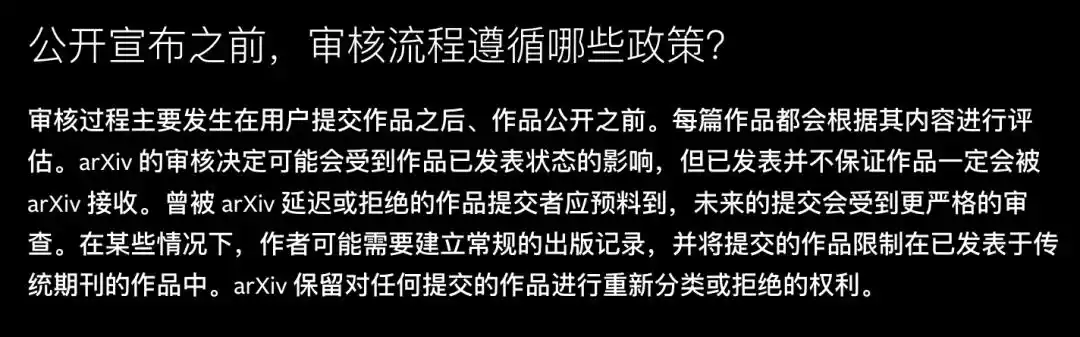
Rejected papers now carry a higher cost as well. A rejected submission still counts toward the monthly quota, and arXiv's moderation policy says submitters whose papers were rejected or delayed before may face stricter scrutiny on later submissions, making those papers easier to hold back.
Moderation policy: https://info.arxiv.org/help/moderation/index.html
A held submission continues to occupy one of the pending-review slots, sometimes for days and sometimes for weeks. The article therefore suggests checking likely trouble spots before submission: whether the primary category is correct, whether computer science review and position papers have already passed peer review, whether a complete English version is attached, whether AI use has been disclosed as required, and whether references have been checked line by line.
In May this year, arXiv publicly described its one-strike ban approach to AI hallucinations. If a paper contains fabricated citations or leftover model prompts, the author can be banned for one year. After the ban is lifted, that author may be limited to submitting papers that have already passed peer review.

Related report: https://cerncourier.com/arxivs-one-strike-rule-on-ai/
arXiv usually holds all listed authors jointly responsible, so changing who presses the submit button does not remove that risk.
Timing, replacement versions, and unanswered questions
If a problem is found after submission, the paper can be withdrawn before it is made public. In that case, it does not count toward the monthly quota and does not occupy a pending-review slot.
Timing matters too. arXiv does not release new papers on Friday and Saturday evenings in U.S. Eastern Time, and U.S. holidays can push publication back as well. A submission made close to a weekend or holiday may sit for several extra days.
For papers already posted on arXiv, the accepted final version should be uploaded as a replacement version rather than as a new submission.
Not every paper needs to appear on arXiv immediately. ICLR submissions are already public on OpenReview, and all authors are disclosed after review, so priority can still be established. When quota is tight, the article says researchers may want to reserve slots for papers that need rapid public release, such as those intended for Hugging Face Daily Papers.
Daily Papers is based on arXiv and accepts only papers that have appeared on arXiv within the previous 14 days. The article says some authors have already missed that window because moderation took too long.
Several points remain unclear. arXiv has not said whether replacement versions count toward the quota, how proxy submission accounts for conference proceedings or centralized accounts for large collaborations will be treated, or which time zone defines a "calendar month."
There is also a wording mismatch. The help page says "each author" may submit no more than two papers per month, while the FAQ in the announcement says only the submitter is counted. Until arXiv gives a clear answer, the article says the safer approach is to plan around the strictest reading and not rely entirely on rotating submitters.
arXiv has not provided a timetable for how long the temporary measure will remain in place.
Reference
arXiv announcement: https://blog.arxiv.org/2026/10/01/updated-rate-limit-policy/
The original Chinese article cited in the source says it came from the WeChat account "新智元" (ID: AI_era), edited by Ma Ke.