
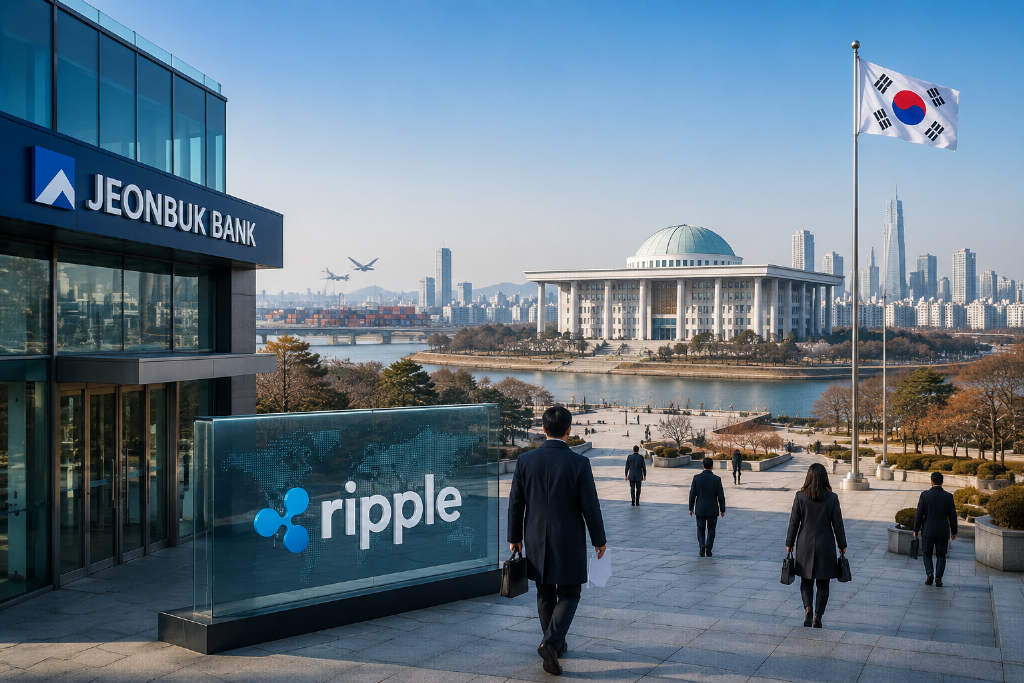
South Korea’s Jeonbuk Bank has partnered with blockchain payments firm Ripple to deploy a cross-border payment system for business customers, in one of the week’s more notable banking developments in Asia’s crypto sector.

The service is aimed at businesses such as import-export companies, technology startups and online content creators. Ripple said the system would give the bank faster and cheaper remittance capabilities than conventional transfers routed through intermediary banks on the SWIFT messaging network, which can take several days.
South Korea pushes on payments, enforcement and market structure
South Korea also saw a wave of policy and market updates beyond the Jeonbuk Bank announcement.
A group of lawmakers introduced a bill to amend an existing financial law and widen the authority of the Financial Intelligence Unit, or FIU, to investigate unregistered crypto businesses. The bill was filed on Thursday by People Power Party lawmaker Eom Tae-young and nine other lawmakers, and would add a new provision to the Act on Reporting and Using Specified Financial Transaction Information.
Under the proposal, anyone would be able to report suspected violations to the FIU. The agency would be able to investigate and analyze alleged violations, file complaints with relevant authorities, request criminal investigations, or provide information to investigators.
The Korea Media and Communications Commission also said Polymarket’s structure and operations amount to illegal gambling, despite its noncustodial design and use of smart contracts.
Separately, regulators reportedly accepted BitGo Korea’s VASP registration on Tuesday, two days before stricter VASP entry requirements took effect.
South Korea is also setting up a Joint Virtual Asset Crime Investigation Unit. The Serious Crimes Investigation Agency is due to be formally established in October and will include 2567 investigators looking into seven categories, with a dedicated unit focused on phishing and virtual asset crimes.
The Korea Exchange is due to open a new fractional investment market called Novel Securities Market in November. It will handle fractional investments and non-traditional securities including artworks, real estate and music copyright.
Japan records licensing, fundraising and tokenization milestones
In Japan, SBI Group led a $68 million Series C round for stablecoin neobanking platform Fasset at a $1 billion valuation.
According to SBI, the companies also plan to jointly operate a digital bank in Malaysia and distribute Fasset-issued tokens.
Nomura Group’s digital asset subsidiary, Laser Digital, received authorization to operate as a crypto asset exchange service provider under Japan’s Payment Services Act.
A list released by the Financial Services Agency on Friday showed Laser Digital received Japan’s first crypto exchange license in four years. The last platform to gain FSA authorization was Binance Japan in October 2022.
Tokyo-based Metaplanet is also expanding its Bitcoin treasury strategy to the United States. Its proposed deal with Nasdaq-listed Super League Enterprise would give it a foothold in US capital markets while relying on existing Bitcoin rather than additional purchases.
Toyota Finance, meanwhile, opened tokenized bond access to retail investors through a mobile payment app. Investors can apply to buy the 1 billion yen bond without a securities account and receive perks through Toyota’s payment app.

Malaysia, Singapore and Pakistan add to the regional shift
Bitdeer’s AI division, Bitdeer AI, signed a five-year customer agreement covering about 50% of the capacity of its A102 Malaysia facility.
Bitdeer said the deal was signed with an undisclosed AI customer of “high credit quality” and is expected to generate about $400 million in total revenue. The company is targeting 350 megawatts of AI cloud data center capacity by the first quarter of 2028.
In Singapore, the Monetary Authority of Singapore unveiled tax exemptions for fund managers and family offices. It will also expand a scheme designed to attract investment professionals into the city-state and launch a co-investment scheme for funds that base operations in Singapore.
Those moves came after Hong Kong cut its own taxes for fund managers, with the two hubs competing for business.
Pakistan’s Virtual Assets Regulatory Authority, or PVARA, has opened its licensing portal for crypto exchanges and other virtual asset service providers operating in the country.
According to the PVARA licensing website, companies providing virtual asset services on or before March 5 must apply for a no-objection certificate by Sept. 5 or cease operations.
PVARA said on LinkedIn: “The licensing window is officially open, creating a clear pathway for businesses to enter Pakistan’s regulated virtual asset market, with defined standards for consumer protection, governance, compliance and market integrity.”
UAE, Hong Kong and corporate updates across the region
Capital.com plans to offer spot crypto services in the United Arab Emirates after its affiliate, Capital Vault, secured a virtual-asset license from the country’s Capital Market Authority.
Once the service goes live, UAE clients will be able to buy and hold actual crypto through the Capital.com app, with Capital Vault handling execution, custody and settlement.
Bitcoin.com has also integrated USDU into its self-custodial wallet. USDU is described as the UAE’s first central bank-registered US dollar stablecoin, and the integration broadens access beyond institutional distribution channels.
Standard Chartered is reportedly set to distribute HKDAP, in what is said to be the first bank distribution of Hong Kong’s new regulated stablecoin. HKDAP is backed by Anchorpoint Digital.
OKX, meanwhile, had to restrict access to Anthropic’s Claude artificial-intelligence model for employees in Hong Kong and for staff traveling through China after its corporate account was temporarily suspended for failing to comply with geographic restrictions. The company reportedly spends up to $8 million a month on tokens across various large language models.
Alibaba raised $10.2 billion by selling shares at an 8.7% discount to fund its AI ambitions. Its shares fell after the sale. The proceeds will go toward chips, AI infrastructure and models.
In Taiwan, authorities reportedly dismantled a money laundering network that had been purchasing USDT through Hong Kong exchanges.