
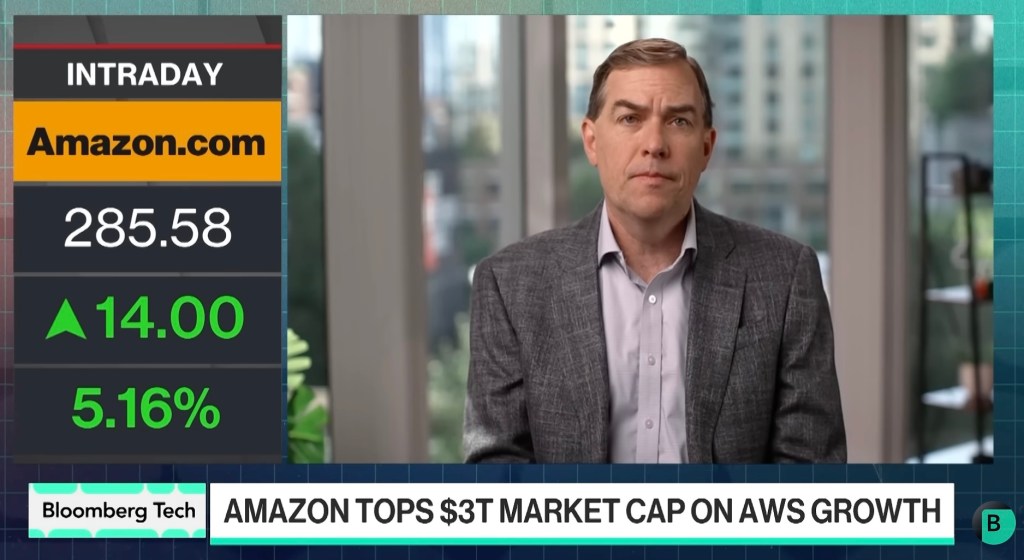
Amazon Web Services is using a mixed AI infrastructure strategy built around Nvidia GPUs, its in-house Trainium ASICs, and Graviton CPUs, AWS CEO Matt Garman said in a recent interview with Bloomberg.
Garman said the setup lets enterprise customers match computing power more precisely to their needs while lowering operating costs. He linked that balance of performance and cost efficiency to AWS’s cloud momentum and to Amazon’s sales performance. Amazon trades on Nasdaq under the ticker AMZN.
AWS says annualized AI revenue has reached $25 billion
According to Garman, AWS has now reached $25 billion in annualized AI revenue. Demand is coming from sectors such as finance, healthcare, and media, and the business covers model training, inference, and agent workloads.
With demand still strong, AWS is preparing to keep spending on cloud infrastructure expansion and to sign long-term agreements with customers.
Trainium is designed to work alongside Graviton and Nvidia GPUs
The report said Trainium was developed by Annapurna Labs, an AWS subsidiary, as an ASIC built for AWS cloud workloads. Its main role is handling intensive AI inference tasks, while also covering training for new models and inference in production.
Garman said AWS controls the full technology stack, from chips and data centers to software. That gives the company room to optimize performance for specific needs. For customers running inference workloads, he said the infrastructure can reduce costs by about 20% to 30%.
Trainium can run alongside Graviton processors and Nvidia GPUs. Graviton is Amazon’s in-house general-purpose CPU based on the Arm architecture, and the report compared it with Nvidia’s Vera Rubin CPU.
AWS is not planning external chip sales for now
The market has also been watching whether AWS might eventually sell its custom chips to other companies, a move that could put it in more direct competition with partner Nvidia.
Garman said AWS has evaluated that possibility, but the company’s current job is to deploy Trainium and the Graviton compute chips inside AWS’s own cloud infrastructure and meet internal demand first. For now, he said, AWS does not plan to sell Trainium or Graviton as products.
Custom silicon is becoming a shared direction for cloud providers
The report said custom chip development has become a common trend among major cloud service providers. Alongside AWS and Trainium, Google Cloud has introduced Tensor Processing Units, or TPUs, to accelerate machine learning. Microsoft Azure has launched the Maia AI accelerator and the Cobalt CPU, while Meta is developing the MTIA processor for its internal AI needs.
AWS’s current position leaves its in-house chips as part of its cloud infrastructure offering rather than standalone products for sale.