

Axis Robotics announced a $12 million seed round on July 27, led by Hack VC with participation from Nomad Capital, Pi Network Ventures and 10K Ventures. PitchBook data cited in the report shows the team has about 11 people and is already generating revenue. The company describes itself as a data infrastructure layer for physical AI, not a builder of foundation models or robotics hardware.

The problem it is trying to solve is very different from the one large language models faced. LLMs could train on massive amounts of text already available on the internet. Robotics does not have an equivalent, ready-made database of physical interaction data. Lab collection is expensive, slow and often narrow in scope, such as the same robotic arm repeating the same grasp under fixed lighting. Data gathered that way does not easily generalize to new environments. Axis is built around a different question: whether high-quality robot interaction trajectories can be produced continuously at low cost, across more diverse settings, and with contributions from a much larger user base.
Browser access is the entry point
Founder Chris has framed the gap in straightforward terms: the industry lacks an efficient and scalable hybrid data production system. Axis presents its product as a composite data engine. Browser-based teleoperation lowers the barrier to participation, while Web3 tooling is used to handle incentives and ownership records.
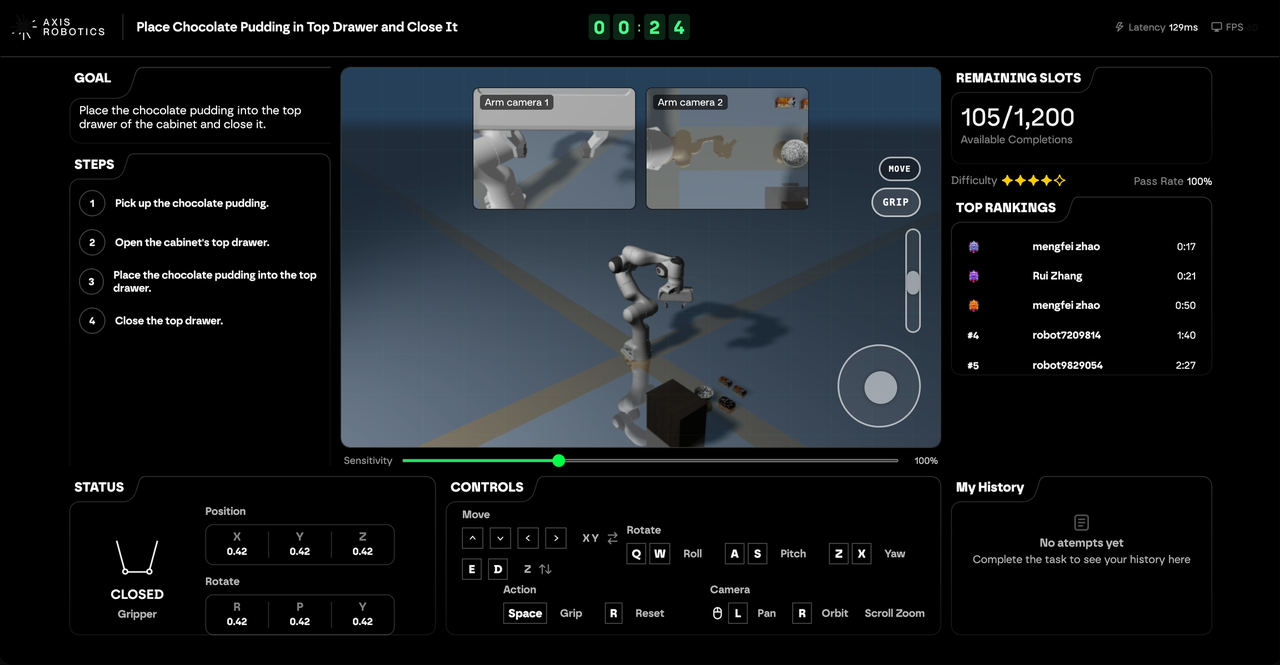
Users do not need robot hardware. Through a web page, they can remotely control a simulated robotic arm to complete tasks such as grasping, sorting and opening drawers. Each session produces a full trajectory containing joint states, object poses, control actions and task metadata.
After collection, trajectories are cleaned and smoothed, then imported into Isaac Sim for domain randomization. Lighting, texture and physics parameters are systematically changed, allowing one trajectory to expand into a larger pool of training samples for VLA models or imitation learning policies.
Axis says it has more than 100,000 active contributors globally, with monthly output of more than 1,200 hours of simulated data and more than 20,000 hours of real first-person data. The report also notes a discrepancy. In early July, the Hub dashboard showed roughly 65,000 registered users and around 1.8 million total trajectories. The different figures may reflect different measurement standards. What matters more over time is whether activity decay, repeat participation and data-quality distribution hold up.
Why Web3 is part of the system
Axis does not frame Web3 simply as a token story. It uses it as a tool for attribution and distribution. A centralized platform could also hire data workers, but it would struggle to give each contributor a verifiable and traceable proof of rights. In that setup, the relationship usually ends as a one-time buyout.
Axis assigns a unique Data ID on Base to each trajectory that passes evaluation. The on-chain record includes the contributor wallet address, submission time, quality score and task metadata. The full trajectory is stored off-chain because of size constraints, while the on-chain entry acts as an anchor. Any future revenue split, licensing arrangement or governance weight could, in principle, trace back to that anchor. In the company’s design, contribution becomes an auditable on-chain fact rather than a vague operating metric.
The evaluation stack has several layers: format completeness checks, rule-based success judgments, visual-language-model review of behavioral plausibility, and peer review for some trajectories. A composite quality score directly affects reward weight. Harder or curated tasks carry higher base rewards, and the final incentive is calculated by applying a quality multiplier rather than paying contributors solely by task count. Failed attempts are not uploaded and are not penalized. Low-quality or near-duplicate trajectories are filtered out. The goal is to reduce the return from volume farming.
POINTS now, token later
The current reward model combines POINTS, possible fiat revenue sharing from enterprise-purchased custom task packages, and future token rewards allocated by quality and difficulty. POINTS is live. The token has not been issued, and the company says tokenomics are still under development.
Axis also operates a dedicated subnet on the BitRobot network, allowing contributors to receive incentives from both sides.
Community tests and academic benchmarks
The company has disclosed several community experiments. In January 2026, Axis launched a task called “The Little Prince’s Rose,” where users remotely controlled robotic arms to water plants. It collected more than 10,000 valid trajectories in five days. A policy trained on that data was then deployed to a real Franka robotic arm, which carried out autonomous watering.
In February, the project scaled the effort to 27 tasks. About 18,000 people took part, contributing nearly 100,000 valid trajectories in five days. According to the report, those experiments suggest browser-level community data can close the loop into physical execution, while quality scores and on-chain records make user actions traceable.
On the academic side, an arXiv paper provides the benchmark most often cited for the project. The AXIS dataset includes 207 tasks and about 50,100 trajectories. After continual pretraining on the π0.5 model, overall success rate on LIBERO-Plus improved by 5.8 percentage points. On RoboCasa365, matched by scale, the gain over baseline was 37.3%. The paper says diversity helped across dimensions such as layout, sensor noise and camera perturbation. The article’s assessment is restrained: the dataset is not exceptional yet, but the direction looks sound for an early-stage effort.
Enterprise demand is the unresolved business test
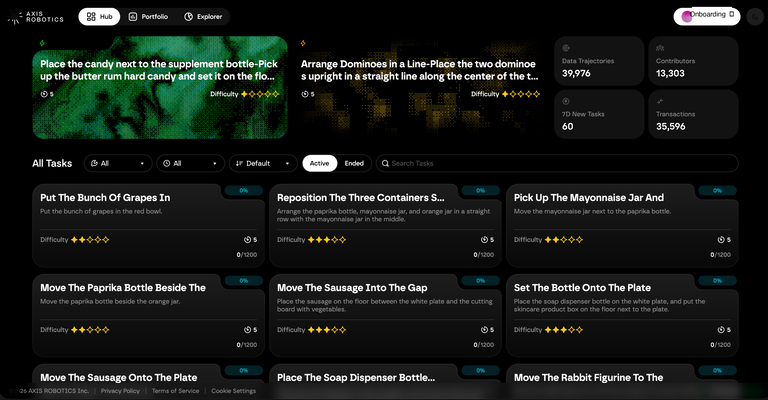
Commercially, Axis packages its offering around task bundles, sold by scene type, atomic skill, in-task randomization level and total trajectory volume. Disclosed partners include Booster Robotics, Manycore Tech, Dexmal, Lotus and Geely Auto.
The company says enterprise purchasing revenue will flow back to contributors, creating a closed loop in which real demand supports POINTS and future token allocation. But the report makes clear that revenue-sharing ratios, contract values and actual payment data have not been disclosed. That part remains at the promise stage and needs to be tracked over time.

In that sense, Axis looks more like a distributed infrastructure layer than a conventional robotics startup. It uses community scale to gain diversity and cost flexibility, keeps humans in the loop for quality judgment, and relies on on-chain records for attribution transparency. The core business question is whether task packages can turn into stable recurring revenue. Without sustained enterprise purchasing, the entire incentive structure would face pressure.
Team background and public-facing roles
CEO Chris Feng previously served as COO of Chainbase and has a background in consulting and venture capital. Core team members come from institutions including Berkeley, CMU, Georgia Tech, Nanyang Technological University and Shanghai Jiao Tong University. The team also includes people with experience in scaling large consumer products. The combination of on-chain coordination and robotics data work is part of what makes the project notable, though public information is still limited.
The report also adds that one of the project’s core figures, Christine, known online as @0xsexybanana and referred to in the article as 郡主 Christine, is deeply involved in Axis Robotics as a contributor. She has also appeared as CMO in official Spaces and other settings, handling community growth and external communications. Ecosystem participants including Base APAC have at times referred to her as a co-founder.
Token timing and recent activity
As of publication, Axis has not launched a native token. Total supply, allocation ratios and unlock schedules have not been disclosed. Official documentation says tokenomics are still being developed and that the team wants to validate the product and revenue model first, with the token positioned as a later amplifier.
The on-chain Data ID framework is already in place. A recent POINTS snapshot required contributors to sign trajectories before a specified deadline, which the report interprets as a way to establish traceable credentials for future token distribution.

Possible token functions discussed in the article include serving as a quality-weighted reward unit, a medium for ecosystem services such as custom task access, data pipelines and advanced augmentation, a staking-based path to higher tiers and priority tasks, and a source of governance weight. TGE is scheduled for the “Beyond 2026” phase. The timetable is described as relatively conservative, easing short-term speculative pressure while leaving contributor expectations closely tied to the pace of commercial execution.
Axis Robotics also launched a Content Creator Program through KaitoAI Studio in May 2026, inviting creators to produce Physical AI content in exchange for rewards. After the seed round and Kaito’s restored data agreement with X, some in the community expect the two sides could work together again on a creator campaign, possibly involving mindshare and token incentives. No official details have been confirmed.
What to watch next
POINTS and the quality-weighted reward structure are already active, but if fiat revenue does not return fast enough relative to contributor growth, the perceived value of POINTS could fluctuate and stronger participants may drop off. On-chain records improve attribution transparency, yet the platform still controls scoring standards and the rules for sharing data-related revenue. The article identifies that as a common centralized point in many Web3 data protocols.
At this stage, Axis stands out less for a token launch than for using Web3 in a narrow, operational way around rights confirmation and distribution. Whether the data infrastructure layer can build lasting value will depend on proof of real business demand. The report points to three main areas to follow: actual enterprise contract signing and repayment progress, the transition from POINTS to a token model, and whether quality-weighted data keeps improving downstream model performance.